
When browsing through pressure measurement products you will notice that some of the products are called pressure transducers and others are called pressure transmitters.
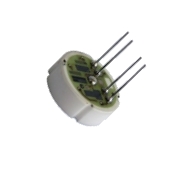 A pressure transducer is any device that fundamentally converts an applied pressure into an electrical signal. There have been many different types of pressure transducer developed over the years such as bonded foil, thick film, thin film, variable capacitance, LVDT & semiconductor strain gauge to name just a few. All of these sensing technologies are used to convert a pressure into a measurable electrical signal.
Since the transducer core signal varies significantly from one device to another it is often necessary to add some electronic compensation to trim the zero & span offsets and reduce thermal sensitivity over the operating temperature range.
Featured millivolt output pressure transducer products
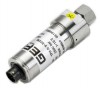 TPH Strain Gauge Ultra High Pressure Sensor - Very high range pressure sensor with a millivolt output signal for pressure ranges from 1000 up to 5000 bar gauge.
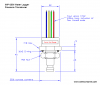 Low voltage 20 bar range OEM water logger pressure transducer - The stripped down OEM version of the IMP transducer is specifically designed for use inside freshwater pressure loggers
Some pressure transducers are manufactured without any compensation circuitry which are called pressure transducer capsules, modules or headers. These pressure transducer elements and then integrated with electronics by instrument manufacturers to compensate the pressure transducer, and bring the output signal within the design parameters required by the instrumentation specification.
Due to the weak signal generated by the pressure transducer, it is only used over relatively short distances, such as inside a test laboratory or inside some instrumentation. When you want to run the electrical output signal over greater distances, some additional electronics is required to boost the signal. This is when it is necessary to add an amplifier to a pressure transducer to transmit the signal. A pressure transducer which has been combined with an output signal amplifier is typically called a pressure transmitter.
Featured amplified voltage signal pressure transducer products
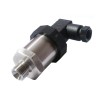 IMPLR Low Range All Stainless Steel OEM Pressure Sensor - Low cost sensor for measuring small pressure ranges from 0-50 mbar (10 inH2O) to 0-1000 mbar (15 psi) of liquids or gases.
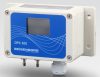 DPS300 User Switchable Pressure Range, Volts or Current Output Low DP Sensor - The DPS 300 is a low range HVAC differential pressure sensor. The lowest possible pressure range is 0...100 pascals. 2 or 3 switchable pressure ranges, plus volts or current output are included with most standard configurations.
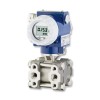 Many types of amplified signals have been developed over the years as electronics have advanced and power considerations have changed, the most common type are 4-20mA current loop pressure transmitters and amplified voltage output pressure transducers.
Despite the distinguishing technical differences between a pressure transducer and a pressure transmitter, both have become synonymous with describing any type of pressure sensor, and are often interchanged by different manufacturers. So from a marketing and product naming point of view there is no common distinction between the two types of pressure sensor.
Featured amplified current signal pressure transducer products
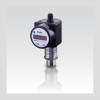 Pressure Indicator Transmitters - Pressure indicator transmitters have a digital indicator for providing a local pressure reading, and a 4-20mA pressure transmitter.
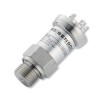 SIL 2 Approved Safety Rated Pressure Transmitters - SIL2 approved safety rated pressure transmitters which have the option for SIL 2 (Safety Integrity Level) certified electronics.
Related Help Guides
- Determining the hydrostatic pressure range for a tank level sensor
- How to get a 10 volt signal from a 4-20mA output pressure sensor
- How to Connect a 4-20mA Current Loop Pressure Transmitter
- Symptons and Causes of Damage to Pressure Transducer Diaphragms
- Pressure Sensor Accuracy Specifications
- What is difference between working, burst and over pressure
- Measuring vacuum as a negative gauge pressure using a dp sensor
- Measuring liquid level in a tank using a dp sensor
- Measuring density of a liquid using a dp sensor
- Pressure Sensor Technology Comparative Guide
Related Technical Terms
- Ceramic Pressure Sensors
- Digital Compensation
- Dry Cell
- Dry/Dry
- HART®
- Isolation Diaphragm
- LVDT – Linear Variable Differential Transformer
- Pressure Sensors
- SOI – Silicon on Insulator
- Stainless Steel Pressure Sensors
- Static Line Pressure
- Wet/Dry
- Wet/Wet
Related Online Tools
- Pressure Transmitter 4-20mA Current Output Calculator
- Pressure Sensor Calculator
- DP Flow Transmitter Output Calculator
- Pressure Transducer Millivolt (mV) Output Calculator
- Pressure Transducer 0-10V Voltage Output Calculator
- Pressure Transducer 0-5V Voltage Output Calculator
- Pressure Transducer 1-5V Voltage Output Calculator
- Pressure Transducer 0.5-4.5V Voltage Output Calculator
- Pressure Sensing Errors Calculator
- Pressure Transmitter 0-20mA Current Output Calculator
Related Product and Application Guides
Related Application Questions and Answers
- 16 bar, 200°C steam pressure transmitter and gauge
- Pass/Fail timed 500 kPa pressure leak test software and sensor
- Air Replacement Plant (ARP) 100 mm H2O differential pressure transmitter
- Ex rated ambient pressure sensor with 800-1100 mbar range
- 20 bar absolute steam pressure transducer
- 5 bar water irrigation pressure transducer with 0 to 5 volt output
- 180 degC pressure sensor for saturated steam up to 10 bar
- 300 foot sea depth waterproof pressure sensor with 0-5V signal
- Mechanical press 1000 bar pressure sensor and panel indicator
- Argon gas compatible pressure sensor for measuring up to 100 mbar
- High reading rate for measuring dynamic pressures to -200psf
- 1013 to 1400 mbar barometric pressure transmitter & readout
Contact us about this What is the difference between a pressure transducer and a transmitter page to request more information, or to discuss your application requirements.