
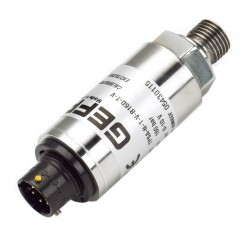
The TPSA series is a precision high-pressure transmitter engineered for demanding hydraulic testing applications where high accuracy and long-term reliability are paramount.
Available in measurement ranges from 0…4 bar (60 psi) up to 0…1000 bar (15,000 psi), the series offers a measurement accuracy of 0.1% FS typical for ranges above 100 bar. This transmitter utilizes a robust fluid-free sensing element machined from a single piece of 17-4 PH stainless steel, incorporating bonded foil strain gauges in a Wheatstone bridge arrangement. An innovative mechanical design ensures the sensing element is isolated from external stresses, making the unit completely insensitive to tightening during installation.
Product Parameters
- Pressure Ranges: from 0…4 bar up to 0…1000 bar gauge (0…60 to 0…15,000 psi)
- Accuracy: ± 0.1% FS typical for ranges ≥ 100 bar and ± 0.15% FS typical for ranges < 100 bar
- Output Signal: 4-20mA current loop or multiple amplified voltage options including 0-10V and 0.1-10.1V
- Response Time: Fast dynamic response with a 10…90% FS time of less than 1 millisecond.
- Temperature Range: Operates in process temperatures from -40 to +105°C with a compensated range of -10 to +85°C.
- Electrical Connections: EN 175301-803 Type A/C plugs, M12x1 connectors, 6-pole bayonet, and integral shielded cables
- Protection Rating: Ingress protection levels available up to IP67 depending on the electrical connection.
- Pressure Connections: BSP, NPT, UNF and metric threads, male or female
Product Description
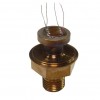
The TPSA series precision pressure transmitter is designed for high-performance measurement in industrial and research environments. Its primary design philosophy focuses on mechanical integrity and signal stability. By machining the sensing element from a solid piece of 17-4 PH stainless steel, the transmitter eliminates the need for composite welds in the primary sensing structure, resulting in a uniform structural lattice with superior mechanical integrity. The sensing diaphragm, typically 0.8 mm to 1.0 mm thick, is exceptionally durable and capable of withstanding the punishing pressure changes found in high-pressure test stands.
Performance is further enhanced by the use of an analogue amplifier, which provides infinite resolution and avoids the quantization limits often associated with digital sensing electronics. The signal conditioning PCB rationalizes the Wheatstone bridge output to provide a high-level voltage or current signal with minimal noise (typically around 5mV pk-pk for voltage versions). To ensure reliability in volatile environments, the series includes short-circuit and reverse polarity protection.
Versatility in installation is provided through a wide array of process fittings and electrical connectors. The internal construction TIG welds the sensing element to a specially designed pressure connector, which serves to isolate the measurement bridge from the mechanical stresses induced during installation torque. This makes the TPSA highly repeatable even when installed by different technicians or under varying tightening conditions.
Product Features
Fluid-Free Sensing
The TPSA utilizes a dry, stainless steel sensing diaphragm, avoiding the need for internal fill fluids such as silicone oil. This design eliminates risks associated with fluid leakage or contamination, particularly important in high-purity systems. Furthermore, the absence of internal liquids ensures the sensor is not subject to errors caused by thermal expansion, providing consistent zero-point stability across the entire temperature range.
Tightening Insensitivity
To address common calibration shifts during installation, the TPSA employs a mechanical design that isolates the sensing diaphragm from the pressure connector. This decoupling prevents the transfer of torque stresses—often encountered when tightening the sensor into a process port—to the sensing bridge. This ensures that the transmitter maintains its factory-calibrated accuracy regardless of installation conditions, simplifying setup for technicians.
High Overpressure Ratings
Engineered for industrial resilience, the TPSA is built with a sensing element machined from 17-4 PH stainless steel, providing high mechanical strength. The series is rated to withstand overpressure up to 3 times the nominal range (for units up to 500 bar), offering a significant safety margin against pressure spikes or “water hammer” effects. This robust physical construction helps prevent mechanical deformation, extending the service life of the unit in volatile hydraulic circuits.
High-Speed Dynamics
The TPSA is equipped with high-frequency analog electronics, enabling a response time of less than 1 millisecond. By bypassing the processing delays found in some digital-compensated sensors, this analog signal path allows for accurate capture of rapid pressure transients. This capability is well-suited for monitoring fast-changing events in hydraulic actuators, high-frequency valve switching, or cyclic injection molding processes.
Product Applications
The TPSA series is engineered to support a diverse range of high-pressure environments, where accuracy and long-term durability are critical. Its mechanical robustness and rapid response time make it suitable for both continuous industrial monitoring and precise, high-frequency test applications.
Hydraulic Test Benches
The TPSA series is frequently utilized in hydraulic test benches, where it provides high-frequency pressure monitoring for components such as actuators, pumps, and valves. Because of its fast, sub-millisecond response time, the sensor can capture rapid pressure transients often missed by standard transmitters, allowing engineers to validate component performance and fatigue life with high data fidelity.
Hydraulic System Monitoring
In heavy industrial machinery, such as hydraulic presses and power units, the TPSA series offers reliable real-time feedback for control loops. Its resistance to mechanical stress during installation and its stable output signal ensure that control systems receive consistent, accurate pressure data, reducing the likelihood of process deviations and preventing system failure.
Injection Molding
The injection molding process involves rapid, cyclical high-pressure fluid changes that place significant mechanical demand on sensing equipment. The TPSA series’ monolithic stainless steel construction and ability to withstand high-pressure spikes make it an ideal choice for monitoring cycle pressures. Its durability ensures long-term operational consistency, minimizing the need for frequent maintenance in high-throughput manufacturing environments.
Research and Development
Laboratory settings often require the high accuracy (0.1% FS) and reliability provided by the TPSA series. Whether characterizing new materials, testing hydraulic circuits, or validating experimental hardware, the transmitter offers a level of precision that provides researchers with confidence in their measurements. Its stable long-term drift characteristics make it a dependable tool for experiments spanning extended periods.
Aerospace Testing
Aerospace applications demand precise validation of hydraulic component performance under extreme environmental stress, including high pressures and temperature variations. The TPSA series is built to maintain structural integrity and signal accuracy in these demanding conditions, ensuring that critical data is captured during safety-critical testing protocols for flight-control actuators and landing gear systems.
Product Specifying Guide
Select measurement range and units
Identify the maximum operational pressure required for your application. Standard ranges are available from 4 bar up to 1000 bar (or 60 psi to 15,000 psi). Ensure the range selected provides an adequate safety margin for temporary overpressure events, noting that a 400 bar unit can withstand up to 1,200 bar temporarily.
Choose output signal
Select the signal type compatible with your controller or data acquisition system. Options include standard 4-20mA current loop (Code E) or various amplified voltage signals such as 0-10Vdc (Code N) and 0.1-10.1Vdc (Code C).
Select process connection
Standard threads include G 1/4 male (DIN 3852-A). On-request options include 7/16-20 UNF-2A (SAE 4), G 1/2A, and various NPT or metric sizes. For specialized high-pressure needs, 1/2-14 NPT male (Code J) is also available.
Determine electrical connection and protection
Select the connector based on the required Ingress Protection (IP) rating and cabling preference. Choices range from EN 175301-803 plugs (IP65) to M12x1 or bayonet connectors (IP67), or integral shielded cables for direct wiring.
Specify accuracy and response time
Confirm the required accuracy class; the standard offering is ± 0.1% FS typical (Code T). The “Fast” response time option (Code V) ensures dynamics of less than 1 ms for transient pressure monitoring.
Part Number Builder
Generate or decode TPSA ordering code
Installation & Operation Guide
Mechanical installation
Install the transmitter using the hex nut (Ch 22) located on the body. Because the series is designed to be insensitive to tightening, the primary concern is ensuring a leak-free seal. For G 1/4 male fittings, a bonded (dowty) seal made of Nitrile, EPDM, or Viton should be used between the transmitter and the process port.
Grounding and shielding
To ensure immunity from electromagnetic interference, the transducer must be grounded, typically through the machine body or the equipment it is installed on. Always use shielded cables for signal transmission. The braiding must be connected to the connector case and left floating on the PLC/instrument side to prevent ground loops.
Electrical wiring for current output
For 4-20mA configurations, the device is typically a 2-wire system. Connect the positive power supply to the designated pin (e.g., Pin 1 on EN 175301-803 or Pin 3 on M16 connectors) and the signal output to the corresponding return pin. Ensure the combination of load resistance and power supply voltage falls within the safe operating area of the load diagram.
Electrical wiring for voltage output
Voltage versions utilize a 3-wire or 4-wire system depending on the model. Connect the power supply (+) and common (-) pins, then wire the output signal (+) to the controller input. Use the specific wiring tables provided in the technical data sheet to match the connector code (V, P, F, E/M, or Z) to the correct wire colors or pin numbers.
Product Help
1/4″ SAE female connector port
Is it possible for TPSA to have a 1/4″ SAE female connection?
Yes, the 7/16-20 UNF-2A female (SAE 4) process connection option is the same as a 1/4″ SAE female.
50 bar range overpressure
I have a question about this sensors’ overpressure limit. Does this indicate the pressure at which the sensor’s accuracy will be influenced? For instance, the 0 to 50 bar measurement range has an overpressure of 150 bar. Does this mean that I can fit it within a system which could potentially go up to 150 bar, but only trust the readings up to 50 bar?
Yes that is correct, you will only be able to trust the accuracy of the reading up to 50 bar, but there maybe some over-range measurement output since the signal is not capped at exactly 100% of range, but this is not checked or calibrated.
An over-pressure can be applied up to the max rating without the sensor accuracy being affected beyond specification limits. There maybe be some zero offset which can be easily corrected by the user, and the span shift will not exceed the stated accuracy specification on the data sheet.
If the over-pressure is exceeded, this may cause a zero or span shift beyond specification limits or even cause permanent damage to the sensing performance, however the mechanical integrity should not be compromised unless the pressure exceeds the burst pressure.
Over-pressure limits are intended to be for temporary unexpected events such as a system failure condition, and not a frequent or cyclic operational pressure limit.
Safety factor over-pressure
Looking to measure pressure in a hydraulic system, the operating range is up to 400 bar, but I would like some safety factor on over pressure.
A 400 bar range TPSA has an over-pressure rating of 1,200 bar, and a burst pressure rating of 2,000 bar.
1/2 NPT male special option
We need a 1000 bar pressure transmitter for high pressure application, with a cable electrical connection, and also a 1/2NPT male pressure connection, is it possible to provide the TPSA with a 1/2 NPT male connection, since I do not see that option on the data sheet?
Yes it is possible to supply the TPSA with a 1/2 NPT male, which is a special option not mentioned on the standard data sheet. The optional part code for 1/2-14 NPT male is “J”.
- SKU ID: s1-tpsa-96-28134
- Part No: TPSA-E-J-F-B01M-T-V 2130X000X00
- Pressure Range: 0 to 1000
- Units: bar
- Range Type: Positive Gauge (atm to +P)
- Output Signal: 4-20mA
- Electrical Connection: Integral shielded cable (2 metre long)
- Process Connection: 1/2-14 NPT male
Steel only exposed to process fluid
The TPSA description mentions that the sensor diaphragm is milled from a single piece of Stainless. Can you confirm that this means that the only material in contact with process fluid would be steel, or is there anything else, such as seals that would also be exposed?
The wetted parts are all welded INOX 17-4PH Stainless Steel. If using the G1/4 male fitting you will need to use a dowty (bonded) seal which has an incorporated elastomer seal made from Nitrile, EPDM or Viton, but these can easily be replaced if they deteriorate over time.
500 bar with 3 times overpressure
I am searching for an industrial pressure transmitter which is going to be used in hydraulic systems, and my requirements include an output signal of 4 – 20mA, accuracy of ±0.35% FSO, with non linearity & hysteresis less than 0.25% FSO, and a response time of better than 5 msec.
The TPSA with a 500 bar range has a 3x overpressure rating and a response time which is less than 1 msec.
- SKU ID: s1-tpsa-0001
- Part No: TPSA-E-1-E-B05C-T-V-2130-X-000-A-0-0
- Pressure Range: 500
- Overpressure Rating: 1500
- Units: bar
- Range Type: Positive Gauge (atm to +P)
- Output Signal: 4-20mA
- Response Time (10…90% FSO): < 1 msec
- Accuracy: < 0.1% FSO typical
- Electrical Connection: DIN43650A standard plug IP65
- Optional Mating Connectors: DIN43650A standard IP65
- Process Connection: G1/4 male (DIN3852-A)
0-10Vdc output resolution & noise level
What is the output resolution including noise levels for the TPSA with 0-10Vdc output?
The TPSA has an analogue amplifier so there is no limit on resolution that you would normally see using a sensor with a digital amplifier. The noise level is around 5mV pk-pk.
Positioning sensitivity
What is the position effect that I have noticed is specified on some data sheets such as the one for the TPSA?
Most pressure sensors rely on the movement of a diaphragm to convert a change in pressure into an electrical signal. The size and mass of a pressure diaphragm will vary depending on the pressure range and technology utilised. Since the diaphragm is typically flat and thin, it will flex or sag under its own weight in certain orientations. The lower the pressure range the more sensitive the sensor will be to changes in orientation.
In some types of pressure sensors there is also a sealed oil filled void behind an isolation diaphragm which protects the sensing diaphragm from exposure to corrosive media. An oil filled device will suffer from an additional position effect caused by the hydrostatic pressure of the volume of oil acting on the sensing diaphragm.
Since the TPSA is a sensor for high range pressures with a relative thick stainless steel diaphragm and no oil-fill, there will be negligible affect on performance when changing it’s mounting position as stated in the specification data sheet.
Calibration temperature
At what temperature is the TPSA pressure transducer calibrated?
It is calibrated at 23 degC (room temperature) and the readings at zero and full scale are included on the production calibration report that accompanies the transducer.
The temperature errors are also checked over the compensated temperature range of -10 to +85 degC to verify each transducer is inside the specification limits.
Total accuracy
What is the overall accuracy for the TPSA pressure transducer within the specified operating temperatures, is the total %FSO a summation of the accuracy and temperature effects, as well as long term stability?
There are many parameters that can affect accuracy, but using the combination of errors which are on the TPSA data sheet the total uncertainty would be as follows:
Non-Linearity, Hysteresis and Repeatability at room temperature = 0.15% FS BSL (~0.3% TSL) max.
Temperature Effects for zero and span = 2 x 0.008%/degC x 95degC = 1.52% FS max.
Total error over -10 to +85 DegC ~ +/- 1.82% FS max.
If you null the zero and span offsets during installation this would be the total error.
Also another error to consider is the long term stability of 0.1% FS/year, so after a period of 1 year the total uncertainty would be more like +/- 1.92% FS.
Related Documents
Specification data sheet
Request Product Price
Please select the options you require for the TPSA Precision High Pressure Transducer in your application and request a quote.