
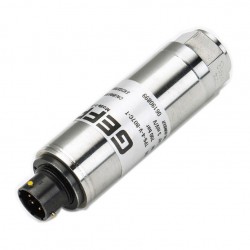
Strain gauge pressure sensor with a millivolt output direct from a four arm wheatstone bridge strain gauge circuit in pressure ranges from 10 up to 1000 bar gauge.
The TPS strain gauge pressure sensor utilises a robust stainless steel 17-4PH diaphragm with bonded foil strain gauges, and incorporates an innovative mechanical design which makes the sensor insensitive to tightening during installation.
The TPS strain gauge pressure sensor is ideally suited for applications that require high accuracy in dynamic pneumatic or hydraulic control & test systems, like material testing machines.
Product Parameters
- Pressure Ranges: from 10 up to 1000 bar (150 up to 15000 psi) gauge
- Accuracy: ±0.15% FSO typical for ranges above 200 bar, and ±0.25% FSO typical for ranges up to 200 bar
- Output Signal: 1.5 to 3 mV/V output sensitivity depending on range
- Process Temperature Range: -40…+120°C (-40…+248°F)
- Electrical Connections: Plug and cable options with IP65 to 67 protection rating
- Pressure Connections: BSP, NPT, UNF and metric threads, male or female
- Media Compatibility: Process fluids or gases must be compatible with INOX 17-4PH stainless steel.
Product Description
The TPS series pressure transducer incorporates strain gauge technology bonded directly onto a robust metal diaphragm structure to convert fluid force into precise millivolt electrical signals. By isolating the internal sensing core within an engineered mechanical body, the transducer completely eliminates measurement drift or calibration shifts caused by mounting torque during installation. This structural stability ensures exceptional repeatability and long-term signal stability of less than 0.1% FS per year under severe continuous operating condition demands.
Electrical signal excitation requires a regulated 10 Vdc/ac supply voltage, producing an unamplified bridge output with a nominal impedance of 350 Ω. Depending on the configured pressure range, full-scale sensitivity ranges from 1.5 mV/V for lower pressure spans (10…40 bar) up to 3 mV/V for high-pressure configurations (100…1000 bar). Internal thermal compensation circuitry ensures stable signal response across ambient variations from -20…+85°C, keeping thermal drift within ±0.01% FS/°C typical.
The modular construction provides broad flexibility for integration into complex fluid power and process networks. Electrical connectivity options include M12x1 4-pole connectors, DIN 43650 solenoid plugs, 6-pole bayonet connectors, 7-pole threaded industrial sockets, or directly integrated shielded cable assemblies. Mechanical process ports encompass standard parallel threads, tapered NPT options, and SAE hydraulic fittings, enabling seamless mechanical matching without custom adapter blocks.
Product Features
The TPS pressure transducer is engineered for ultimate reliability, high-precision accuracy, and multi-faceted versatility within the most demanding industrial sectors. By combining advanced strain gauge technology with rugged structural materials, it provides a stable and dependable measurement solution for complex hydraulic and pneumatic systems operating under harsh conditions.
Torque-Insensitive Design
The unit features an innovative mechanical architecture and a robust metal housing that effectively insulates the internal sensing core from external installation stresses. This specialized design prevents zero offset shifts and calibration errors during mounting, allowing for a recommended tightening torque of 30 Nm (up to a maximum of 40 Nm) using a 22 mm wrench without compromising signal integrity.
Robust Fluid-Wetted Construction
Constructed to maintain mechanical and chemical integrity, the transducer utilizes 17-4PH stainless steel for all fluid-wetted parts. This material choice, paired with an AISI 304 stainless steel external housing, ensures broad compatibility with a wide variety of industrial fluids and ensures the device remains resilient in corrosive or high-pressure environments.
Shunt Calibration Capability
For advanced system verification without the need for applied fluid pressure, selectable versions of the TPS support R-Cal shunt calibration. By bridging dedicated pins on supported connectors (such as the 6-pole or 7-pole variants), users can simulate a predictable electrical load shift to verify instrument scaling and signal path integrity remotely.
Applications
The TPS series transducers are engineered for demanding environments that require raw, unamplified signal fidelity. By providing a highly responsive, high-resolution millivolt strain gauge output directly from the sensing bridge, these devices offer the pristine signal precision essential for advanced control systems where external or remote signal conditioning is preferred to maintain maximum data integrity.
Industrial Hydraulic Power Units
In industrial hydraulic power systems, the TPS transducer’s non-amplified millivolt output allows for direct integration with local high-precision data acquisition hardware. This configuration bypasses internal electronic filtering, providing engineers with a raw, high-resolution stream of pressure data. This is critical for monitoring the rapid pressure fluctuations and hydraulic shock waves inherent in heavy-duty presses, ensuring that control systems can react instantaneously to stabilize system performance.
Injection Molding Machinery
For precision injection molding, the TPS utilizes its high-resolution millivolt bridge output to capture transient pressure spikes with exceptional speed. The lack of internal amplification stages ensures minimal signal latency, allowing the system to monitor the exact timing of plastic injection and clamping pressure cycles. This granular level of detail is vital for maintaining part consistency and identifying minute variations during high-speed production cycles.
Test Benches and Calibration Stands
In research and development settings, the TPS serves as a primary reference standard by delivering a pure, unconditioned millivolt signal. Because the output is not processed by internal circuitry, there is no risk of electronic noise injection or signal degradation. This makes the transducer ideal for calibration stands where capturing the most accurate, unfiltered data is necessary for validating the performance of other sensors or developing new fluid control protocols.
High-Pressure Fluid Containment
Monitoring pressurization cycles up to 1000 bar requires a sensor that can maintain high-resolution output under extreme physical load. The TPS’s robust strain gauge architecture ensures that its raw millivolt output remains stable and highly linear even under severe pressure. This allows operators to detect subtle changes in system pressure that may indicate micro-leaks, structural fatigue, or containment instability in critical high-pressure gas or liquid systems.
Heavy Mobile Equipment
In construction and agricultural machinery, the TPS’s unamplified millivolt interface provides a reliable data pathway that is highly resistant to the intense electromagnetic interference (EMI) typical of heavy-duty mobile environments. By delivering a raw signal directly to the vehicle’s central control unit, the transducer ensures high-resolution pressure verification in steering and lifting circuits, maintaining signal integrity even across long, complex cabling runs where amplified signals might otherwise suffer from noise.
Pneumatic Automation Systems
For factory-scale pneumatic automation, the TPS transducer is used to monitor supply line stability with exceptional precision. The direct, unamplified millivolt output allows for seamless integration into high-density industrial logic controllers that require raw, unconditioned analog feedback. This ensures that even the smallest deviations in supply pressure are captured with high resolution, allowing automated systems to adjust airflow dynamically for optimized process efficiency.
High-Pressure Material Testing
When performing destructive material testing on samples such as concrete or soil, hydraulic methods generate significant force and weight loading. As samples weaken, high-level pressure spikes are generated, requiring a sensor that can handle these rapid transitions. The TPS precision pressure sensor, with its durable mechanical design and raw millivolt output, captures these sudden changes in pressure over thousands of cycles without performance degradation, providing the high-resolution, responsive data necessary to accurately track stress and material failure.
Product Specifying Guide
Selecting the pressure range
Determine the maximum working pressure of the system and select a standard full-scale range from 0…10 bar to 0…1000 bar (0…150 psi to 0…15000 psi). Ensure that peak dynamic pressure spikes do not exceed the specified overpressure limits, which range from 2x full scale for lower pressure spans up to 2000 bar for high-pressure variants.
Choosing the mechanical process connection
Identify the fluid port configuration required by the piping system. Standard male options include G 1/4 (DIN 3852-A or DIN 3852-E), G 1/2A (DIN 16288), 7/16-20 UNF SAE 4, NPT, or metric threads, while female ports such as G 1/4, 1/8-27 NPT, 1/4-18 NPT, and 7/16-20 UNF are available for custom plumbing interfaces.
Selecting the electrical interface and IP rating
Select an electrical connection compatible with the wiring infrastructure and target environment. Options range from 4-pole M12x1 connectors (IP67) and 6-pole VPT connectors (IP66) to DIN 43650 solenoid or microsolenoid plugs (IP65) and 6-core integral shielded cables (IP67).
Specifying required accuracy and calibration features
Choose the standard performance tier delivering ±0.15% FS typical accuracy for ranges above 200 bar or ±0.25% FS typical for lower ranges. If remote zero/span calibration testing is required, select connector configurations (such as the 6-pole or 7-pole connectors) that support the R-Cal shunt calibration pin connections.
Part Number Builder
Generate or decode TPS ordering code & request quote
Installation & Operation Guide
Mechanical mounting and torque application
Screw the transducer into the mating process port using the appropriate sealing washer or O-ring (such as RON 300 for standard parallel threads). Tighten the unit using a 22 mm wrench on the integrated Ch 22 hex flat to the recommended torque of 30 Nm, ensuring not to exceed the maximum allowable torque of 40 Nm. The internal mechanical isolation prevents mounting stress from distorting the zero signal.
Electrical wiring and pin configuration
Connect the transducer to a regulated 10 Vdc/ac RMS power supply across the designated excitation pins according to the specific connector wiring diagram. Ensure signal output leads are wired into a high-impedance display or control circuit (>1000 kΩ) to maintain measurement accuracy. Connect the cable shield directly to the body ground or system ground as specified by local noise mitigation guidelines.
System zero verification and calibration
Apply power to the unit and allow thermal equilibrium to establish within the -20…+85°C compensated temperature window. Under zero pressure conditions, verify that the baseline millivolt output matches the factory zero spec (within ±0.5% FS). If using models equipped with R-Cal shunt calibration pins, activate the shunt circuit to simulate an output signal shift for instrument verification.
Product Help
Tightening torque effects on transducer output
Does mounting torque affect the baseline zero setting or measurement accuracy of the transducer?
No, the TPS transducer is designed with an innovative mechanical housing structure that insulates the internal strain gauge core from external stresses. Tightening the unit into its process port up to the recommended torque of 30 Nm (or max 40 Nm) will not introduce zero offsets or degrade output accuracy.
Power supply requirements for millivolt output
What power supply voltage is required to power the TPS strain gauge transducer?
The unit requires a nominal regulated power supply of 10 Vdc/ac RMS, with an absolute maximum limit of 15 Vdc/ac RMS. Because the output sensitivity (e.g., 1.5 mV/V, 2 mV/V, or 3 mV/V) is ratiometric to the excitation voltage, maintaining a stable supply voltage is critical for high-accuracy readings.
Output sensitivity variation across pressure ranges
Why does the millivolt output sensitivity vary depending on the selected pressure range?
Full-scale output sensitivity is optimized for diaphragm mechanical deflection across different pressure classes. Pressure ranges from 10…40 bar yield a 1.5 mV/V sensitivity, ranges from 50…60 bar yield 2 mV/V, and higher pressure ranges from 100…1000 bar produce a 3 mV/V sensitivity.
Operating transducer outside compensated temperature range
What occurs if the transducer process fluid temperature exceeds the compensated range?
The transducer supports process media temperatures from -40…+120°C, but active thermal compensation operates within -20…+85°C. Operating the fluid or ambient environment outside the -20…+85°C range may introduce additional zero-span signal temperature drift beyond the standard ±0.01% FS/°C specification.
Connecting remote shunt calibration circuit
How is the shunt calibration feature wired on supported electrical connectors?
On models equipped with 6-pole (V) or 7-pole (P) connectors, specific pins are dedicated to the R-Cal shunt calibration circuit (e.g., pins E and F on the V connector). Bridging these pins simulates an electrical load across the strain gauge bridge, generating a predictable output shift to verify instrument channel scaling without applying fluid pressure.
Operating temperature limits
What is the operating temperature range for the transducer?
The transducer supports a process operating temperature range from -40 to +120 degrees Celsius, while the ambient temperature for the electronics part must not exceed 105 degrees Celsius.
Installation tightening torque sensitivity
Will over-tightening the sensor during installation impact its accuracy?
No, the transducer features an innovative mechanical structure that makes it completely insensitive to tightening during installation.
Transducer output signal type
What type of electrical output does this sensor transmit to a controller?
The transducer provides a non-amplified analog mV/V output signal.
Process fluid wetted materials
Which materials make up the wetted parts of the sensor?
The wetted parts of the transducer are constructed from INOX 17-4PH stainless steel, so the process fluid must be compatible with this specific material.
Cable shielding termination
What is the proper way to terminate the shielded cable during installation?
You must use a shielded cable where the braiding on the connector side is left floating, and the braiding on the PLC or instrument side is properly connected to the power supply ground.
R-Cal figure on calibration report
Why does the calibration report show that the sensors achieved 3mV/V output at 4,000 psi when they were rated for 5,000 psi at 3mV/V?
The calibration report lists a value of ~4000 psi, corresponding to ~80% of the sensor’s range. This indicates that instead of applying actual pressure for calibration, a resistor is added internally to the strain gauge bridge of the TPS pressure sensor. This resistor unbalances the bridge, simulating a specific output corresponding to ~80% of the full-scale range. This method of resistor-generated sensor calibration is called an R-Cal function. Therefore, the output sensitivity of ~3mV/V relates to the full-scale value of 5000 psi, while the value of ~4000 psi represents the simulated pressure generated by the R-Cal function.
Obsolete TFN replacement
We are looking for a replacement pressure transducer for our concrete cube compression strength test machine which measure a maximum force of 2000 kN. The old pressure sensor is marked TFN-V-7C, 700 bar, 3.0 mV/V.
The TFN is no longer manufactured, and we would suggest the TPS with the specification below as an alternative:
- SKU ID: s1-tps-96-28073
- Pressure Range: 0 to 700
- Units: bar
- Range Type: Positive Gauge (atm to +P)
- Output Signal: 3 mV/V
- Electrical Connection: 6 pin military style connector IP66
- Optional Mating Connector: 6 pin military style IP66 plus 2 metres of cable (C02W)
- Process Connection: G1/4 female
Hydraulic oil up to 700 bar
I need a hydraulic transducer for use on oil up to 700 bar with a 4 wire configuration which will operate from exciting 5V to 10V dc and output in mV.
The TPS is compatible with hydraulic oil and will work with any voltage between 5-10Vdc supply because it has a ratiometric input/output circuit, but bear in mind that the supply voltage will need to be stable to preduce a stable output.
- SKU ID: s1-tps-0001
- Part No: TPS-1-F-B07C-T 2130X000X00
- Pressure Range: 700
- Units: bar
- Range Type: Positive Gauge (atm to +P)
- Output Signal: 3 mV/V
- Electrical Connection: Integral shielded cable (1 metre long)
- Optional Mating Connectors: Not required
- Process Connection: G1/4 male (DIN3852-A)
Related Documents
Specification data sheet
Request Product Price
Please select the options you require for the TPS Strain Gauge Pressure Sensor in your application and request a quote.