
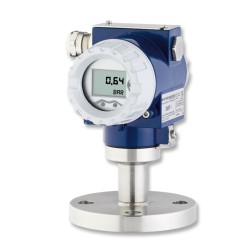
 All devices connected to make up a 4 to 20 milliamp current loop are connected in series.
The devices that are typically connected together include:
- Pressure Transmitter
- Input Device to accept the signal from the Pressure Transmitter such as a Programmable Logic Controller (PLC), Controller, Panel Meter, Analog to Digital Converter (ADC) or Signal Conditioning Unit (SCU)
- Sensor Power Supply to power the Pressure Transmitter such as a Programmable Power Supply unit, DC Power Supply Unit (PSU), AC/DC Voltage Regulated Transformer or a DC Battery
Featured related products
 Pressure Indicator Transmitters - Pressure indicator transmitters have a digital indicator for providing a local pressure reading, and a 4-20mA pressure transmitter.
 Low operating temperature plus/minus 1 psi pressure transmitter - Reliable pressure measurements down to -40°C. Ideal for low range applications with a -1 to +1 psi gauge range.
A) If the 4-20mA Input Device includes an Internal Sensor Power Supply and has 2 input connections:
- Connect Positive (+) Input connection to Positive (+) Pressure Transmitter connection
- Connect Negative (-) Input connection to Negative (-) Pressure Transmitter connection
B) If the 4-20mA Input Device requires an External Sensor Power Supply and has 2 input connections:
- Connect Positive (+) External Sensor Power Supply connection to Positive (+) Pressure Transmitter connection
- Connect Negative (-) Pressure Transmitter connection to Positive (+) Input connection
- Connect Negative (-) Input connection to Negative (-) External Sensor Power Supply connection
C) If the 4-20mA Input Device includes an Internal Sensor Power Supply and has 2 input connections plus 2 supply connections:
- Connect Positive (+) Internal Sensor Power Supply connection to Positive (+) Pressure Transmitter connection
- Connect Negative (-) Pressure Transmitter connection to Positive (+) Input connection
- Connect Negative (-) Input connection to Negative (-) Internal Sensor Power Supply connection
Some Input Devices bridge the Negative (-) Input connection to the Negative (-) Internal Sensor Power Supply via an internal / external jumper or link.
If the input device only includes a Voltage input, it can be easily adapted to measure a 4-20mA signal by adding a 250 Ohm load resistor across the Positive (+) and Negative (-) Input connections. This will generate a voltage drop of between 1 and 5 Volts which is directly proportional to the 4-20mA signal.
Featured related products
 DMP331 Precision Pressure Transmitter - Stainless steel pressure transmitter with ranges from 100mbar up to 40 bar gauge or absolute. Special options for ATEX , SIL2 and compound ranges.
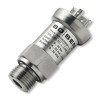 SIL2 approved 10 bar pressure transducer with 4 to 20 mA output - Pressure transducer with SIL 2 approved electronics that provide a 4-20mA output over a 0-10bar working range.
Related Help Guides
- How do you measure flow rate with a dp cell
- How to get a 10 volt signal from a 4-20mA output pressure sensor
- Advantages and Disadvantages of using a 4 to 20 mA Signal
- What is difference between working, burst and over pressure
- Why use 4-20mA and 3-15 psi rather than 0-20mA & 0-15psi
- Supply voltage and load resistance considerations for pressure transmitters
- Choosing calibrator for pressure transmitters
- What can cause random variation in pressure transducer output
- How to create a list of specification parameters for a pressure sensor
- Transforming a 2 wire Current Loop into a Voltage Output Signal
- What is the difference between a pressure transducer and a transmitter
- Does the type of Engineering Units matter for Pressure Transmitters
Related Technical Terms
- 2 Wire
- 4 to 20 mA Current Loop Output Signal
- HART®
- Isolation Diaphragm
- Square Root Extraction
- Stainless Steel Pressure Sensors
- Transmitter
- Turndown Ratio
Related Online Tools
- Pressure Transmitter 4-20mA Current Output Calculator
- Flow Transmitter 4-20mA Current Output Calculator
- DP Flow Transmitter Output Calculator
- 4-20mA Signal to Measurement Reading Converter
- SqRt Extraction 4-20mA Signal to Measurement Reading Converter
- Temperature Transmitter 4-20mA Current Output Calculator
- Liquid Level Transmitter 4-20mA Current Output Calculator
- 4 to 20 mA Supply, Load, Shunt and Signal Calculator
- Pressure Transmitter 0-20mA Current Output Calculator
Related Product and Application Guides
Related Application Questions and Answers
- 16 bar, 200°C steam pressure transmitter and gauge
- Submersible rainwater tank level sensor for measuring 3.5m depth
- Air Replacement Plant (ARP) 100 mm H2O differential pressure transmitter
- Ex rated ambient pressure sensor with 800-1100 mbar range
- HART flameproof (Ex d) re-scalable level transmitter for hydrostatic head up to 2 metres
- Dockside sea water tide level transmitter up to 6 metres depth
- Mechanical press 1000 bar pressure sensor and panel indicator
- Argon gas compatible pressure sensor for measuring up to 100 mbar
- Sulfuric acid 12-15% conc. drop-in level probe for 10m high tank
- High reading rate for measuring dynamic pressures to -200psf
- 1013 to 1400 mbar barometric pressure transmitter & readout
- 180°C UHT milk compatible pressure transmitter
Contact us about this How to Connect a 4-20mA Current Loop Pressure Transmitter page to request more information, or to discuss your application requirements.