
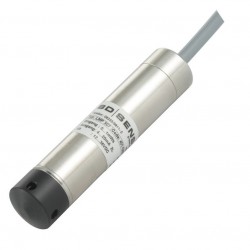
 I‘m having a problem zeroing a submersible pressure sensor. Before placing it in the water, the zero offset is trimmed on the indicator, and then it is submerged to full range depth of 10 metres. During the first few minutes we notice that the full scale reading drifts by about 10mm in the negative direction and then stabilizes after a few minutes. We then pull the sensor up to the surface and it reads about -8mm. Do you know what might be causing the zero to drift?
It is most likely due to the difference between air and water temperature. Before placing the sensor in the water it will be at ambient air temperature. Once submerged the temperature of the sensor will change until it reaches equilibrium with the surrounding water temperature. If the sensor is then removed from the water, it will still be at water temperature for a short period of time before it gradually reaches equilibrium again with the air temperature.
All pressure sensors are affected by changes in temperature, and the amount of error will vary depending on the sensor type and specification. For example if the outside air temperature is +26degC and the water temperature is +6 degC, the sensor will experience a 20degC change in temperature. If the sensor varies by 8mm between these two temperatures, this would indicate an error of 8/10000 x 100% = 0.08% FS, or 0.004% FS/degC, which is not an unusual temperature error for a pressure sensor.
You should be able to eliminate this drift problem if you dip the sensor in the water first to allow it to reach equilibrium with the water temperature, and then adjust the zero reading as soon as the sensor is removed form the water.
Featured submersible pressure sensor products
 LMK 487 Submersible Ballast Tank and Draught Level Pressure Transmitter - A 22mm diameter titanium body seawater depth and level probe with a 4-20mA output with Lloyds and DNV-GL ship approval, for monitoring the quantity of ballast or the draft of a ship’s hull.
 SSPT Subsea Wet-Mateable Electrical Connector Pressure Sensor - This stainless steel ceramic sensing diaphragm based subsea connector pressure sensor provides a unamplified ratiometric millivolt output or an amplified analogue output signal corresponding to ranges from 0…1 bar (14.50 psi) up to 400 bar ( 5800 psi).
Related Help Guides
- Not reading zero when pressure is vented to atmosphere
- Determining calibration error of Bourdon tube pressure gauge
- What is the difference between zero offset and zero drift?
- What can cause random variation in pressure transducer output
- Shunt resistor calibration explanation
Related Technical Terms
- BSL – Best Straight Line
- Compensated Temperature Range
- Dead Weight Tester
- g Effect
- NPL – National Physical Laboratory
- PPM – Parts Per Million
- Primary Pressure Reference Standard
- RTE – Referred Temperature Error
- Secondary Pressure Standard
- Span Offset
- TEB – Temperature Error Band
- TEB – Total Error Band
- Temperature Compensation
- Temperature Error
- Thermal Hysteresis
- Traceable Calibration
- TSL – Terminal Straight Line
- TSS – Thermal Span or Sensitivity Shift
- TZS – Thermal Zero Shift
- UKAS – The United Kingdom Accreditation Service
- UKAS Calibration Certificate
- Zero Offset
- Zero Tare
Related Online Tools
- Input to Output Measurement Reading Converter
- Pressure Transmitter 4-20mA Current Output Calculator
- Pressure Sensor Calculator
- Temperature Sensor Calculator
- Flow Transmitter 4-20mA Current Output Calculator
- DP Flow Transmitter Output Calculator
- SqRt Extraction 4-20mA Signal to Measurement Reading Converter
- Pressure Transducer Millivolt (mV) Output Calculator
- Square Root Extraction Input to Linear Output Converter
- 4-20mA Signal to Measurement Reading Converter
- Linear Input to Square Root Extraction Output Converter
- Load Cell Millivolt (mV) Output Calculator
- Torque Transducer Millivolt (mV) Output Calculator
- Liquid Level Transmitter 4-20mA Current Output Calculator
- Temperature Transmitter 4-20mA Current Output Calculator
- Strain Gauge Transducer Millivolt (mV) Output Calculator
- 0.5-4.5V Signal to Measurement Reading Converter
- 1-5V Signal to Measurement Reading Converter
- 0-5V Signal to Measurement Reading Converter
- 0-10V Signal to Measurement Reading Converter
- 0-20mA Signal to Measurement Reading Converter
- Ratiometric mV/V Signal to Measurement Converter
- Ratiometric V/V Signal to Measurement Converter
- Pressure Transducer 0-10V Voltage Output Calculator
- Pressure Transducer 0-5V Voltage Output Calculator
- Pressure Transducer 1-5V Voltage Output Calculator
- Pressure Transducer 0.5-4.5V Voltage Output Calculator
- Measurement to Digital Reading Converter
- Bit to Measurement Resolution Converter
- Calibration Error Calculator
- Pressure Transmitter 0-20mA Current Output Calculator
Related Application Questions and Answers
- SCU for Isolating signal from sensors and trimming zero and full span
- Zero & Span calibration adjustable signal output pressure transducers
Contact us about this Problem with zero drift when installing submersible pressure sensor page to request more information, or to discuss your application requirements.