
Learn the method of utilising a differential pressure (DP) sensor for barometric pressure measurement.
- Barometric pressure is the pressure of the surrounding atmosphere.
- It can be measured using a differential pressure (DP) sensor.
- DP sensors work by measuring the difference in pressure between two points.
- One side of the sensor must be evacuated to create a reference pressure.
- The other side of the sensor is then exposed to the atmosphere.
- The difference in pressure between the two sides of the sensor is then measured by the sensor.
- DP sensors can be rescaled to output a signal that is proportional to the barometric pressure over a specific range.
Featured differential pressure sensor products
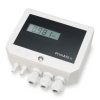 Low Range DP Sensors - Low range differential pressure sensors for measuring very small pressure differences.
- PrimAtü 10 Low Cost Low Range Differential Air Pressure Transducer - The PrimAtü 10 low cost low range differential air pressure transducer can detect and display both positive and negative differential pressure variations of very low low pressure ranges from 0.5 up to 1000 mbar/hPa, and output the pressure as a 4-20mA, 0-20mA or a 0-10Vdc analog output.
Barometric pressure is the pressure of the surrounding atmosphere which is constantly changing due to the local weather conditions. Since barometric pressure only varies by a narrow range at a particular location, it is usual to scale the output signal over an elevated and narrow band of pressure to improve the resolution of barometric pressure readings.
Measuring atmospheric pressure is normally achieved by using a absolute referenced pressure sensor which has a vacuum trapped on the reverse side of the sensing diaphragm, and an output range which corresponds to the lowest and highest barometric pressure. A common pressure range for this purpose is 800 to 1200 mbar absolute, which can be used in most applications at ground level across the globe.
A differential pressure sensor is designed for pressure to be applied to both sides, and the mechanical design and fittings are designed to be used over a wide range of pressures including the barometric range and vacuum range. It is therefore possible to apply full vacuum to the negative side of the dp sensor, to create an absolute reference, and then leave the positive side open to atmosphere to allow the barometric pressure to be measured.
The vacuum on the negative side can be created by connecting a vacuum source from a pump to continuously maintain an absolute reference during operation, or a vacuum can be applied and then sealed off, using a suitable isolation valve able to provide a leak tight vacuum seal.
The atmospheric pressure applied to the positive side connection of the dp sensor, will now be measured relative to full vacuum, in the same way as an absolute pressure sensor.
DP sensor often include the ability to rescale the output signal via push buttons, potentiometers, digital interface or HART coms. Using the rescaling functionality it is possible to set zero output to 800 mbar, and the full range output to 1200 mbar, creating a higher resolution output signal for barometric pressure measurement.
Featured differential pressure sensor products
 Wireless environmental sensors with custom MQTT SCADA system for energy management IoT platform - An energy management specialist required a multi-point wireless sensor network with specific accuracy requirements and a gateway that could output to their own MQTT-based SCADA system. This explains the selection of sensors and the dual gateway solution offered, covering both Modbus RTU and cellular MQTT options.
- PrimAtü 10 Low Cost Low Range Differential Air Pressure Transducer - The PrimAtü 10 low cost low range differential air pressure transducer can detect and display both positive and negative differential pressure variations of very low low pressure ranges from 0.5 up to 1000 mbar/hPa, and output the pressure as a 4-20mA, 0-20mA or a 0-10Vdc analog output.
Here are the steps involved in measuring barometric pressure using a DP sensor:
- Evacuate one side of the sensor to create a reference pressure.
- Expose the other side of the sensor to the atmosphere.
- Measure the difference in pressure between the two sides of the sensor.
- Rescale the output signal if necessary.
Related Help Guides
- Measuring the difference in air pressure between rooms
- Measuring liquid level in a sealed tank with a hydrostatic pressure sensor
- Difference between vented and non-vented water level measurement
- Measuring negative pressure using a positive differential pressure range
- Measuring vacuum as a negative gauge pressure using a dp sensor
- Measuring liquid level in a tank using a dp sensor
- Measuring density of a liquid using a dp sensor
Related Technical Terms
- at – Technical Atmosphere Pressure Unit
- atm – Standard Atmosphere Pressure Unit
- Dry/Dry
- inHg – Inches of Mercury at 0 degrees C Pressure Unit
- MSL – Mean Sea Level
- Static Line Pressure
- Wet/Dry
- Wet/Wet
Related Online Tools
- DP Flow Transmitter Output Calculator
- High and Low Side Pressure to Differential Pressure Calculator
- Gauge + Barometric to Absolute Pressure Calculator
- Suction Pressure to Vacuum Calculator
- US Standard Atmosphere Altitude and Pressure Calculator
- ICAO Standard Atmosphere Altitude and Pressure Calculator
- Elevation, Station (QFE) and Sea Level (QNH) Pressure Calculator
Related Product and Application Guides
Related Application Questions and Answers
- Air Replacement Plant (ARP) 100 mm H2O differential pressure transmitter
- Ex rated ambient pressure sensor with 800-1100 mbar range
- 1013 to 1400 mbar barometric pressure transmitter & readout
- Using 25 mbar DP sensor on vacuum below 0.2 bar absolute
- Low range ATEX approved 100 Pascal range DP transmitter
- Wind turbine USB PC logging pressure & temperature sensor
- Biogas HDPE cover PD blower pressure sensor
- Gas sensors testing barometric pressure sensor with RS485 Modbus RTU interface
- Engine test cell fuel filter 2.5 bar differential pressure sensor with ATEX approval
- Atmospheric range for 4-20mA pressure sensor
- USB pressure sensors for detecting water leaks & restrictions
- 5 to 20 psi absolute ambient 4 to 20 ma pressure transmitter
Contact us about this Measuring barometric pressure using a dp sensor page to request more information, or to discuss your application requirements.