
When it is necessary to present gauge reference pressure data, an absolute pressure sensor can be used in some situations if a gauge pressure sensor is not available.
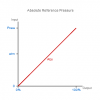
An absolute pressure sensor will measure total pressure independent of atmospheric pressure changes, unlike a gauge pressure sensor which measures pressure relative to atmospheric pressure. To convert the absolute reading to a gauge reference type the atmospheric pressure should be subtracted from the total measured pressure.
The same sensor can be used to measure the total pressure and the atmospheric pressure. Since the atmospheric pressure will change over time, the more often it is checked, the more precise will be the conversion to gauge pressure. The overall uncertainty of the gauge pressure conversion will be the sum of both reading errors, which for most sensors is double the full scale error indicated on the product specification data sheet.
If the atmospheric pressure at a particular location rarely exceeds 1 bar abs, an absolute pressure sensor should only be used if it’s pressure range is at least 1 bar higher than the gauge range required. So a 0-2 bar absolute range should only be used to measure 0-1 bar gauge at this example location.
Featured absolute pressure sensor products
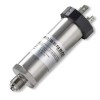 Barometric 550 to 1150 hPa abs high resolution pressure transmitter - High precision barometric pressure transmitter for measuring atmospheric pressure from 550 hPa to 1150 hPa absolute.
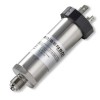 Ex rated ambient pressure sensor with 800-1100 mbar range - Could you give details of a high accuracy pressure sensor which measures ambient pressure (800 to 1100 mb) for environmental purposes.
Related Help Guides
- Measuring vacuum with negative gauge or absolute ranges
- Measuring liquid level in a sealed tank with a hydrostatic pressure sensor
- What is the difference between gauge and absolute pressure measurement
- What is the difference between vacuum and absolute pressure
- What does negative and positive gauge pressure mean
- Measuring vacuum as a negative gauge pressure using a dp sensor
Related Technical Terms
- Gauge Reference Pressure
- MSL – Mean Sea Level
- Negative Gauge Pressure
- Reference Pressure
- SG – Sealed Gauge
- Vented Cable
- Vented Gauge
Related Online Tools
Related Product and Application Guides
Related Application Questions and Answers
- 16 bar, 200°C steam pressure transmitter and gauge
- Pass/Fail timed 500 kPa pressure leak test software and sensor
- 60000 psi pressure indicator with RS232 interface
- Submersible rainwater tank level sensor for measuring 3.5m depth
- Ex rated ambient pressure sensor with 800-1100 mbar range
- 20 bar absolute steam pressure transducer
- HART flameproof (Ex d) re-scalable level transmitter for hydrostatic head up to 2 metres
- Dockside sea water tide level transmitter up to 6 metres depth
- Vacuum drying pressure data logger
- 5 bar water irrigation pressure transducer with 0 to 5 volt output
- Low range vacuum pressure logger for 0 to -60 inH2O g
- 180 degC pressure sensor for saturated steam up to 10 bar
Contact us about this Using an Absolute Sensor to Measure Gauge Reference Pressure page to request more information, or to discuss your application requirements.