
How can you use a differential pressure measurement device to measure a negative pressure if it has been factory configured to measure a positive pressure range without making any adjustments to the electronics or the signal output?
Finding a pressure sensor to read negative pressure can be difficult since the vast majority of pressure measurement devices are only available with positive ranges as standard, since most applications require a positive pressure range, and therefore manufacturers understandably focus on the most popular pressure ranges for their product range.
Although manufacturers will often consider a custom configuration for measuring negative pressure, this could cause a delay to delivery and an extra cost compared to the standard pressure range configuration.
Featured differential pressure measurement products
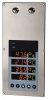 Clean Room Monitor for Air Differential Pressure, Temperature and Humidity – PMDS4 - The PMDS4 clean room monitor is designed for positive and negative monitoring of differential air pressure between the inside and outside of a clean room.
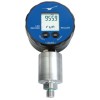 LEO Record (Ei) Capo Low Pressure Logger - Battery powered data logger for measuring and recording low range pressures. Pressure ranges from 30 mbar (12 inH2O) up to 300 mbar (120 inH2O).
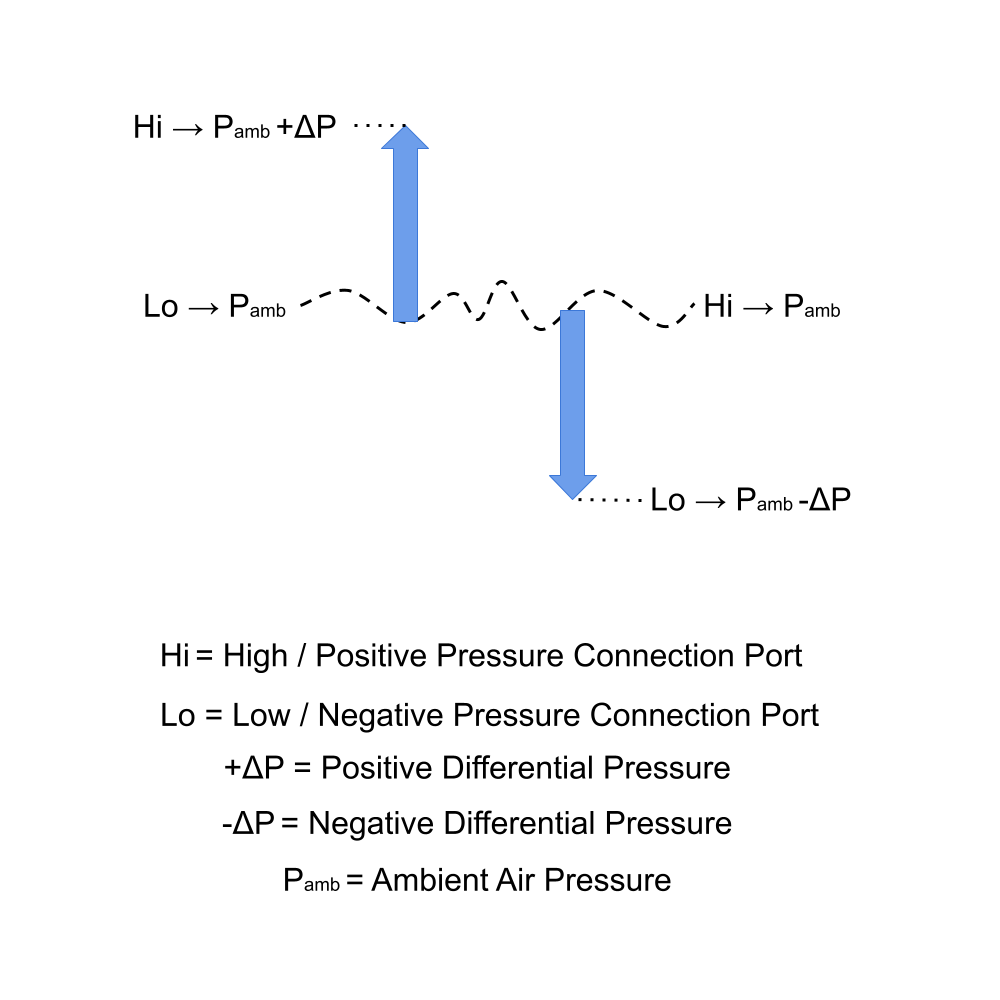
There is a much simpler and convenient solution to measuring negative pressures. A differential pressure measurement device has two separate pressure connections so that the difference in pressure between the two connections can be measured. One connection will be marked as High (Hi) or Positive (+), and the other as Low (Lo) or Negative (-).
Typically when measuring positive pressures, the Low side connection would be open to ambient air pressure, and the High side connection would be connected to the positive pressure to be measured.
If you want to measure negative or suction pressure instead, you can reverse the connection, so that the High side connection is open to ambient air pressure, and the Low side connection is connected to the vacuum pressure. As the vacuum increases, the greater will be the difference in pressure between the Low and High side.
As an example, a 0 to +100 mbar differential pressure range will become a 0 to -100 mbar differential pressure range simply by reversing the connections.
Featured differential pressure measurement products
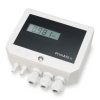 Measuring HVAC plenum and sub-floor air pressure in data centers - Monitoring the critical air pressure gradients in data center sub-floors, server rooms, and ceiling plenums. Low range differential pressure transmitter provides stable gauge pressure readings for optimizing HVAC and cooling efficiency.
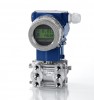 Low range ATEX approved 100 Pascal range DP transmitter - The DPT200 is a robust ATEX approved differential pressure transmitter which has a very low range of 100Pa.
Featured differential pressure measurement products
 Heating appliance chimney draft and barometric pressure testing using differential and absolute sensors - Very low, bi-directional chimney draft pressure and barometric pressure sensor for testing preformance of wood stoves in a research environment.
- Bi-directional low pressure sensing for yacht engine room ventilation control - Bi-directional differential pressure transmitter with a range of -100 to +100 Pa provides the core measurement for an automated fan control system on a yacht, ensuring critical engine room pressurisation.
Related Help Guides
- Measuring vacuum with negative gauge or absolute ranges
- Measuring the difference in air pressure between rooms
- Measuring liquid level in a sealed tank with a hydrostatic pressure sensor
- What is the difference between vacuum and absolute pressure
- What does negative and positive gauge pressure mean
- Measuring vacuum as a negative gauge pressure using a dp sensor
- Measuring liquid level in a tank using a dp sensor
- Measuring density of a liquid using a dp sensor
Related Technical Terms
Related Online Tools
- DP Flow Transmitter Output Calculator
- High and Low Side Pressure to Differential Pressure Calculator
- Suction Pressure to Vacuum Calculator
Related Product and Application Guides

Related Application Questions and Answers
- Air Replacement Plant (ARP) 100 mm H2O differential pressure transmitter
- Vacuum drying pressure data logger
- Low range vacuum pressure logger for 0 to -60 inH2O g
- High reading rate for measuring dynamic pressures to -200psf
- Using 25 mbar DP sensor on vacuum below 0.2 bar absolute
- Low range ATEX approved 100 Pascal range DP transmitter
- Biogas HDPE cover PD blower pressure sensor
- Engine test cell fuel filter 2.5 bar differential pressure sensor with ATEX approval
- USB pressure sensors for detecting water leaks & restrictions
- Leak testing set for checking 1mb/min drop at negative 10 mbar vacuum
- Vacuum suction sensor & wall mount digital readout with switched contacts
- Solvent compatible +/-100mWG dp transmitter with PTFE seals
Contact us about this Measuring negative pressure using a positive differential pressure range page to request more information, or to discuss your application requirements.