
Measuring hydrostatic liquid level is normally carried out using a vented gauge reference pressure sensor. However, venting the inside of a pressure sensor to the outside air is not always possible and failures can be caused by internal condensation.
When measuring the water level in a freshwater reservoir for example, the hydrostatic pressure sensor is measuring both the pressure of water above its position and the atmospheric air pressure acting on the surface of the reservoir. Normally a vented reference would be used to equalise the offset due to atmospheric pressure so that the true water level is measured. However if it is necessary to use an absolute hydrostatic pressure sensor this is not possible and the atmospheric pressure has to be measured at the surface and taken away from the reading of the absolute hydrostatic pressure sensor.
In geotechnical applications for example where there are several submersible borehole level sensors installed within a local area, only one barometric pressure sensor is necessary to compensate all the other level instruments. This can work out much lower cost especially with deep boreholes where the cost of vented cable and desiccant packs outweighs the cost of one extra barometric pressure sensor.
Featured absolute reference hydrostatic level pressure sensor products
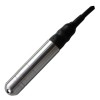 IWSL Potable Water Submersible Level Sensor - IP68 protect pressure sensor for monitoring potable water level to depths of 100 metres.
- IMCL Submersible Absolute Reference Depth Sensor - Absolute reference hydrostatic depth sensor with an IP68 sealed electrical interface, SS316L, Duplex or PVC housing and a mV, voltage or current output.
Where there is a ratio greater than 10 to 1 between the hydrostatic pressure and the barometric pressure, no significant additional errors will be introduced over the vented gauge reference method as longs as both pressure instruments are of a similar accuracy grade. But when the liquid level range falls below 100 metres, the barometric pressure compensation starts to play a bigger part in the error budget eventually increasing the errors effectively by 300% for a 10 meter level range for instance.
This disproportionate increase in accuracy is caused by having to use a 2 bar absolute range to measure a 10 metre (approx 1 bar gauge pressure) level range plus a barometric range of approximately 1 bar absolute. So if it is assumed that each sensor has an accuracy of 0.1% full scale the overall error will be 0.3% full scale when compared to a vented hydrostatic level instrument with a level range of 1 bar gauge (10 mWG).
The atmospheric pressure is effectively being measured twice and as the level range reduces it becomes the dominant component of the total error. This becomes even worse with level ranges between 1 and 10 meters of water and quickly the economical and practical benefits of using an absolute hydrostatic pressure instrument become over-shadowed by the severe degradation in accuracy.
Featured atmospheric pressure sensor products
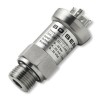 Barometric Pressure Transmitters - Select barometric pressure transmitters with compressed output scaling for superior resolution in detecting incremental atmospheric changes. Ideal for environmental controls & gas analysis compensation.
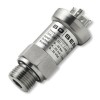 Atmospheric air pressure transducer with 10 volt output - Pressure transducer with 0 to 10 v signal to monitor ambient air pressure in a room accurate to 0.5% range.
Related Help Guides
- Determining the hydrostatic pressure range for a tank level sensor
- Measuring liquid level in a sealed tank with a hydrostatic pressure sensor
- Difference between vented and non-vented water level measurement
- Determining water tank volume using hydrostatic pressure
- Measuring the volume of liquid in a horizontal cylinder tank
- How do you measure the volume of a liquid using pressure
- Measuring liquid level in a tank using a dp sensor
Related Technical Terms
- cmH2O – Centimetres of Water Column at 4 deg C Pressure Unit
- ftH2O – Feet of Water Column at 4 deg C Pressure Unit
- mH2O – Metres of Water Gauge at 4 deg C Pressure Unit
- mmH2O – Millimetres of Water Column at 4 deg C Pressure Unit
- Specific Gravity
Related Online Tools
- Liquid Level to Hydrostatic Pressure Calculator
- Fluid Depth, Density, Gravity, and Pressure Calculator
- Pressure to Liquid Level Calculator
Related Product and Application Guides
Related Application Questions and Answers
- Immersible water level sensor for 4 metre deep cold water storage tank
- Submersible rainwater tank level sensor for measuring 3.5m depth
- HART flameproof (Ex d) re-scalable level transmitter for hydrostatic head up to 2 metres
- Dockside sea water tide level transmitter up to 6 metres depth
- Low cost 2 metre high diesel tank level sensor with 0-10 volt output
- Sulfuric acid 12-15% conc. drop-in level probe for 10m high tank
- Submersible oil pressure sensor alternative to Ashdown CNS
- 1-5Vdc output, 2.5m range, salt water ballast tank level sensor
- Ferric Chloride solution hydrostatic level transmitter
- Hydropower reservoir submersible hydrostatic level transmitter & indicator
- Raw leachate feed tank depth probe
- Water tank level gauge transmitter with adjustable range
Contact us about this Using absolute pressure sensors to measure hydrostatic level page to request more information, or to discuss your application requirements.