
The value of hydrostatic pressure for a fixed height column of fluid is directly proportional to the gravitational strength at a particular geographical location.
Generally if the height above sea level is increased the hydrostatic pressure will decrease. Also since the world is wider at the equator than the poles the gravitational pull will increase as you move closer to either the north or south pole.
For example, the acceleration due to gravity in Bangkok, Thailand is 9.783 m/s², whereas in London, England it is 9.812m/s². This represents a difference of approx 0.3%, therefore a column of water that has a hydrostatic pressure of 1000 mmWG in Bangkok will measure 1003 mmH20 in London, England even though the water level has not changed between the two locations.
In order to standardise the measurement of hydrostatic pressure the universal value for Earth’s gravity of 9.80665 m/s² is used.
This local gravity calculator will provide you with a good approximation of the local gravity at your location.
Featured hydrostatic pressure measurement products
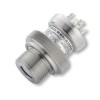 Hydrostatic Level Sensors - Hydrostatic pressure sensing devices for measuring liquid level and converting it to an electrical signal to send to other instrumentation.
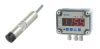 Underground rain water storage tank level sensor and readout for 2 metre depth - Water level indicator for a 2 metre deep rain water storage tank located underground.
Related Help Guides
- Determining the hydrostatic pressure range for a tank level sensor
- Measuring liquid level in a sealed tank with a hydrostatic pressure sensor
- Difference between vented and non-vented water level measurement
- Determining water tank volume using hydrostatic pressure
- Measuring the volume of liquid in a horizontal cylinder tank
- How do you measure the volume of a liquid using pressure
- Measuring liquid level in a tank using a dp sensor
Related Technical Terms
- cmH2O – Centimetres of Water Column at 4 deg C Pressure Unit
- ftH2O – Feet of Water Column at 4 deg C Pressure Unit
- mH2O – Metres of Water Gauge at 4 deg C Pressure Unit
- mmH2O – Millimetres of Water Column at 4 deg C Pressure Unit
- Specific Gravity
Related Online Tools
- Liquid Level to Hydrostatic Pressure Calculator
- Fluid Depth, Density, Gravity, and Pressure Calculator
- Pressure to Liquid Level Calculator
Related Product and Application Guides
Related Application Questions and Answers
- Immersible water level sensor for 4 metre deep cold water storage tank
- Submersible rainwater tank level sensor for measuring 3.5m depth
- HART flameproof (Ex d) re-scalable level transmitter for hydrostatic head up to 2 metres
- Dockside sea water tide level transmitter up to 6 metres depth
- Low cost 2 metre high diesel tank level sensor with 0-10 volt output
- Sulfuric acid 12-15% conc. drop-in level probe for 10m high tank
- Submersible oil pressure sensor alternative to Ashdown CNS
- 1-5Vdc output, 2.5m range, salt water ballast tank level sensor
- Ferric Chloride solution hydrostatic level transmitter
- Hydropower reservoir submersible hydrostatic level transmitter & indicator
- Raw leachate feed tank depth probe
- Water tank level gauge transmitter with adjustable range
Contact us about this How does changes in Local Gravity affect Hydrostatic Pressure page to request more information, or to discuss your application requirements.