
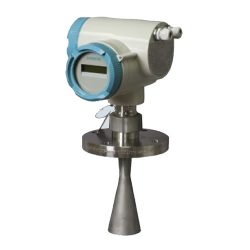
 Radar based sensing devices for measuring liquid level and converting it to an electrical signal to send to other instrumentation.
A radar liquid level sensor is an instrument for measuring the height of a liquid and converting it to an electrical signal. The liquid level signal output can then be utilised by other instrumentation to display, monitor, log or control the liquid level.
Radar liquid level sensors are measurement devices which transmit and receive high frequency radio waves (microwaves) to measure the distance to the surface of a liquid based substance.
Featured liquid level measurement products
 4-20mA Output Hydrostatic Level Transmitters & Sensors - Explore industrial 4-20mA hydrostatic level transmitters for reliable liquid depth measurement. Ideal for tank gauging, borehole control & process monitoring applications.
 LMP307 Submersible Level Transmitter - Submersible level transmitter for measuring liquid level with a 4-20mA current loop or a 0-10V voltage output plus optional ATEX approval for intrinsically safe use in hazardous areas in ranges from 1mH2O up to 250mH2O. The LMP307 is suitable for use on potable water with no leaching, and can be supplied with a drinking water certificate according to DVGW and KTW.
Radar liquid level sensor technology transmits a high frequency electromagnetic wave pulse typically in the microwave spectrum, and receives the wave reflected off a liquid surface. The time taken for the microwave pulse to traverse the distance between the transmitting antenna and target surface, and back again to the receiving antenna is measured.
The distance (d) between the radar liquid level sensor and the liquid surface can be calculated by dividing the time taken (t) by two, and multiplying that by the speed of light (c), i.e. d = c ∙ t / 2. The liquid level in a tank (LT) can then be determined by subtracting distance (d) from the height of the radar level sensor (HT), i.e. LT = HT – d.
Unlike ultrasonic sensors, the performance of a radar level sensor is not easily affected by temperature changes, humidity or vapour between the sensor and the liquid surface. This is because changes in air density only have a very small effect on the speed of electromagnetic waves. Also radar liquid level sensors can work in a vacuum, high pressures and high temperatures without any noticeable difference on measured transit time, so it can be used in applications where it is not possible to use ultrasonic based sensors.
Due to the high frequency electromagnetic waves used, it is possible to measure distance to a very high accuracy, as long as the surface is not too close to the sensor, where the pulse transit time becomes too small to measure precisely. This is called the dead zone, blocking distance or deadband, and is typically greater than an ultrasonic based device.
Featured liquid level measurement products
 LMK307 Submersible Waste Water Level Sensor - Submersible waste water level sensor with optional intrinsic safety certification for monitoring the level of sewage and effluent in water treatment plants.
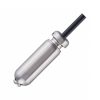 IMTG Low Cost OEM Submersible Tank Gauging Level Sensor - Economical pressure transducer for monitoring fluid level inside a tank where there is no external mounting point at the bottom of the tank.
Since there is no contact with the fluid to be measured, radar liquid level measurement technology can be used in applications where sensors requiring contact are otherwise prohibited. These sensors have no moving parts which makes them very reliable, requiring very little maintenance.
Radar liquid level sensors are typically housed in a single assembly combining the transmitter and receiver antenna in one device.
The main two types of radar liquid level sensor used is through air radar (TAR) and guided wave radar (GWR).
The through air radar liquid level sensor is the most commonly used type due to it being contactless and easier to install. The transmitted magnetic waves fan out from the sensor until they hit the surface of the liquid and are reflected back. The main drawback with TAR liquid level sensors is that the electromagnetic pulse energy is attenuated by greater distances and lower dielectric process media. Since there is no contact with the fluid to be measured, TAR liquid level measurement technology can be used in corrosive chemical applications.
The guided wave radar type include a wave guide attached to the front of the sensor which is used to focus microwave pulse and boost the reflected wave energy. This makes it possible to use GWR type sensors with lower dielectric process media where the performance of a TAR type sensor would otherwise be degraded.
Radar liquid level sensors are mounted above the surface of the liquid in the top of a tank or from a platform spanning the top of an open tank.
Featured liquid level measurement products
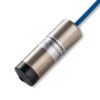 Dockside sea water tide level transmitter up to 6 metres depth - Pressure transmitter for measuring depth of tide in a dock from 0 to 6 metres of seawater.
- Diesel level transducer for telecom cell tower generator tanks - Monitor fuel levels in telecom generator tanks with this submersible level sensor. Features low-power output, robust design, and wide temperature range.
Advantages
- No media contact for vertically mounted type, so flexibility for use on different corrosive media, thick fluids, slurries, wastewater
- High temperature fluid compatibility for vertically mounted types, since no sensitive components make contact with the fluid
- High accuracy due to high frequency pulse wave and precise transit time time measurement
- Sealed pressurised vessel will not affect performance
- Longer range than ultrasonics
- Not affected by surface changes such as air temperature, which cause problems with ultrasonics
Disadvantages
- Foaming, splashing, vapour and humidity can affect measurement performance
- High cost compared to other technologies
- Top mounting only
- Minimal blocking distance limits operation when in proximity to liquid level
- Longer blocking distance than ultrasonic
- Radar passes through low dielectric constant fluids
Featured liquid level measurement products
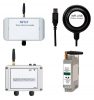 Long range wireless hydrology sensor network for remote water level data acquisition - Monitor river water levels in remote locations using battery-powered wireless transmitters that provide an internal boost circuit for radar sensor loop power.
- 4-20mA Output Hydrostatic Level Transmitters & Sensors - Explore industrial 4-20mA hydrostatic level transmitters for reliable liquid depth measurement. Ideal for tank gauging, borehole control & process monitoring applications.
Related Help Guides
- Determining the hydrostatic pressure range for a tank level sensor
- Measuring liquid level in a sealed tank with a hydrostatic pressure sensor
- Difference between vented and non-vented water level measurement
- Determining water tank volume using hydrostatic pressure
- Measuring the volume of liquid in a horizontal cylinder tank
- Measuring liquid level in a tank using a dp sensor
- How do you measure the volume of a liquid using pressure
- Liquid Level Measurement
- How to determine milk tank level and volume from pressure
- Selecting the correct pressure sensor range for low-level applications
- Installing a submersible level sensor horizontally
- Measuring diesel level in shallow tanks
- Atmospheric pressure compensation for hydrostatic level sensors
- Determining the signal cable length of a suspended liquid level transducer
- Calculating required pressure range for fuel tank level measurement
- How does changes in Local Gravity affect Hydrostatic Pressure
- Using absolute pressure sensors to measure hydrostatic level
- Using a screw-in or waterproof pressure transmitter to measure liquid level
- Improve the electrical termination of vented submersible pressure sensors
- Considerations for monitoring Landfill Water Level
- Why are Submersible applications so demanding of Pressure Transducers?
- Are all IP68 Water Resistant Protection Ratings the same
- Converting non-vented depth readings & barometric pressure to true depth
Related Technical Terms
- Capacitive Fluid Level Measurement
- cmH2O – Centimetres of Water Column at 4 deg C Pressure Unit
- Conductive Fluid Level Detection
- Float Fluid Level Detection
- ftH2O – Feet of Water Column at 4 deg C Pressure Unit
- mH2O – Metres of Water Gauge at 4 deg C Pressure Unit
- mmH2O – Millimetres of Water Column at 4 deg C Pressure Unit
- Specific Gravity
- Vibrating Tuning Fork Fluid Level Detection
Related Online Tools
- Liquid Level to Hydrostatic Pressure Calculator
- Fluid Depth, Density, Gravity, and Pressure Calculator
- Liquid Level Transmitter 4-20mA Current Output Calculator
- Vertical Cylindrical Shaped Tank Contents Calculator
- Horizontal Cylindrical Shaped Tank Contents Calculator
- Rectangular Shaped Tank Contents Calculator
- Pressure to Liquid Level Calculator
Related Product and Application Guides
Related Application Questions and Answers
- HART flameproof (Ex d) re-scalable level transmitter for hydrostatic head up to 2 metres
- Dockside sea water tide level transmitter up to 6 metres depth
- Water tank level gauge transmitter with adjustable range
- Portable battery powered tank level gauge with submersible sensor
- Generator diesel tank height level sensor for 1 metre height
Contact us about this Radar Liquid Level Sensors page to request more information, or to discuss your application requirements.