Why is it critical to select a pressure-based level sensor with a range that closely matches the maximum liquid depth, especially when measuring low levels?
Selecting a sensor with a measurement range that closely matches the application’s required depth is crucial for maximizing measurement resolution and accuracy. This is especially true for low-level applications. The principle is to use as much of the sensor’s analog output signal (e.g., 4-20 mA) as possible to represent the process variable.
Consider an application to measure a maximum level of 20 cm of diesel, which exerts about 17 mbar of pressure.
- Case 1: Poorly Matched Sensor. If a sensor with a range of 0-100 mbar is used, the 17 mbar of pressure only utilizes 17% of the sensor’s full-scale capability. The corresponding change in the 4-20 mA output signal would be small, making it difficult for the control system to resolve small fluctuations in level.
- Case 2: Correctly Matched Sensor. If a sensor with a range of 0-40 mbar is used, the 17 mbar of pressure utilizes about 42% of the sensor’s range. This provides a significantly larger change in the output signal for the same change in level, resulting in higher resolution and more precise process control.
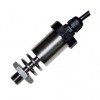
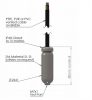
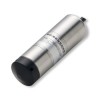
Featured low range liquid level sensor products
Furthermore, sensor accuracy is typically specified as a percentage of full-scale output (% FSO). A higher-range sensor will have a larger potential error in absolute terms. For example, a 0.5% FSO accuracy on a 100 mbar sensor is ±0.5 mbar, which is a significant error relative to a 17 mbar measurement. In contrast, a 0.35% FSO accuracy on a 40 mbar sensor is ±0.14 mbar, providing a much more accurate reading at that specific low level.
By properly matching the sensor’s range to the application, engineers can ensure higher resolution, better accuracy, and more reliable system performance.
Related Help Guides
- Pressure Sensor Accuracy Specifications
- Determining calibration error of Bourdon tube pressure gauge
- Measurement Accuracy
- What is the difference between zero offset and zero drift?
- Choosing calibrator for pressure transmitters
- Measuring diesel level in shallow tanks
Related Product and Application Guides

Related Technical Terms
- Accuracy
- BSL – Best Straight Line
- Compensated Temperature Range
- Digital Compensation
- g Effect
- Hysteresis
- LHR – Linearity, Hysteresis and Repeatability
- Long Term Stability/Drift
- NL – Non-Linearity
- PPM – Parts Per Million
- Precision
- Pressure Hysteresis
- Repeatability
- RTE – Referred Temperature Error
- Secondary Pressure Standard
- TEB – Temperature Error Band
- TEB – Total Error Band
- Temperature Compensation
- Temperature Error
- Thermal Hysteresis
- Threshold
- TSL – Terminal Straight Line
- TSS – Thermal Span or Sensitivity Shift
- TZS – Thermal Zero Shift
Related Online Tools
- Pressure Sensor Calculator
- Temperature Sensor Calculator
- Bit to Measurement Resolution Converter
- Pressure Sensing Errors Calculator
- Pressure Measurement Accuracy and Error Calculator
Contact us about this Selecting the correct pressure sensor range for low-level applications page to request more information, or to discuss your application requirements.