
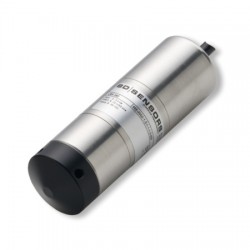
Submersible Low Range waste water level transmitter with intrinsically safe option for monitoring the level of sewage and effluent in water treatment plants.
The LMK 382 Submersible Level Transmitter is engineered for continuous hydrostatic level measurement in waste water, polluted fluids, and higher-viscosity media across nominal pressure ranges from 0…40 cmH2O up to 0…200 mH2O (0.04…20 bar).
Built around a robust capacitive ceramic sensor with an Al2O3 99.9% diaphragm housed in 316L stainless steel, the probe delivers outstanding chemical resistance, high overpressure stability, and standard measurement accuracy of ≤ ±0.35% FSO, with an optional ≤ ±0.25% FSO rating.
Featuring a probe outer diameter of 39.5 mm, removable POM-C protection cap for flush-diaphragm conversion, versatile cable materials rated for temperatures up to -25…+125 °C, standard 2-wire 4…20 mA, and intrinsically safe Ex ia options for Zone 0 hazardous locations, the LMK 382 provides reliable process monitoring in municipal wastewater, industrial processing, and fuel storage environments.
Product Parameters
- Hydrostatic Pressure Range: from 0.4 up to 200 mWG
- Accuracy: 0.35% or 0.25% FS IEC 60770
- Output Signal: 4-20mA, 2 wire current loop
- Electrical Connection: IP68 submersible gland with PVC, PUR, FEP or TPE shielded cable
- Pressure Connection: Flush ceramic diaphragm with protective nose cone
- Media Compatibility: Stainless steel 316l body, Ceramic Al2O3 (96%) diaphragm, FKM, FFKM or EPDM seal gasket plus selected cable jacket
- Dimensions: 39.5 mm diameter
- Weight: 400 g excluding cable
- Special Options: ATEX certified to II 1 G EEx ia IIC T4, vented cable junction box with PT100 transmitter and/or overvoltage protection circuit, flange or pipe mounting, 125 degC max temperature for submersion with TPE cable, HART communications
Product Description
The LMK 382 Submersible Stainless Steel Level Transmitter is designed for demanding continuous hydrostatic level applications where media contamination, high viscosity, or aggressive chemical content would degrade conventional pressure transmitters. Featuring an overall outer diameter of 39.5 mm, the probe incorporates a capacitive ceramic sensor fabricated from 99.9% high-purity Al2O3. This construction delivers high overpressure ratings—up to 45 bar—and long-term signal stability of ≤ ±0.1% FSO per year under reference conditions. The sensor operates reliably at low hydrostatic pressure ranges starting at 0…40 cmH2O (0.04 bar), providing accurate monitoring in open tanks, shallow basins, and sumps.
To shield the ceramic diaphragm from mechanical impact during installation and maintenance, the probe is supplied with a removable POM-C protection cap as standard. When deploying the transmitter in high-viscosity or pasty media such as sewage sludge or wastewater slurry, the protective nose cone can be easily removed by hand or tool to create a flush-diaphragm assembly, preventing media entrapment and clogging around the sensor face. Mechanical mounting options include suspended installation via high-tensile cable, rigid pipe mounting prepared for stainless steel extension tubes, and transmitter flange configurations conforming to DIN 2507 (DN25/PN40, DN50/PN40, and DN80/PN16).
Electrically, the transmitter converts hydrostatic pressure into a standard 2-wire 4…20 mA analog output (9…32 VDC power supply). An optional integrated Pt 100 temperature sensor operating in a 3-wire configuration can be incorporated to transmit media temperature alongside level measurement. For installations in hazardous operating environments, intrinsically safe versions (Ex ia) are available with maximum safety parameters (Ui = 28 V, Ii = 93 mA, Pi = 660 mW) for gas and dust explosion zones. All probe cables feature an integrated capillary ventilation tube fitted with a capillary PTFE filter to ensure relative atmospheric pressure compensation.
Product Features
Advanced Ceramic Sensor Technology
The LMK 382 features a sophisticated capacitive ceramic sensor at its core, utilizing a 99.9% pure Al2O3 ceramic diaphragm. This robust, high-purity construction is engineered to withstand demanding environments, offering exceptional high overpressure safety of up to 45 bar. This ensures consistent, long-term signal stability and reliable operation even under extreme process conditions.
Versatile Flush-Diaphragm Conversion
The probe is designed with a removable POM-C protective nose cone that can be easily detached by hand or with a tool. This allows for rapid conversion to a flush-diaphragm assembly, which is essential for applications involving high-viscosity, pasty, or sludge-laden media. This design prevents clogging and media entrapment, ensuring the sensor remains clear and operational in difficult fluids.
Durable Material Construction
Housed in a rugged 316L (1.4404) stainless steel enclosure, the LMK 382 is built to endure harsh industrial environments. To ensure broad chemical resistance and compatibility, the probe can be configured with a selection of FKM, FFKM, or EPDM elastomeric seals, allowing for a precise match to the specific chemical composition of the process media.
Flexible Cabling Options
The transmitter provides a range of vented cable sheath materials—including PVC, PUR, FEP, and TPE-U—to suit various operational requirements. These materials ensure operational temperature resistance from -25…+70 °C (+125 °C for TPE-U), offering durability and reliability in diverse industrial, municipal, and outdoor installations.
High Measurement Accuracy
The LMK 382 provides reliable, precise process monitoring with a standard measurement accuracy of ≤ ±0.35% FSO. For applications requiring tighter tolerances, an optional high-precision rating of ≤ ±0.25% FSO is available per IEC 61298-2, ensuring trustworthy data for critical industrial operations.
Intrinsic Safety for Hazardous Zones
Designed for safety in critical environments, the probe offers optional ATEX/IECEx intrinsic safety approvals (Ex ia IIB T4 Ga / Ex ia IIIC T110°C Da). These certifications enable safe, compliant operation in Zone 0 gas and Zone 20 dust explosive environments, making it suitable for volatile industrial settings.
Integrated Temperature Sensing
The LMK 382 supports optional integrated Pt 100 temperature sensing, enabling the simultaneous measurement of both fluid level and media temperature. This dual-functionality is delivered through a single, streamlined cable assembly, simplifying the installation process and reducing the need for additional instrumentation.
Product Applications
95°C hot water tank
Hot water tank level measurement where the temperature of water reaches a maximum of 95°C.
- SKU ID: s1-lmk382-0003
- Part No: 566-2500-1-C-1-1-4-3-010-000
- Pressure Range: 0 – 2.5mWG
- Output Signal: 4-20mA, 2-wire
- Accuracy: 0.35% FS IEC 60770
- Installation Type: Probe version with nose cone
- Housing Material: Stainless Steel
- Diaphragm Material: Ceramic Al2O3 99.9%
- Media Exposed Seals: FKM
- Cable Type: TPE-U (125 deg C max)
- Cable Length: 5
- Cable Length Units: Metres (m)
- Options: none
Sedimentation tank
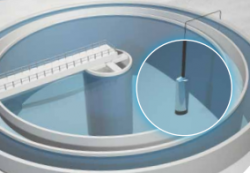
Waste water is processed in various cleaning stages, with the goal of obtaining reusable drinking water. Mechanical, physical and biological procedures provide optimum cleaning performance.
The applicable explosion protection regulations have to be observed during the various processing stages, and therefore it is necessary to use intrinsically safe approved sensor with the appropriate isolating barriers to protect instrumentation either side of the hazardous zone. The level of the different tanks is monitored with the LMK382 for monitoring and controlling the system which has the necessary explosion protection certification.
Municipal and Industrial Wastewater Treatment
The LMK 382 is ideally suited for the rigorous demands of municipal and industrial wastewater facilities. It provides consistent hydrostatic level monitoring across various stages, including influent channels, aeration basins, sludge holding tanks, and digesters. Its robust ceramic sensor handles the suspended solids and potentially corrosive nature of these media, ensuring reliable data for process control and facility efficiency.
Genset daily tank fuel level
Monitoring fuel level in daily tanks of gensets with fuel temperature up to 85 °C.
- SKU ID: s1-lmk382-0001
- Part No: 566-3000-1-C-E-1-4-3-005-000
- Pressure Range: 0 to 3
- Units: mH2O
- Reference Type: Gauge / Vented (atm to +P)
- Output Signal: 4-20mA, 2 wire
- Accuracy: 0.35% FS
- Installation Type: Probe version with nose cone
- Housing Material: Stainless Steel 316L
- Diaphragm Material: Ceramic Al2O3 99.9%
- Media Exposed Seals: FKM
- Cable Type: TPE (125degC max)
- Cable Length: 5
- Cable Length Units: Metres (m)
- Optional Extras: ATEX Intrinsic safety approval
Sewage Pumping and Storm Water Systems
Designed to withstand the harsh conditions of sewage pumping stations and storm water retention basins, this transmitter excels in environments containing polluted, viscous, or pasty fluids. The flush-diaphragm configuration prevents the clogging and material buildup typically encountered in these applications, ensuring uninterrupted operation without the need for frequent maintenance or cleaning.
Wastewater pumping stations
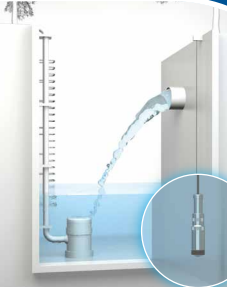
Pumping stations are used to overcome inclines during the transfer of waste from one location to another where there is a positive change in terrain elevation preventing the gravity fed flow of waste water.
The pumping stations include automatically controlled systems which monitor the level in the collecting tank.
The LMK382 is installed in the collection tank to control the pump on/off switching procedures to prevent dry running of the pump and tank overflow.
Fuel, Oil, and Biogas Storage
For fuel depots, oil tank farms, and biogas plants, the LMK 382 offers precise level monitoring in low-height open tanks. Its long-term stability and reliable signal output ensure that storage levels are accurately maintained over extended periods, while the optional intrinsic safety features provide the necessary compliance for operation in potentially explosive zones.
Potable Water and Resource Management
The transmitter is a highly reliable choice for potable water abstraction, water recycling facilities, and deep well monitoring. Its high measurement accuracy ensures that critical water levels in reservoirs and deep wells are tracked with precision, supporting efficient resource management and helping to prevent supply disruptions in municipal or private water systems.
Product Specifying Guide
Step 1: Select nominal pressure range and unit
Choose the appropriate nominal range corresponding to the maximum expected hydrostatic liquid column height. Standard nominal gauge pressure ranges span from 0.04…20 bar (equivalent to 0…40 cmH2O up to 0…200 mH2O). Ensure the selected range provides adequate overpressure capability while maintaining resolution across the primary operating level window.
Step 2: Determine output signal and electrical configuration
Select the electrical output required by your control system. The standard baseline configuration is a 2-wire 4…20 mA analog output operating from a 9…32 VDC supply. If simultaneous media temperature measurement is required, specify the integrated Pt 100 temperature element.
Step 3: Choose housing, seal, and diaphragm materials
Verify media compatibility with wetted materials. The standard housing material is 316L (1.4404) stainless steel paired with a 99.9% Al2O3 ceramic diaphragm. Select FKM, FFKM, or EPDM internal seals depending on fluid chemical composition, process temperature, and solvent content.
Step 4: Select cable sheath material and length
Specify the cable sheath material based on fluid exposure and operating temperature: PVC (-5…+70 °C) for standard water applications, PUR (-25…+70 °C) for oil and wastewater resistance, FEP (-25…+70 °C) for aggressive chemical environments, or TPE-U (-25…+125 °C) for elevated temperature processes. Calculate total cable length in meters or feet, ensuring sufficient margin to reach junction boxes outside the submersion zone.
Step 5: Specify mounting option and explosion protection
Select the physical mounting style: standard submersible probe with POM-C nose cone, version prepared for stainless steel mounting pipe, or flanged connection (DN25, DN50, or DN80). For installations located in hazardous gas or dust areas, specify the intrinsically safe Ex ia version paired with certified Zener barriers or galvanic isolation repeaters.
Part Number Builder
Generate or decode LMK 382 ordering code
Installation & Operation Guide
Step 1: Pre-installation inspection and handling
Unpack the LMK 382 probe carefully and inspect the housing, cable sheath, and protective cap for physical damage. Ensure the protective nose cone remains attached during mechanical installation to shield the delicate Al2O3 ceramic diaphragm from direct impact. Avoid subjecting the probe or cable to severe mechanical shock, drop forces, or excessive cable tension.
Step 2: Mechanical mounting and submersion
Slowly lower the probe into the process fluid to prevent dynamic pressure spikes on the ceramic diaphragm caused by liquid surface impact. For high-viscosity media or sludge, carefully remove the POM-C protective cap prior to immersion to allow full media contact with the flush diaphragm. Secure the cable using an approved terminal clamp or mounting flange, ensuring the probe cannot swing or strike vessel walls during fluid movement. Maintain a minimum static cable bend radius of at least 10-fold cable diameter (or 20-fold for dynamic applications).
Step 3: Electrical connection and grounding
Connect the transmitter according to the pin configuration (e.g., White = VS+, Brown = VS-) using shielded, twisted multicore cable. Ensure the cable shield is connected to earth potential via low-impedance grounding clamps to prevent electrical interference and equipotential ground loop defects. For relative pressure reference, route the integrated ventilation tube into a dry connection box equipped with an intact capillary PTFE filter.
Step 4: Commissioning and safety verification
Verify that loop supply voltage limits are strictly observed (9…32 VDC for standard versions, 14…28 VDC for Ex ia versions). When operating intrinsically safe probes in Zone 0 or Zone 20 areas, confirm that associated Zener barriers or galvanic isolators satisfy safety parameters (Ui = 28 V, Ii = 93 mA, Pi = 660 mW) and that loop voltage drop calculations account for total cable resistance. Power the loop and verify signal baseline at zero hydrostatic head.
Step 5: Maintenance and cleaning
Establish periodic inspection intervals to check for chemical corrosion, signal drift, or media buildup. If the ceramic diaphragm accumulates sludge or mineral scale, gently clean the outer housing using a moist cloth and soft sponge or non-aggressive cleaning solution. Never clean the ceramic diaphragm with pointed tools, hard scrapers, or high-pressure air guns, as mechanical scratching will cause permanent diaphragm damage and void warranty coverage.
Product Help
How to select cable sheath material for harsh media
What factors should be considered when choosing between PVC, PUR, FEP, and TPE-U cable sheaths for aggressive or viscous fluids?
The selection of cable sheath material depends on fluid chemical composition and operational temperature limits. Grey PVC is cost-effective for standard water and mild effluent applications up to +70 °C. Black PUR provides superior resistance to mechanical wear, oils, and municipal wastewater up to +70 °C. Black FEP offers chemical resistance in aggressive media up to +70 °C, though fixed cable installation is required if electrostatic charging processes are expected. Blue or red TPE-U sheaths are designed for extreme thermal demands up to +125 °C and offer durability in aggressive industrial effluents.
Blocking of nose cone by viscous media with particulates
Is the probe version with a nose cone, applicable for condensate water mixed with high viscous medium and suspended particles or it will it become blocked?
The nose cone can be easily removed, if the particulates are likely to block the holes in the nose cone. This will leave a semi-flush diaphragm which will not clog or block.
Lowest range in inches
What are the lower limits of the range for this product? I need a sensor that can detect changes in water depth in fractions of an inch. Can this sensor be used for a range of 0 to 4 inches?
The lowest range is 0 to 16 inches, so although it you only be using 25% of the range, you will be able to detect changes in fractions of an inch.
TPE cable landfill compatibility
Is the 125 degC rated TPE cable suitable to use in landfill applications?
Yes you can use the TPE coated submersible sensor cable on installations where the cable will be in contact with landfill leachate.
Display interface
Do you provide a display that will interface with the LMK 382 level transmitter?
We would suggest the PA440, SRP94 or SRP-N118 display indicators, and the choice will depending on how you wish to mount indicator and what other features you need such as alarm trips and analogue output.
Converting the probe for sludge and viscous fluids
Is the LMK 382 suitable for thick sludge or wastewater slurries, and how is the sensor adapted for flush mounting?
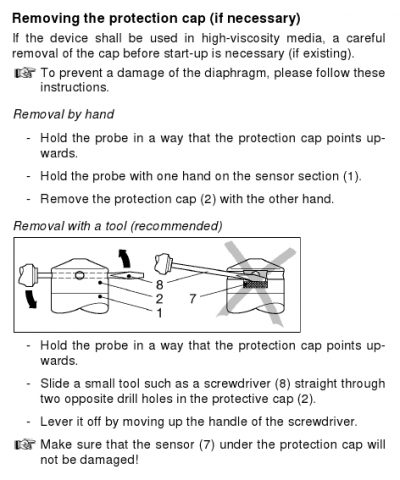
Yes, the LMK 382 is specifically designed for viscous, pasty, and highly contaminated media. To prevent sludge accumulation around the sensing head, the standard POM-C protective nose cone can be pulled off by hand or levered off using a small screwdriver inserted through the cap’s drill holes. Removing the cap exposes a flush-mount 99.9% Al2O3 ceramic diaphragm, enabling immediate media contact and self-cleaning performance.
Bend radius of cable
What is the bend radius of the cable that will need to be maintained?
For static installation use the 10-fold cable diameter, for dynamic applications use the 20-fold diameter.
212F pool temperature
My application requires a device that can be lowered into a pool that will increase in temperature to 212F?
The maximum allowed temperature for the LMK 382 is 257F with the TPE cable option.
15ft cable length weight
The probe will be lowered into a pool down to a depth of 15ft, will the weight be too much?
There will be no noticeable effect on performance when installing ot a depth of 15 feet.
Removing nose cone
Is the submersible cone on the LMK382 removable and will it have a deleterious effect if removed?
Yes, if you remove the nose cone carefully as described in the operating manual it will not cause any harm or damage to the sensor.
However an exposed flush diaphragm will be vulnerable to mechanical damage so we only recommend removing just before installing.
Absolute range
Is it possible to make an absolute version of the LMK382 submersible waste water pressure transmitter?
Yes, although it is not mentioned on the data sheet currently, it is possible to provide absolute ranges as a custom option from 1 bar up to the maximum range of 10 bar absolute.
Fitting tapered threads with flush diaphragm
Is it possible for the threaded flange mount version of the LMK382 flush level transmitter to be provided with a tapered thread on the outside of the transmitter, instead of the standard parallel thread?
Sorry no, not for the LMK382, generally it is not possible to use tapered threads with an exposed flush sensing diaphragm due to the close proximity of mechanical stresses generated by tightening this type of thread. The induced stresses on the diaphragm can affect calibration settings, particularly with low pressure ranges, and in worst cases cause the sensing diaphragm to fail.
Flange size options
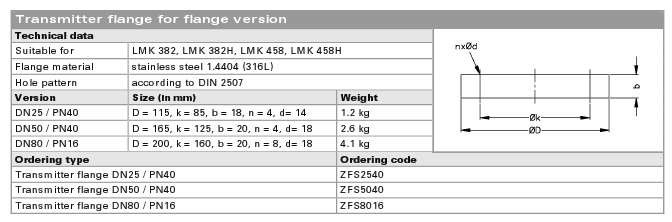
We would like to use the LMK382 waste water hydrostatic level transmitter for measuring the amount of sludge inside a storage tank. We intend to install it using the flange version, but can the sensor be supplied with a flange or do we have to find a separate supplier for this?
The flange can supplied as a separate item for screwing onto the LMK382 sensor, you can choose from 3 different flanges: DN25, DN50 or DN80, as described in the table below.
Operating in intrinsically safe hazardous areas
What parameters and barriers are required when installing the probe in Zone 0 or Zone 20 explosion-hazard zones?
For hazardous area installation, the intrinsically safe variant (Ex ia) must be selected. It carries ATEX certifications II 1G Ex ia IIB T4 Ga for Zone 0 gas and II 1D Ex ia IIIC T110°C Da for Zone 20 dust environments. The probe must be connected via an ungrounded, galvanically isolated power supply or certified Zener barrier meeting safety parameters Ui = 28 V, Ii = 93 mA, Pi = 660 mW, Ci = 14 nF, and Li ≈ 0 µH. System loop calculations must verify that terminal voltage at the probe remains above 14 VDC under full 20 mA signal conduction.
150°F water temperature
I’m looking for a submersible water level sensor which will operate in water temperatures of 150 degrees Fahrenheit, and measure over 0 to 2 ft?
Since the temperature is close to the maximum limit for PUR and PVC cable, we would recommend the TPE cable option which is suitable for water temperatures up to 257 degrees Fahrenheit. Also the LMK 382 can be custom scaled to a range of 0 to 2 feet of water column.
- SKU ID: s1-lmk382-0002
- Pressure Range: 2
- Units: ftH2O
- Reference Type: Gauge / Vented (atm to +P)
- Output Signal: 4-20mA, 2 wire
- Accuracy: 0.35% FS
- Installation Type: Probe version with nose cone
- Housing Material: Stainless Steel 316L
- Diaphragm Material: Ceramic Al2O3 99.9%
- Media Exposed Seals: FKM
- Cable Type: TPE (125degC max)
- Cable Length: 6
- Cable Length Units: Feet (ft)
Ensuring accurate atmospheric pressure compensation
How does the integrated vented cable function, and what precautions are necessary during installation?
Relative pressure measurement relies on an integrated capillary ventilation tube running internally through the sensor cable to reference ambient atmospheric pressure against the rear of the ceramic diaphragm. A protective PTFE filter is fitted at the cable end to block moisture and airborne dust. The cable end must be terminated inside a dry junction box free from condensing moisture or corrosive fumes. The PTFE filter must never be removed, damaged, or kinked, as blockages cause signal drift and moisture ingress leads to sensor failure.
Flange fitting on sensor
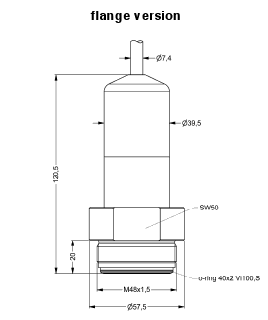
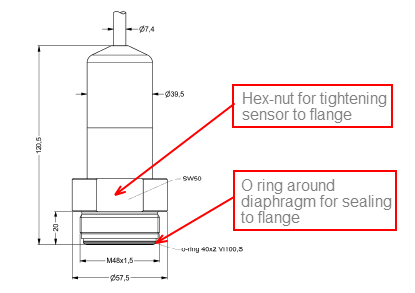
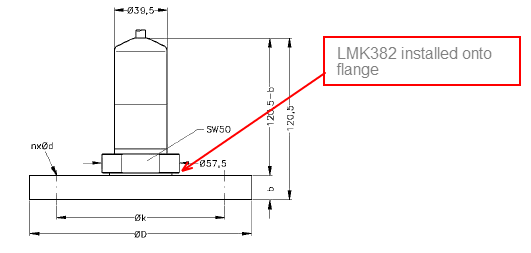
The LMK382 wastewater pressure transmitter technical datasheet appears to show a parallel thread that screws into a flange with a tapped hole and a back-nut to lock the sensor in place. Please could you clarify if this is how the two parts are joined together?
Please see the sketches below which show how the sensor is mounted onto the flange, it seals on the front O ring, and the fixed back-nut is for tightening the sensor onto the flange.
Diesel compatibility
The LMK382 low range submersible level sensor product page suggests that the sensor is for installing in water, so I was wondering whether it will need any additional certification to operate in diesel and will it affect the service life of the sensor?
Additional certification is only required if the area that it is being installed is classified as a hazardous area (potentially explosive). The normal service life will not be affected by immersion in Diesel.
Grubby rain water
Can the LMK382 be used with grubby rain water?
Yes, this sensor has a flush diaphragm under the nose cone so it can be installed with or without the nose cone, and easily cleaned either way if it becomes clogged.
Safe cleaning procedures for ceramic diaphragms
How should a contaminated or scaled ceramic diaphragm be cleaned without causing damage?
If the probe displays zero-point shift or media buildup, clean the outer housing using a moist cloth and non-aggressive cleaning solution. The high-purity Al2O3 ceramic diaphragm is extremely hard but sensitive to point impact. Never use sharp tools, metal scrapers, wire brushes, or high-pressure air guns to clean the diaphragm, as mechanical scratching causes irreparable failure that is excluded from warranty coverage. For heavy mineral scaling, factory decalcification and recalibration service is recommended.
Related Documents
Specification data sheet
Request Product Price
Please select the options you require for the LMK382 Low Range IP68 Waste Water Level Transmitter in your application and request a quote.