
Any pressure transducer which relies on a force collecting diaphragm for sensing pressure, will be sensitive to a change in orientation.
A pressure transducer diaphragm is designed to flex when a force is applied to it. If the diaphragm is orientated horizontally it will sag slightly under the force of its own weight. If the diaphragm is then flipped upside down it will sag in the opposite direction. The movement in the diaphragm will translate as a slight change in pressure when monitoring the output signal of the device.
The offset generated by a change of diaphragm orientation is commonly called the G Effect, since the force causing the offset is due to the gravitational pull on the diaphragm.
In high pressure transducers the diaphragm’s sensitivity to orientation is very small and almost undetectable, but in low ranges where the diaphragm has a comparatively larger surface area to thickness ratio, it is significant enough to be a noticeable effect on the sensor performance.
Since the G effect is a static value at a particular orientation the offset error can be easily trimmed out as long as the pressure transducer position is fixed.
For low range pressure transducers with a high measurement accuracy, it is usual to indicate the orientation of the device during factory calibration by adding a reference mark on the transducer body or to indicate it on the calibration report.
Featured hydrostatic pressure measurement products
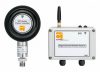 IWPT Wireless Battery Powered Pressure Sensor and Receiver - Wireless battery powered pressure sensor and receiver system for connecting pressure sensors without wires to a central wireless receiver which converts each received pressure signal channel to a 1-5Vdc, 4-20mA output, USB, Ethernet TCP, RS232 RTU, RS485 RTU or 2G 3G 4G mobile cellular network.
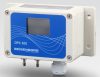 DPS300 User Switchable Pressure Range, Volts or Current Output Low DP Sensor - The DPS 300 is a low range HVAC differential pressure sensor. The lowest possible pressure range is 0...100 pascals. 2 or 3 switchable pressure ranges, plus volts or current output are included with most standard configurations.
Related Help Guides
- Measuring the difference in air pressure between rooms
- What affects the performance of low pressure sensors
Related Technical Terms
- g Effect
- inH2O – Inches of Water Column at 4 deg C Pressure Unit
- mmH2O – Millimetres of Water Column at 4 deg C Pressure Unit
- oz/in² – Ounce per Square Inch Pressure Unit
- Pa – Pascal Pressure Unit
Related Application Questions and Answers
- Low range vacuum pressure logger for 0 to -60 inH2O g
- Argon gas compatible pressure sensor for measuring up to 100 mbar
- Using 25 mbar DP sensor on vacuum below 0.2 bar absolute
- Low range ATEX approved 100 Pascal range DP transmitter
- Biogas HDPE cover PD blower pressure sensor
- Four cleanroom zones monitoring system to measure overpressure, temperature & humidity
- Stainless steel 316L wetted parts 100 mbar ATEX pressure transmitter
- Solvent compatible +/-100mWG dp transmitter with PTFE seals
- Low delta P sensor with 200mmH2O range and response time < 5ms
Contact us about this How Gravity affects the performance of Pressure Transducers page to request more information, or to discuss your application requirements.