
When selecting pressure sensor options, occasionally you will come across a choice of seal materials to choose depending on the sensor design.
An all welded construction provides a high integrity and homogeneous material design. The main disadvantages of this kind of sensor design is the lack of flexibility to customise for different applications, induced measurement errors from mechanical stresses caused by the welding process and higher manufacturing costs.
A sensor design that incorporates a standardised pressure sensing capsule which clips into place enables product designers to easily adapt it to a multitude of custom fittings. This helps to keep manufacturing lead time to a minimum and allows rapid development of new designs.
Featured pressure sensor products
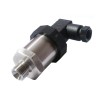 IMPLR Low Range All Stainless Steel OEM Pressure Sensor - Low cost sensor for measuring small pressure ranges from 0-50 mbar (10 inH2O) to 0-1000 mbar (15 psi) of liquids or gases.
 DMP320 0.5 msec Fast Response Pressure Sensor - High frequency response pressure sensor with a better than 0.5 millisecond response time and internal digital signal conditioning that samples readings at a rate of 10 kilohertz.
One of the problem areas in sensor design is the effect on sensor performance following the rigid bonding of the process connector housing directly to the sensing element. Welding introduces heat into the construction which causes mechanical stress that relaxes over time causing incremental drift in measurement. Bonding with industrial adhesives also build in mechanical stress as the bond dries during manufacture and degrades over its service life with changes in temperature and pressure.
Using an elastomer material to seal between the sensing element and the pressure connector housing prevents the need to expose the assembly to stresses that result from a welded or glued joint. As there are no fixed seals in this design it is possible to quickly assemble without any intricate welding, cleaning and de-stressing processes. This type of sealing arrangement also opens up the choice of materials the design engineer is able to use without having to worry about the implications of welding or bonding together dissimilar materials.
There are many types of elastomer material such as Silicone, NBR/Buna-N, Viton / FKM, EPDM, Kalrez / FFKM and Chemraz. All have there own distinct properties making them the most suitable for certain operating temperatures and media types. This is why many sensors of this type of construction require the selection of a seal material to ensure media compatibility.
Featured pressure sensor products
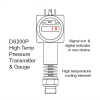 16 bar, 200°C steam pressure transmitter and gauge - Combined pressure transmitter and indicator in one package with the option for use with high temperature media such as steam at 200°C
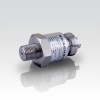 Low operating temperature plus/minus 1 psi pressure transmitter - Reliable pressure measurements down to -40°C. Ideal for low range applications with a -1 to +1 psi gauge range.
Related Help Guides
- Symptons and Causes of Damage to Pressure Transducer Diaphragms
- Process Connections
- Measuring the Pressure of Hot Media
- How Gravity affects the performance of Pressure Transducers
- Why are Submersible applications so demanding of Pressure Transducers?
- Are all IP68 Water Resistant Protection Ratings the same
Related Technical Terms
- Al2O3
- BFSG – Bonded Foil Strain Gauge
- Bonded Seal
- Bourdon Tube
- Burst Pressure
- Dry Cell
- Dry/Dry
- Food Grade
- g – Acceleration due to Gravity
- g Effect
- Hysteresis
- Isolation Diaphragm
- LVDT – Linear Variable Differential Transformer
- M10 x 1
- Mechanical Stop
- MTBF – Mean Time Between Failures
- Piezoresistive Strain Gauges
- Stainless Steel Pressure Sensors
- Static Line Pressure
- Wet/Dry
- Wet/Wet
- Wetted Parts
- Wheatstone Bridge Strain Gauge
Contact us about this Why do you have to select an elastomer seal material for some types of pressure sensor? page to request more information, or to discuss your application requirements.