
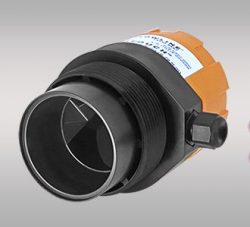
 Ultrasonic echo sounding sensors for measuring liquid level and converting it to an electrical signal to send to other instrumentation.
Ultrasonic liquid level sensors are contactless measurement devices which transmit and receive high frequency acoustic waves to measure the distance to the surface of a liquid based substance.
Featured liquid level measurement products
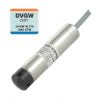

Ultrasonic liquid level sensors are contactless measurement devices which transmit and receive high frequency acoustic waves to measure the distance to the surface of a liquid based substance.
Ultrasound liquid level sensor technology transmits a high frequency sound wave pulse and receives the wave echo reflected off a liquid surface. The time taken for the acoustic pulse to traverse the distance between the transmitter and target surface, and back again to the receiver is measured.
The distance (d) between the ultrasonic liquid level sensor and the liquid surface can be calculated by dividing the time taken (t) by two, and multiplying that by the speed of sound (c) in air, i.e. d = c ∙ t / 2. The liquid level in a tank (LT) can then be determined by subtracting distance (d) from the height of the ultrasonic level sensor (HT), i.e. LT = HT – d.
The performance of a ultrasonic level sensor is mainly affected by changes in the speed of sound and disturbances on or above the surface of the liquid.
The speed of sound will change if the air density changes. Since air density changes in the Earth’s atmosphere are directly related to changes in air temperature (measured in Kelvins), an ultrasonic fluid level sensor is compensated by incorporating an air temperature sensor.
Featured liquid level measurement products
Surface effects can be reduced by experimenting with the position of the device, installing within a stilling well or wave guide, and some ultrasonic devices include features to minimise the effects of foaming, bubbles, vapour and turbulence.
Since there is no contact with the fluid to be measured, ultrasound liquid level measurement technology can be used in applications where sensors requiring contact are otherwise prohibited. These sensors have no moving parts which makes them very reliable, requiring very little maintenance.
Ultrasonic liquid level sensors are typically housed in a single assembly combining the acoustic transmitter and receiver in one device.
An ultrasonic liquid level sensor is an instrument for measuring the height of a liquid and converting it to an electrical signal. The liquid level signal output can then be utilised by other instrumentation to display, monitor, log or control the liquid level.
Since ultrasonic liquid level sensors are contactless, they are mounted above the surface of the liquid in the top of a tank or from a platform spanning the top of an open tank.
Featured liquid level measurement products
Advantages
- No media contact for vertically mounted type, so flexibility for use on different corrosive media, thick fluids, slurries, wastewater
- High temperature fluid compatibility for vertically mounted types, since no sensitive components make contact with the fluid
- High accuracy due to high frequency pulse wave and precise transit time time measurement
- Operates with conductive or non-conductive fluids
- Sealed pressurised vessel will not affect performance
- Shorter blocking distance than radar
Disadvantages
- Foaming, splashing, vapour and humidity can affect measurement performance
- High cost compared to other technologies
- Top mounting only
- Minimal blocking distance limits operation when in proximity to liquid level
- Temperature compensation required to compensate for speed of sound variation with air temperature
- Sound waves cannot be transmitted through a vacuum
- Shorter range than radar
Featured liquid level measurement products
Related Help Guides
- Measuring liquid level in a sealed tank with a hydrostatic pressure sensor
- Determining the hydrostatic pressure range for a tank level sensor
- Measuring liquid level in a tank using a dp sensor
- Difference between vented and non-vented water level measurement
- How do you measure the volume of a liquid using pressure
- Determining water tank volume using hydrostatic pressure
Related Product and Application Guides
Related Technical Terms
- Capacitive Fluid Level Measurement
- cmH2O – Centimetres of Water Column at 4 deg C Pressure Unit
- Conductive Fluid Level Detection
- Float Fluid Level Detection
- ftH2O – Feet of Water Column at 4 deg C Pressure Unit
- Hydrostatic Pressure
- Liquid Level Sensors
- mH2O – Metres of Water Gauge at 4 deg C Pressure Unit
- mmH2O – Millimetres of Water Column at 4 deg C Pressure Unit
- Specific Gravity
- Vibrating Tuning Fork Fluid Level Detection
Related Online Tools
- Liquid Level to Hydrostatic Pressure Calculator
- Fluid Depth, Density, Gravity, and Pressure Calculator
- Liquid Level Transmitter 4-20mA Current Output Calculator
- Vertical Cylindrical Shaped Tank Contents Calculator
- Horizontal Cylindrical Shaped Tank Contents Calculator
- Rectangular Shaped Tank Contents Calculator
Contact us about this Ultrasonic Liquid Level Sensors page to request more information, or to discuss your application requirements.