
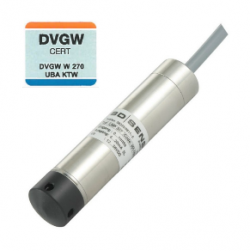
Submersible level transmitter for measuring liquid level with a 4-20mA current loop or a 0-10V voltage output plus optional ATEX approval for intrinsically safe use in hazardous areas in ranges from 1mH2O up to 250mH2O. The LMP307 is suitable for use on potable water with no leaching, and can be supplied with a drinking water certificate according to DVGW and UBA KTW.
Product Parameters
- Hydrostatic Level Ranges: from 1mH2O to 250mH2O gauge
- Accuracy: 0.35% full scale with optional 0.25% or 0.1% IEC60770
- Output Signal: 4-20mA, 0-20mA or 0-10Vdc, optional ATEX/IECEx and SIL2
- Electrical Connections: Submersible PVC, PUR, FEP, or TPE-U cable with IP68 ingress protection
- Pressure Connection: Protective self draining nose cone
- Media Compatibility: Stainless steel 316L body / diaphragm, FKM or EPDM seal gasket plus selected cable jacket
- Dimensions: 27mm dia
- Weight: 200 g without cable
- Special Options: Drinking water certificate to DVGW W 270 & UBA KTW, ATEX and IECEx approved for intrinsic safety, IP66 cable termination enclosure (4-20mA, 2wire only), SIL2 electronics, temperature measurement, RS485 interface, petrol version
Product Description
The LMP307 is a high-performance submersible level transmitter engineered for continuous hydrostatic level measurement in water, clean or lightly polluted fluids, and fuel or oil storage environments. It offers a versatile nominal pressure range spanning from 0 … 1 mH2O up to 0 … 250 mH2O with a slim 26.5 mm housing diameter, making it ideal for tight containment installations. The sensor operates with standard 2-wire 4 … 20 mA or optional 3-wire 0 … 20 mA and 0 … 10 V output signals, and provides an outstanding standard accuracy of 0.35% FSO, with high-precision options down to 0.1% FSO. Designed for long-term electrical and structural reliability, this robust stainless steel probe is customizable with multiple elastomer seals, specialized cable sheaths, intrinsically safe explosion protection, and safety integrity certifications.
The core of this submersible level probe is a premium stainless steel pressure sensor optimized for exceptional long-term stability and small thermal effects across its operating compensated range of 0 to 70 °C. Enclosed in a robust stainless steel 1.4404 (316L) housing with a stainless steel 1.4435 (316L) diaphragm, the sensor body is engineered to withstand deep submersion and demanding pressure conditions, supporting a maximum ambient housing pressure of up to 40 bar. A removable POM-C protection cap shields the diaphragm from physical damage during deployment and handling without restricting fluid contact.
For seamless integration into industrial control networks, the probe supports standard 2-wire current loops as well as 3-wire voltage or current architectures, backed by comprehensive permanent short-circuit protection and reverse polarity resilience. Engineers can configure the probe for specialized environments, such as a welded pressure sensor and housing assembly designed explicitly as a petrol-version, or an option prepared for rigid mounting with a stainless steel pipe instead of a suspended cable. For high-consequence safety applications, an optional SIL 2 configuration compliant with IEC 61508 and IEC 61511 provides validated functional safety data for low-demand safety loops.
To ensure accurate gauge pressure readings relative to changing atmospheric conditions, the device utilizes a shielded connection cable equipped with an integrated ventilation tube. The choice of cable sheath material allows the probe to be tailored to specific media temperatures and chemical exposures: grey PVC for cost-effective standard applications (-5 to 70 °C), black PUR for superior mechanical durability (-10 to 70 °C), black FEP for high chemical resistance in fuels (-10 to 70 °C), or blue TPE-U for drinking water installations (-10 to 70 °C). Additionally, an external overvoltage protection unit can be integrated within a terminal box to safeguard the installation from electrical surges or lightning strikes.
Product Features
The LMP307 submersible level transmitter is designed for reliability and versatility, offering a robust, high-precision solution for a wide range of hydrostatic level measurement applications, from municipal water management to critical industrial control loops. It features specialized certifications and adaptable configurations to ensure seamless, long-term performance in demanding environments.
Slim 26.5 mm Housing Profile
The 26.5 mm diameter housing provides a streamlined form factor that enables easy installation in space-restricted environments, including narrow-diameter boreholes, standpipes, and confined containers. This profile ensures that deployment remains straightforward even in infrastructure where clearance is a primary constraint.
High-Precision Measurement Options
To meet the requirements of sophisticated control loops, the probe supports standard accuracy levels, as well as high-precision tiers of 0.25% FSO and 0.1% FSO. These options provide the exact measurement capability needed for critical processes where minimal deviation is required for optimal system operation.
Intrinsically Safe Explosion Protection
For installations in hazardous locations, the sensor includes optional intrinsically safe configurations (ATEX/IECEx Ex ia). These protections ensure the device operates safely in gas and dust environments defined as Zone 0 and Zone 20, meeting the strict regulatory standards required for volatile industrial settings.
SIL 2 Functional Safety Integration
Designed for safety-critical applications, the transmitter offers optional SIL 2 capability in accordance with IEC 61508. This feature allows for seamless integration into safety-instrumented industrial systems, providing the necessary functional safety data required for compliance and risk management in high-consequence processes.
Drinking Water Compliance
To support municipal utilities, the probe offers approved configurations that meet DVGW and KTW drinking water standards. These options ensure full compliance and material safety for deployment in drinking water treatment, storage, and supply networks, safeguarding water quality throughout the infrastructure.
Reliable Atmospheric Pressure Reference
The shielded connection cable features an integrated ventilation tube that provides a precise, continuous reference to atmospheric pressure. This design ensures accurate gauge pressure readings while simultaneously filtering out electromagnetic interference, resulting in cleaner and more dependable signal data.
Long-Term Sensor Stability
The transmitter is engineered for excellent long-term stability and minimal thermal offset, ensuring consistent performance over extended service cycles. By minimizing the drift caused by temperature fluctuations or environmental aging, the sensor provides reliable data that reduces the need for frequent recalibration or maintenance.
Product Applications
The LMP307 level transmitter is a versatile solution suitable for a broad spectrum of liquid level monitoring tasks. Its robust design and material compatibility allow it to be deployed effectively across municipal, environmental, and industrial sectors where continuous, reliable hydrostatic measurement is required.
Environmental and Geological Monitoring
Ideal for groundwater level monitoring and precise borehole depth measurements, this transmitter provides critical data for environmental research and geological surveys. Its stability ensures consistent readings in remote or inaccessible locations.
Flooded vault water level
Use this sensor to measure the water level when a vault becomes flooded. The sensor can be installed in a dry location at the lowest point in the vault which is likely to be flooded. As soon as water starts to flood the underground chamber and rise over the top of the sensor probe it will begin to detect and measure the hydrostatic head of water above its position.
- SKU ID: s1-lmp307-48-40127
- Sensor Type: Level only
- Level Sensing Range: 0 to 30
- Units: ftH2O
- Reference Type: Gauge / Vented (atm to +P)
- Output Signal: 4-20mA, 2 wire
- Accuracy: 0.35%FS (11-12bit res)
- Installation Type: Submersible probe with flush diaphragm and detachable nose cone
- Housing Material: Stainless Steel 316L
- Diaphragm Material: Stainless Steel 316L
- Media Exposed Seals: FKM
- Cable Type: PVC (70degC max)
- Cable Length: 40
- Cable Length Units: Feet (ft)
Municipal Water Infrastructure
Designed for use in drinking water supply networks, storage containers, and municipal filtration facilities, the probe offers reliable level sensing while adhering to high-standard safety compliance requirements for water quality.
Water Management and Flood Control
The transmitter is well-suited for integration into rain spillway basins, flood protection systems, and water recycling management facilities, providing real-time level data necessary for effective water resource management and safety monitoring.
Industrial Pump and Treatment Control
For utility infrastructure such as pump control systems, water treatment plants, and booster stations, the LMP307 delivers the precise measurement needed to automate processes and maintain optimal operational efficiency.
Deep well pump shut off
Monitoring level of water above a deep well pump to determine pump shut off point.
- SKU ID: s1-lmp307-0004
- Part No: 451-4001-1-1-1-1-3-2-050-000
- Sensor Type: Level only
- Level Sensing Range: 0 to 40
- Units: mH2O
- Reference Type: Gauge / Vented (atm to +P)
- Output Signal: 4-20mA, 2 wire
- Accuracy: 0.35%FS (11-12bit res)
- Installation Type: Submersible probe with removable nose cone
- Housing Material: Stainless Steel 316L
- Diaphragm Material: Stainless Steel 316L
- Media Exposed Seals: FKM
- Cable Type: PUR (70degC max)
- Cable Length: 50
- Cable Length Units: Metre (m)
Fuel and Petroleum Storage
With options for chemical-resistant cabling and robust housing materials, the probe is highly effective in fuel storage systems, petroleum tank farms, and commercial oil containment, ensuring safe and accurate monitoring in potentially hazardous environments.
Wastewater and Drainage Handling
Suitable for challenging wastewater environments, this transmitter provides dependable tracking for filtrated sewage management and drainage systems, maintaining measurement integrity even in applications involving polluted or treated fluids.
Petrol filling station management
Level monitoring of the different fuel containers using the LMP307 with welded seals to improve reliability.
Yacht grey water tank
Measure the level of grey water tank which holds waste water from a yacht’s galley sink, shower, washing machine and dish washer.
- SKU ID: s1-lmp307-0001
- Part No: 451-1000-1-1-1-1-5-2-003-000
- Sensor Type: Level only
- Level Sensing Range: 0 to 1
- Units: mH2O
- Reference Type: Gauge / Vented (atm to +P)
- Output Signal: 4-20mA, 2 wire
- Accuracy: 0.5% FS (11-12bit res)
- Installation Type: Submersible probe with removable nose cone
- Housing Material: Stainless Steel 316L
- Diaphragm Material: Stainless Steel 316L
- Media Exposed Seals: FKM
- Cable Type: PUR (70degC max)
- Cable Length: 3
- Cable Length Units: Metres (m)
Product Specifying Guide
Step 1: Establish the measurement range
Identify the total hydrostatic column or pressure depth required for your application, selecting from standard nominal ranges between 0 … 1 mH2O and 0 … 250 mH2O. Cross-check that the maximum possible liquid height does not exceed the designated overpressure limit of the sensor to prevent calibration shift or structural fatigue.
Step 2: Select the appropriate output signal
Choose an electrical interface that matches your control instrumentation, opting for the standard 2-wire 4 … 20 mA loop or 3-wire configurations providing 0 … 20 mA or 0 … 10 V. If the installation involves safety-critical loops or explosive atmospheres, specify the SIL 2 or intrinsically safe (IS) electrical configurations.
Step 3: Choose seal materials and design variants
Select the elastomer seal compound exposed to the fluid, choosing standard FKM for general applications or EPDM for drinking water systems. Alternatively, select the welded version without any elastomer seals for maximum fluid compatibility in applications like fuel storage.
Step 4: Define the required accuracy grade
Determine the precision level necessary for your process engineering requirements, utilizing the standard 0.35% FSO accuracy or choosing upgraded 0.25% FSO or 0.1% FSO precision parameters. Note that ranges below 0.4 bar have a standard accuracy baseline of 0.5% FSO.
Step 5: Specify cable insulation and required length
Match the connection cable sheath to the fluid properties and temperature profile, picking PVC, PUR, chemical-resistant FEP, or certified TPE-U. Calculate the total deployment depth to define the exact cable length in meters or feet, ensuring it includes enough slack to reach the terminal box connection.
Part Number Builder
Generate or decode LMP 307 ordering code
Installation & Operation Guide
Step 1: Perform pre-installation handling and inspection
Keep the level transmitter inside its original packaging until immediately before mounting to prevent premature damage to the diaphragm or threads. Inspect the product label to verify that the ordered pressure range, output signal, and supply voltage specifications match your site electrical drawings.
Step 2: Secure the probe body with accessories
Mount the probe using certified accessories such as terminal clamps or mounting flanges, ensuring the housing is suspended straight and firmly anchored. Position the sensor head to eliminate any possibility of rubbing or bumping against container walls due to fluid turbulence or flow conditions.
Step 3: Submerge the probe into the medium
Lower the probe slowly and steadily into the process fluid. Do not drop the transmitter or allow it to slam into the liquid surface, as the instantaneous hydrodynamic impact can permanently deform or destroy the thin stainless steel diaphragm.
Step 4: Complete electrical wiring and shield grounding
Connect the conductor lines according to the standard terminal layout, ensuring the white wire connects to positive supply, the brown wire to negative supply, and the green wire to the signal line on 3-wire models. Terminate the cable shield to earth potential at the terminal box using proper low-impedance grounding clamps to establish overvoltage and lightning protection.
Step 5: Implement equipotential bonding
Establish a robust equipotential bonding network across the measuring system to eliminate potential differences between the probe grounding location and the connection points. Unresolved differences in earth potential can induce stray currents that cause severe electronic malfunctions or terminal damage to the sensor.
Step 6: Power on and complete commissioning
Apply an appropriate direct current supply voltage, ensuring a range of 8 … 32 VDC for standard 2-wire installations. Monitor the initial current or voltage output to verify standard operation, keeping in mind that high-accuracy 0.1% FSO versions utilize internal microcontroller electronics which process values over short step intervals rather than a continuous analog sweep.
Product Help
Available pressure and level ranges
What are the available nominal pressure and level sensing ranges for this level probe?
This series provides nominal level measurement ranges from 0 … 1 mH2O up to 0 … 250 mH2O, which correspond to gauge pressure inputs from 0.1 bar up to 25 bar. Custom ranges can be evaluated upon request.
Compatible process fluids
What types of liquids are compatible with this submersible transmitter?
The stainless steel probe is optimized for continuous level measurement in water, clean or lightly polluted liquids, filtrated sewage, ground water, and drinking water systems. It can also be configured with an FEP cable and a welded housing to safely measure fuels and oils in tank farms.
Construction and wetted materials
Which wetted materials are utilized to ensure chemical resistance?
The probe is built with a stainless steel 1.4404 (316L) housing, a stainless steel 1.4435 (316L) measurement diaphragm, and a removable POM-C protection cap. Internal wetted seals can be specified in FKM or EPDM, while the cable sheath is available in PVC, PUR, FEP, or TPE-U.
Hazardous area certification options
Can this level transmitter be used in explosive atmospheres?
Yes, an optional intrinsically safe version (IS-version) is available for gas and dust environments. It features ATEX and IECEx certification for zone 0 (II 1G Ex ia IIC T4 Ga) and zone 20 (II 1D Ex ia IIIC T135 °C Da) compliance.
Requirements for drinking water compliance
How do I order a version certified for municipal drinking water systems?
For drinking water applications, the transmitter must be specified with an EPDM seal combined with a blue TPE-U cable sheath to achieve DVGW and KTW compliance certificates. Please note that this drinking water configuration cannot be combined with the intrinsically safe explosion protection version.
Atmospheric pressure compensation
Is there a compensation for atmospheric pressure in this sensor?
These sensors have a vent tube running through the cable, this will vent the rear of the sensor diaphragm to the atmospheric pressure at the surface where the other end of the cable is terminated. The sensor will therefore self-compensate for changes in surface air pressure, without the need for a separate barometric pressure sensor and additional electronics.
Intrinsically safe barriers
Is a barrier is required, and if there is a specific one recommended or should we use a standard one?
If you are installing in a hazardous area then the intrinsically safe approved version will need to be installed with a barrier. A particular barrier is not specified, so any will be fine as long as they do not allow the maximum safety values to of Ui = 28 V, Ii = 93 mA, Pi = 660 mW, Ci ≈ 0 nF, Li ≈ 0 µH to be exceeded.
Motor yacht diesel tank level
We have a motor yacht with 2 diesel tanks, both approximately 2m tall and both have a capacity of 2500. They are currently installed with ultrasonic senders on the tank lids, however these are proving to be quite unreliable when the fuel level approaches 50%. I am investigating an alternative method of reading the tank capacity. Given this explanation, is this product the correct part for what I’m trying to achieve?
Yes it’s quite common to utilise hydrostatic pressure measurement to determine level in fuel, wastewater and ballast tanks on ships and yachts.
The LMP307 is more suited to land based applications, however if marine approval is not required then there is no reason why the LMP307 could not be used in this particular application.
The LMP307 would be suspended from the top of the tank and lowered to the bottom preferably supported a few inches from the bottom away from sediment and to prevent it moving around.
As an alternative the LMK458 is purpose designed for marine applications to measure fuel, wastewater, ballast and liquid cargo.
- SKU ID: s1-lmp307-92-36992
- Sensor Type: Level only
- Level Sensing Range: 0 to 2
- Units: metres of diesel column
- Reference Type: Gauge / Vented (atm to +P)
- Output Signal: 0-10Vdc, 3 wire
- Accuracy: 0.35%FS above, 0.5% FS below 4mH2O (11-12bit res)
- Installation Type: Submersible probe with flush diaphragm and detachable nose cone
- Housing Material: Stainless Steel 316L
- Diaphragm Material: Stainless Steel 316L
- Media Exposed Seals: FKM
- Cable Type: FEP (70degC max)
- Cable Length: 5
- Cable Length Units: Metres (m)
Diesel compatibility
Is this sensor compatible with diesel liquid?
Yes, this sensor is compatible with diesel, and we would suggest selecting either PVC or FEP for the cable material.
Installed position
Should the sensor be inserted vertically into the bottom of the tank?
The sensor can be installed laying on the base of the tank or suspended from the cable floating just above the bottom of the tank.
Modbus RTU protocol
Is this sensor compatible with a standard modbus RTU serial interface?
There is a dedicated product for use with a Modbus RTU protocol interface called the DCL 531, which is a like for like alternative to the analogue output LMP 307.
Drinking water
Is it possible to supply the LMP 307 with a health certificate for use on potable water?
When the LMP 307 is selected with the EPDM seal and TPE-U cable it can be certified for use on drinking water applications according to DVGW W 270 and UBA KTW.
Capillary cable
We have been instructed to use capillary cable to connect the sensor, but we have only ever used BS5308 standard instrument cable, so how is capillary cable different?
The capillary cable is another name for vented cable, this is a cable that has a breather tube running through it to provide an atmospheric pressure reference to the reverse side of the LMP 307 sensor.
10 metre range highest accuracy
What is the best accuracy possible for a 10 metre range LMP307?
The LMP307 has an improved accuracy option of 0.1% full scale, therefore a 10 metre range will achieve an accuracy of 0.01 metres, but this does not include errors associated with temperature changes or long term calibration drift.
RS485 interface
Is it possible to have a submersible level sensor with a RS485 interface?
Yes it is possible to specify a RS485 serial interface for the LMP 307 which is called the LMP 307i and has a special code on the end of the part number -141 along with an output signal code of 2D.
Update: The RS485 version of LMP 307 has now been replaced by the DCL 531.
2m diesel tank level with 2mm resolution
I am looking for a tank level transmitter for measuring diesel level up to 2 metres and I want to detect a 2mm change in level, what product do you suggest?
An LMP307 submersible level transmitter with this specification would provide a 4-20mA output signal with a 14 bit resolution (0.12mm) and 0.1% full scale accuracy (2mm).
Greywater compatibility
Is the LMP307 submersible water level transmitter compatible with greywater?
Yes the LMP307 is compatible with greywater and it is recommended to install the probe with the nose cone removed to prevent blockage.
ATEX approval
Does the LMP307 submersible level probe meet ATEX Class 1 Zone 2 requirements?
The LMP307 exceeds the requirements. Class 1 is not used as part of the European ATEX markings, but is most likely taken from the USA markings where Class 1 corresponds to a Gas environment approval. Zone 2 refers to the ATEX classification for Explosive atmosphere which maybe present during exceptional conditions for a short period of time.
The ATEX markings for the LMP307 are II 1 G Ex ia IIC T4 Ga, which is suitable for use in Gas Zone 0 which is a higher safety risk environment.
ATEX 1/21
I am looking to install a water level sensor in a tunnel running below a river and the area is rated at ATEX 1/21. I would like to know if the LMP307 would be suitable for this application.
Yes the LMP307 is ATEX approved for zone 0 hazardous gas environments or zone 20 hazardous dust environments which is a higher rating than zone 1/21.
120m deep artisian borehole recharge rate
We have a 120m deep artesian borehole with pump located at 70m depth. We are trying to establish the recharge rate of our borehole from the aquifer we are drawing from.
The LMP307 can be ranged to 120m water depth, and we suggest using the polyurethane cable option which incorporates strain relief which will prevent cable stretch on long cable drops, which affects depth calibration.
- SKU ID: s1-lmp307-0005
- Part No: 451-1202-1-1-1-1-3-2-130-000
- Sensor Type: Level only
- Level Sensing Range: 120
- Units: mH2O
- Reference Type: Gauge / Vented (atm to +P)
- Output Signal: 4-20mA, 2 wire
- Accuracy: 0.35%FS (11-12bit res)
- Installation Type: Submersible probe with removable nose cone
- Housing Material: Stainless Steel 316L
- Diaphragm Material: Stainless Steel 316L
- Media Exposed Seals: FKM
- Cable Type: PUR (70degC max)
- Cable Length: 130
- Cable Length Units: Metres (m)
Calibration out of the water
How do I calibrate the LMP307 submersible pressure transmitter when it is out of the water?
Like many submersible pressure transmitters used for water level measurement, a process connection is not necessary and can actually be detrimental to precise measurement, due to trapped air.
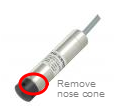
In order to calibrate the LMP307 out of the water, first you must prise off the nose cone to reveal the flush diaphragm underneath.
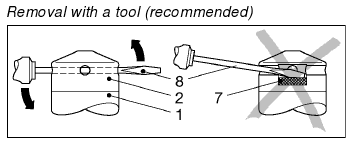
Then using the clamping fixture, the LMP307 can be sealed inside the metal cylindrical part, with an elastomer seal, by tightening the clamping part down onto the backend of the sensor around the cable exit. Care should be taken not to overtighten the wing nuts otherwise too much stress maybe applied to the front end sensing element. The assembly is now ready to be connected to a suitable pressure calibrator for testing.

High temperature diesel fuel level to 2m
Would I be able to use the LMP307 for measuring the level of high temperature Diesel fuel immersed a 2 metre high tank?
Yes the LMP307 has the option for FEP cable which is resistant to Diesel fuel, and the capability to measure lower range level such as a 2m depth fuel tank. The maximum operating temperature range for the LMP307 is 70 degC. If the temperature is higher than this then we would suggest the LMK382 instead with TPE cable, which is designed to tolerate up to 125°C.
Max measurement depth
What is the maximum measuring range in meters for the LMP307?
The maximum depth range is 250 metres.
Related Documents
Specification data sheets
Request Product Price
Please select the options you require for the LMP307 Submersible Level Transmitter in your application and request a quote.