
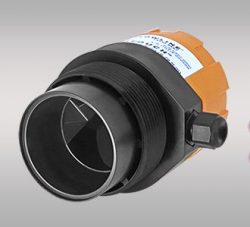
 Ultrasonic echo sounding sensors for measuring liquid level and converting it to an electrical signal to send to other instrumentation.
Ultrasonic liquid level sensors are contactless measurement devices which transmit and receive high frequency acoustic waves to measure the distance to the surface of a liquid based substance.
Featured liquid level measurement products
 Hydrostatic Level Sensors - Hydrostatic pressure sensing devices for measuring liquid level and converting it to an electrical signal to send to other instrumentation.
 Water Level Transmitters with 4-20mA Output - Browse for 4-20mA water level transmitters using two-wire loop power. Ideal for wells, tanks, rivers & reservoirs with excellent noise immunity & long cable runs.
Ultrasonic liquid level sensors are contactless measurement devices which transmit and receive high frequency acoustic waves to measure the distance to the surface of a liquid based substance.
Ultrasound liquid level sensor technology transmits a high frequency sound wave pulse and receives the wave echo reflected off a liquid surface. The time taken for the acoustic pulse to traverse the distance between the transmitter and target surface, and back again to the receiver is measured.
The distance (d) between the ultrasonic liquid level sensor and the liquid surface can be calculated by dividing the time taken (t) by two, and multiplying that by the speed of sound (c) in air, i.e. d = c ∙ t / 2. The liquid level in a tank (LT) can then be determined by subtracting distance (d) from the height of the ultrasonic level sensor (HT), i.e. LT = HT – d.
The performance of a ultrasonic level sensor is mainly affected by changes in the speed of sound and disturbances on or above the surface of the liquid.
The speed of sound will change if the air density changes. Since air density changes in the Earth’s atmosphere are directly related to changes in air temperature (measured in Kelvins), an ultrasonic fluid level sensor is compensated by incorporating an air temperature sensor.
Featured liquid level measurement products
 LMK382 Low Range IP68 Waste Water Level Transmitter - Submersible Low Range waste water level transmitter with intrinsically safe option for monitoring the level of sewage and effluent in water treatment plants.
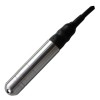 IWSL Potable Water Submersible Level Sensor - IP68 protect pressure sensor for monitoring potable water level to depths of 100 metres.
Surface effects can be reduced by experimenting with the position of the device, installing within a stilling well or wave guide, and some ultrasonic devices include features to minimise the effects of foaming, bubbles, vapour and turbulence.
Since there is no contact with the fluid to be measured, ultrasound liquid level measurement technology can be used in applications where sensors requiring contact are otherwise prohibited. These sensors have no moving parts which makes them very reliable, requiring very little maintenance.
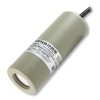
Ultrasonic liquid level sensors are typically housed in a single assembly combining the acoustic transmitter and receiver in one device.
An ultrasonic liquid level sensor is an instrument for measuring the height of a liquid and converting it to an electrical signal. The liquid level signal output can then be utilised by other instrumentation to display, monitor, log or control the liquid level.
Since ultrasonic liquid level sensors are contactless, they are mounted above the surface of the liquid in the top of a tank or from a platform spanning the top of an open tank.
Featured liquid level measurement products
- Submersible water level and temperature probe with SDI-12/USB interface for freshwater monitoring - Versatile 10m water level and temperature probe with USB and SDI-12 connectivity, designed for hydrological studies and long-term environmental monitoring programs.
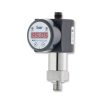 Hydrostatic Liquid Level Switches - Select hydrostatic level switches for precise threshold detection in tanks. Understand density effects, sealed tank solutions, and flush diaphragm benefits.
Advantages
- No media contact for vertically mounted type, so flexibility for use on different corrosive media, thick fluids, slurries, wastewater
- High temperature fluid compatibility for vertically mounted types, since no sensitive components make contact with the fluid
- High accuracy due to high frequency pulse wave and precise transit time time measurement
- Operates with conductive or non-conductive fluids
- Sealed pressurised vessel will not affect performance
- Shorter blocking distance than radar
Disadvantages
- Foaming, splashing, vapour and humidity can affect measurement performance
- High cost compared to other technologies
- Top mounting only
- Minimal blocking distance limits operation when in proximity to liquid level
- Temperature compensation required to compensate for speed of sound variation with air temperature
- Sound waves cannot be transmitted through a vacuum
- Shorter range than radar
Featured liquid level measurement products
- Aquaculture submersible freshwater level & temperature transmitter - Use this submersible dual output transmitter for monitor or controlling the water level and temperature of freshwater ponds & tanks used in aqua farming.
- S12S SDI-12 Coms IP68 Pressure and Temperature Sensor - Combined pressure and temperature sensor with a 1200 baud rate serial data interface as defined by the SDI-12 support group.
Related Help Guides
- Determining the hydrostatic pressure range for a tank level sensor
- Measuring liquid level in a sealed tank with a hydrostatic pressure sensor
- Difference between vented and non-vented water level measurement
- Determining water tank volume using hydrostatic pressure
- Measuring the volume of liquid in a horizontal cylinder tank
- Measuring liquid level in a tank using a dp sensor
- How do you measure the volume of a liquid using pressure
- Liquid Level Measurement
- How to determine milk tank level and volume from pressure
- Selecting the correct pressure sensor range for low-level applications
- Installing a submersible level sensor horizontally
- Measuring diesel level in shallow tanks
- Atmospheric pressure compensation for hydrostatic level sensors
- Determining the signal cable length of a suspended liquid level transducer
- Calculating required pressure range for fuel tank level measurement
- How does changes in Local Gravity affect Hydrostatic Pressure
- Using absolute pressure sensors to measure hydrostatic level
- Using a screw-in or waterproof pressure transmitter to measure liquid level
- Improve the electrical termination of vented submersible pressure sensors
- Considerations for monitoring Landfill Water Level
- Why are Submersible applications so demanding of Pressure Transducers?
- Are all IP68 Water Resistant Protection Ratings the same
- Converting non-vented depth readings & barometric pressure to true depth
Related Technical Terms
- Capacitive Fluid Level Measurement
- cmH2O – Centimetres of Water Column at 4 deg C Pressure Unit
- Conductive Fluid Level Detection
- Float Fluid Level Detection
- ftH2O – Feet of Water Column at 4 deg C Pressure Unit
- mH2O – Metres of Water Gauge at 4 deg C Pressure Unit
- mmH2O – Millimetres of Water Column at 4 deg C Pressure Unit
- Specific Gravity
- Vibrating Tuning Fork Fluid Level Detection
Related Online Tools
- Liquid Level to Hydrostatic Pressure Calculator
- Fluid Depth, Density, Gravity, and Pressure Calculator
- Liquid Level Transmitter 4-20mA Current Output Calculator
- Vertical Cylindrical Shaped Tank Contents Calculator
- Horizontal Cylindrical Shaped Tank Contents Calculator
- Rectangular Shaped Tank Contents Calculator
- Pressure to Liquid Level Calculator
Related Product and Application Guides
Related Application Questions and Answers
- HART flameproof (Ex d) re-scalable level transmitter for hydrostatic head up to 2 metres
- Dockside sea water tide level transmitter up to 6 metres depth
- Water tank level gauge transmitter with adjustable range
- Portable battery powered tank level gauge with submersible sensor
- Generator diesel tank height level sensor for 1 metre height
Contact us about this Ultrasonic Liquid Level Sensors page to request more information, or to discuss your application requirements.