
Conductive devices for monitoring liquid level and opening and closing switch contacts at predetermined liquid level thresholds.
A conductive liquid level switch is an instrument for monitoring the height of a liquid and tripping a relay contact switch or transmitting solid state relay switch output when a maximum, minimum or intermediate level has been reached. The liquid level switch output can then be utilised by other instrumentation to open a valve, illuminate a warning lamp, activate an audible alarm, or switch on a pump.
Featured liquid level measurement products
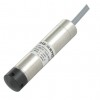 Water Level Transmitters with 4-20mA Output - Browse for 4-20mA water level transmitters using two-wire loop power. Ideal for wells, tanks, rivers & reservoirs with excellent noise immunity & long cable runs.
 18.605 G Low Cost Submersible Diesel Fuel and Water Tank Level Sensor - Low cost OEM diesel fuel or water level sensor for installing inside or outside a storage tank.
Conductive liquid level switches are threshold contact trip devices which typically consist of one or two metal rods extending out from the switch probe housing.
One of the metal rods has a custom length to reach the required liquid height.
The other metal rod extends down to a lower position, or alternatively the outer wall of a metal tank is used to complete the circuit.
When the liquid touches the custom length metal rod, the circuit is closed between the two electrodes.
Both electrodes are wired to an electrode controller module which maybe fitted within the probe housing or connected remotely. The controller will monitor the two electrodes and when the resistance changes, due to the liquid touching both electrodes, it will activate the switch contacts.
Additional liquid level switching thresholds can be achieved by incorporating more metal rods into the switch assembly, each one providing an additional level switching channel.
Featured liquid level measurement products
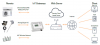 Tank level transmitter monitoring accessible globally via smartphone - Industrial solution for connecting your existing 4-20mA level transmitters to the internet. Enable global monitoring on your smartphone with live data, trends, and SMS alarms.
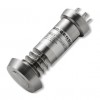 CIP protected dairy sensor for measuring level of milk in 6m high tank - Hygienic pressure sensor designed for CIP cleaning in dairy applications. Withstands harsh chemicals and high temperatures. Accurate and reliable level measurement in milk silos.
A conductive liquid level switch probe makes direct contact with the liquid to be measured, and therefore material compatibility has to be a consideration, but for most applications a stainless construction is more than adequate for most fluids.
Unlike capacitive type liquid level sensing probes, the conductive type works best with conductive liquid media.
Since the conductive level switch probe is essentially a stainless steel rod fitted to a tank, it is possible to construct the device to withstand high pressures so that it can be used on sealed pressurised tanks.
Also, since there is no sensitive components immersed in the fluid it is possible to use them on higher temperature media that would not be tolerated by other types of liquid level switch.
In comparison to other liquid level switch technology the conductive type is much easier to produce, and is often a much more economic option.
Conductive liquid level sensing probes are generally mounted through the top of a tank with the probe protruding into the tank.
Featured liquid level measurement products
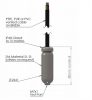 Generator diesel tank height level sensor for 1 metre height - Prevent generator downtime and fuel theft with this easy-to-install diesel level sensor. 0.5 to 4.5Vdc output for seamless integration with MCUs.
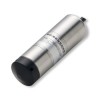 Submersible Hydrostatic Level Sensors & Probes - Explore submersible hydrostatic level sensors for continuous liquid level measurement. IP68 rated probes for tanks, boreholes, rivers & chemical compatibility.
Advantages
- Inexpensive product design, lowest cost type of liquid level switch
- Multiple switch points can be incorporated into one device
- No moving parts requiring regular inspection and maintenance, or leading to wear and tear
- Simple mechanical construction
- Works well with conductive media
- High temperature fluid compatibility, since there are no sensitive components making contact with the fluid
- Sealed pressurised or evacuated vessels will not affect performance
- SG & density insensitive
Disadvantages
- Some types may produce sparks when probe is in proximity to fluid
- Deterioration of probe tips due to residue, electrolytic effect or chemical corrosion leading to pitting, plating, or fouling
- Thick or sticky media will leave a coating on the probe creating an insulation layer causing malfunction
- Requires a higher voltage level across probes when used with less conductive liquids
- Probe protruding into liquid causing obstruction, attracting fouling and hygienic cleanliness issues
Featured liquid level measurement products
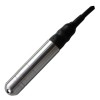 Wash water break tank submersible level transducer with 1.6 m range and 4-20mA output - Monitor wash water levels in break tanks with this submersible 4-20mA transducer. Features high accuracy, 5m vented cable, and robust design.
- 2 metre deep diesel tank level sensor for submersion - Ensure continuous operation of diesel powered equipment with this durable level sensor. Features FEP cable and 4-20mA output.
Related Help Guides
- Determining the hydrostatic pressure range for a tank level sensor
- Measuring liquid level in a sealed tank with a hydrostatic pressure sensor
- Difference between vented and non-vented water level measurement
- Determining water tank volume using hydrostatic pressure
- Measuring the volume of liquid in a horizontal cylinder tank
- Measuring liquid level in a tank using a dp sensor
- How do you measure the volume of a liquid using pressure
- Liquid Level Measurement
- How to determine milk tank level and volume from pressure
- Selecting the correct pressure sensor range for low-level applications
- Installing a submersible level sensor horizontally
- Measuring diesel level in shallow tanks
- Atmospheric pressure compensation for hydrostatic level sensors
- Determining the signal cable length of a suspended liquid level transducer
- Calculating required pressure range for fuel tank level measurement
- How does changes in Local Gravity affect Hydrostatic Pressure
- Using absolute pressure sensors to measure hydrostatic level
- Using a screw-in or waterproof pressure transmitter to measure liquid level
- Improve the electrical termination of vented submersible pressure sensors
- Considerations for monitoring Landfill Water Level
- Why are Submersible applications so demanding of Pressure Transducers?
- Are all IP68 Water Resistant Protection Ratings the same
- Converting non-vented depth readings & barometric pressure to true depth
Related Technical Terms
- Capacitive Fluid Level Measurement
- cmH2O – Centimetres of Water Column at 4 deg C Pressure Unit
- Conductive Fluid Level Detection
- Float Fluid Level Detection
- ftH2O – Feet of Water Column at 4 deg C Pressure Unit
- mH2O – Metres of Water Gauge at 4 deg C Pressure Unit
- mmH2O – Millimetres of Water Column at 4 deg C Pressure Unit
- Specific Gravity
- Vibrating Tuning Fork Fluid Level Detection
Related Online Tools
- Liquid Level to Hydrostatic Pressure Calculator
- Fluid Depth, Density, Gravity, and Pressure Calculator
- Liquid Level Transmitter 4-20mA Current Output Calculator
- Vertical Cylindrical Shaped Tank Contents Calculator
- Horizontal Cylindrical Shaped Tank Contents Calculator
- Rectangular Shaped Tank Contents Calculator
- Pressure to Liquid Level Calculator
Related Product and Application Guides
Related Application Questions and Answers
- HART flameproof (Ex d) re-scalable level transmitter for hydrostatic head up to 2 metres
- Dockside sea water tide level transmitter up to 6 metres depth
- Water tank level gauge transmitter with adjustable range
- Portable battery powered tank level gauge with submersible sensor
- Generator diesel tank height level sensor for 1 metre height
Contact us about this Conductivity Liquid Level Switches page to request more information, or to discuss your application requirements.