
Sealed gauge or SG is a type of pressure reference typically used when a vented reference is not possible because of the type of sensing technology or the need to provide secondary containment overpressure protection.
A sealed gauge reference is a fixed pressure reference, usually 1 bar or a value close to atmospheric pressure.

A fixed reference simplifies an installation because there is no need to provide a vent path through the measurement device.
The main disadvantage of a sealed gauge reference, is that as atmospheric pressure changes, the zero measurement point will shift slightly, each time the measurement port is vented to atmosphere. This will lead to an extra measurement error which is proportional to the pressure range.
Featured sealed gauge referenced pressure measurement products
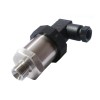 250 bar pressure transducer with 20 millivolt full scale output - Four wire strain gauge type pressure transducer with a twenty millivolt full scale output with a steady 10 volt supply input.
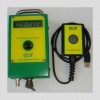 Event triggered high sampling rate pressure logger - This pressure logger can record for months at time at a slow logging rate, and when a predefined event threshold is exceeded it will record pressure at a much faster rate.
The extra measurement error could be as much as 50 millibar over the course of one year. This may not seem much especially for high pressure ranges where any atmospheric changes will have very little impact on the overall accuracy performance. However for lower pressure ranges the impact maybe significant.
If measurement accuracy is critical to your application it is important that you take action to correct any measurement error due to atmospheric changes. Although inconvenient the operation of zero correction is very easy. You will need access to the zero offset adjustment and the ability to disconnect or vent the sensing device temporarily. Once you have fully vented the sensing device via the measurement port and the reading is stable, you are then ready to correct the reading to zero. Some sensors have built-in potentiometers for adjusting zero, but if not you should be able to zero the reading if you have instrumentation connected to the sensor.
Since barometric pressure is unpredictable and changes at different rates, it is not possible to recommend a zero calibration interval, other than, the more often you check the zero pressure reading of a sealed gauge instrument the better will be the measurement accuracy.
Featured sealed gauge referenced pressure measurement products
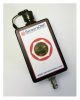 Water system peak demand pressure and flow data logger - Identify peak demand and low-pressure events in your water system with the P-Triton-PF data logger. User-configurable logging regimes, 5-year battery life, and IrDA wireless communication.
- 250 bar pressure transducer with 20 millivolt full scale output - Four wire strain gauge type pressure transducer with a twenty millivolt full scale output with a steady 10 volt supply input.
Related Help Guides
- What is the difference between gauge and absolute pressure measurement
- Difference between vented and non-vented water level measurement
- What is the difference between sealed gauge and vented gauge reference?
- What does the suffix a, abs, d, dp and diff, g, rel and sg mean after the pressure units in a pressure range?
Related Technical Terms
Related Application Questions and Answers
- Logger for verifying water supply pressure over 7 days
- Event triggered high sampling rate pressure logger
Contact us about this Using Sealed Gauge Reference Pressure Sensing Devices page to request more information, or to discuss your application requirements.