
Installing pressure sensors close to high temperatures can lead to significant measurement errors and irreparable damage to the sensing elements and electronics.
The cheapest and simplest approach to protect a pressure sensor is to isolate it from the heat source. This can be done by extending the process connection with a short length of pipe and mounting the pressure sensor on the end instead.
Assuming the ambient air temperature is much lower than the process temperature and below the ambient operating temperature of the pressure sensor, the “stand off” pipe will dissipate enough heat so that the temperature is kept under the required value at the sensor process connection.
Some experimentation will be necessary to find the optimal length of pipe, since the thermal difference between the process and ambient environment will vary. Using a material for the pipe which has a high thermal conductivity such as metal will help increase the cooling efficiency.
Featured high temperature protected products
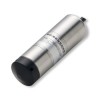 High temperature liquid level measurement for geothermal energy and thermal bath management - Discover how high-purity ceramic diaphragms and specialized TPE cabling ensure accurate hydrostatic level monitoring in fluid environments reaching 125degC, providing a robust solution for geothermal and industrial heat applications.
- High Temperature Resistant Submersible Sensors and Instruments - High temperature protected submersible probes and instrumentation with electronics, housing and cable designed to be immersed in hot liquids.
Since the pipe is dead ended there will be less circulation of heat and a thermal gradient should be established along the length of the pipe.
In some applications such as super heated steam the pressure sensor is isolated from the steam using a “U tube” which allows condensed water to gather in the bottom providing a barrier to prevent steam reaching the pressure sensor.
Using “pigtails” or a coiled pipe is another similar method to the U tube which extends the length of the pipe and generates a greater thermal gradient between the pressure sensor and process media. The pig tail also allows steam to condense and gather in the bottom of the coil.
The temperature can be further reduced by mounting the pressure sensor underneath the heat source to minimise the contribution from convection.
Featured high temperature protected products
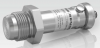 DCT531P RS485 Modbus RTU Flush Pressure Sensor - RS485 Modbus RTU serial interface pressure sensor with exposed all welded stainless steel 316L flush diaphragm in ranges from 100mb up to 40 bar gauge or absolute.
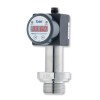 Hot oil pressure transmitter & display to read up to 5 bar at 300degC max - Pressure transmitter with an integral LED loop powered digital display for use with hot oil up to 300 deg. C (max.) over a pressure range of 0-5 bar gauge.
Some pressure sensors are purpose built for measuring hot processes. There are three distinct ways in which pressure sensors can be adapted to high temperatures:
- Extend the pressure connection by using a cooling element with fins to maximise the heat exchange surface area.
- Extend the pressure connection by using a media isolated cooling element filled with a liquid behind a thin membrane.
- Sensing technology that can withstand high temperatures by incorporating material and components such as silicon on insulator semiconductor devices, high melting point solder, wide temperature range sealants, coatings and potting compounds.
All of these options are significantly more expensive to manufacture than a standard pressure sensor but in many instances are more convenient and cheaper if the overall installation cost is considered.
To ensure the best possible accuracy it is advisable to isolate the pressure sensor from the heat source since a narrower temperature range will lead to smaller thermal errors and less measurement drift due to thermal stress on the components.
Featured high temperature protected products
- High Temperature Resistant Submersible Sensors and Instruments - High temperature protected submersible probes and instrumentation with electronics, housing and cable designed to be immersed in hot liquids.
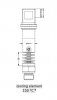 10 bar g steam pressure transmitter - High temperature pressure transmitter for use with steam pressures up to 10 bar gauge.
Help
Stand off pipe lengths for cooling high temperature media
I need to measure the pressure of hot media with a pressure transmitter and I would like to know if there is any guidance available on the length of the pipe that should be fitted between the pressure transmitter and the hot media?
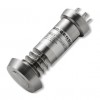 We would suggest downloading this guide on length of temperature stand-offs which provides info on the recommended length for a particular diameter of pipe at different media temperatures.
Alternatively you may wish to consider fitting a pressure transmitter which can withstand a high temperature media without the need for a stand off pipe. The DMP331P and DMK331P are both capable of tolerating media temperatures up to 300 degC (572degF) if supplied with the optional built-in oil filled high temperature isolator.
Zero internal volume process connection
We are looking for a high temperature pressure sensor which can be used with water and steam up to 350 degF in an ambient environment which will not exceed 122degF. The application requires the sensor to add as little internal volume to the system as possible. A flush style diaphragm or some type of diaphragm extension to isolate the pressure transducer from the high temperature media would be needed.
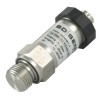 We would suggest the DMP331P for ranges up to 600 psi and the DMK331P for ranges up to 6000 psi. Both sensors have flush diaphragms so they do not add any internal volume when installed, and they have the option for a 572 degF cooling element which is integrated into process connection behind the flush diaphragm.
Featured high temperature protected products
- DCT531P RS485 Modbus RTU Flush Pressure Sensor - RS485 Modbus RTU serial interface pressure sensor with exposed all welded stainless steel 316L flush diaphragm in ranges from 100mb up to 40 bar gauge or absolute.
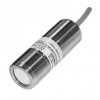 6m range 4-20mA submersible animal feed tank level and PT100 sensor - A hi-temp media 125°C/257°F max, RTD temperature measurement submersible liquid level sensor for submerging in an animal feed tank and measuring the depth over a range of 0 to 6m from the flush diaphragm, and sending the corresponding 4-20mA signal through the submersible cable electrical connection.
Related Help Guides
Related Technical Terms
Related Product and Application Guides
Contact us about this Measuring the Pressure of Hot Media page to request more information, or to discuss your application requirements.