The g Effect is a change in performance of a pressure measuring device that is caused by a change in its orientation.
Typically a pressure sensing device will have some form of flat diaphragm which will generate a change in output when flexed by a change in pressure. If a pressure sensing diaphragm is orientated so that it is horizontal there will be another force acting on it, in addition to the pressure, which is gravity. Irrespective of the pressure applied, the diaphragm will sag slightly in the middle due to the pull of gravity which generates a very slight false pressure reading. If the diaphragm is now flipped upside down it will again sag slightly under its own weight, although this time the false pressure reading will act in the opposite direction causing a zero offset.
The maximum change in pressure reading is limited to 2 x g, where g = 9.80665 m/s², so no change in orientation will generate a force greater than 2g. The amount of offset generated by the g effect will depend on the stiffness of the pressure sensing material.
Featured low range pressure measurement products
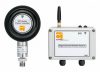 IWPT Wireless Battery Powered Pressure Sensor and Receiver - Wireless battery powered pressure sensor and receiver system for connecting pressure sensors without wires to a central wireless receiver which converts each received pressure signal channel to a 1-5Vdc, 4-20mA output, USB, Ethernet TCP, RS232 RTU, RS485 RTU or 2G 3G 4G mobile cellular network.
 Low Range Pressure Sensors - Explore low range pressure sensors for measuring pressures in Pascals, mbar, or inches H2O. Learn about design challenges, accuracy, and applications like HVAC & cleanrooms.
A high pressure sensing device will tend to have a thicker and smaller surface area sensing diaphragm and therefore will be less sensitive to changes in orientation.
A low pressure sensing device will have a comparably thinner and larger surface area diaphragm and therefore will be more sensitive to changes in orientation.
Manufacturers of low range or high accuracy pressure measurement equipment will often specify the orientation of the device when it it was calibrated, and in some cases a manufacturer will specify the amount of offset to expect from a change in orientation.
In some designs of pressure sensing devices the primary sensing diaphragm is incorporated into an oil filled capsule. In such designs the weight of the oil and the isolating membrane will also contribute to the g Effect.
Featured low range pressure measurement products
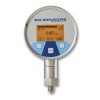 DM01 Multi-Range High Accuracy Pressure Gauge - High precision digital pressure gauge with 0.1% full scale accuracy, exchangeable pressure range modules from 100 mbar (1.5 psi) up to 400 bar (6000 psi).
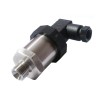 IMPLR Low Range All Stainless Steel OEM Pressure Sensor - Low cost sensor for measuring small pressure ranges from 0-50 mbar (10 inH2O) to 0-1000 mbar (15 psi) of liquids or gases.
Glossary of Low Pressure technical terms
- inH2O – Inches of Water Column at 4 deg C Pressure Unit
- mmH2O – Millimetres of Water Column at 4 deg C Pressure Unit
- oz/in² – Ounce per Square Inch Pressure Unit
- Pa – Pascal Pressure Unit