
Explore our range of submersible pressure sensors engineered with strain gauge technology. These sensors excel in demanding underwater environments, offering accurate hydrostatic level measurements and reliable pressure readings for submerged systems. The low power consumption of the strain gauge circuit makes them an ideal choice for battery-powered underwater monitoring applications, ensuring long-lasting performance and minimal maintenance requirements.
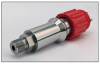 SSPT Subsea Wet-Mateable Electrical Connector Pressure Sensor
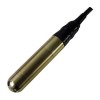 SWL Marine Bronze Submersible Level Sensor
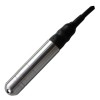 IMCL IP68 Millivolt Output Level Sensor
- IMCL Submersible Absolute Reference Depth Sensor
- IMCL Low Cost Submersible Pressure Sensor
- IMSL IP68 Stainless Steel 316L Hydrostatic Pressure Sensor
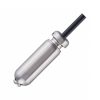 IMTG Low Cost OEM Submersible Tank Gauging Level Sensor
- IWSL Potable Water Submersible Level Sensor
Find out more about Water Resistant Pressure Sensors with Strain Gauge Output to determine which product options and capabilities will best meet your application requirements.
At the heart of these submersible pressure sensors lies strain gauge technology. Strain gauges are highly sensitive components that experience minute changes in electrical resistance when subjected to mechanical strain or deformation. In the context of pressure sensors, a strain gauge is typically bonded to a diaphragm or other flexible element that deflects in response to applied pressure. As pressure increases, the diaphragm deforms, causing the strain gauge to stretch or compress, altering its resistance. This change in resistance is then measured and converted into a corresponding pressure reading.
One prominent application of submersible pressure sensors is in hydrostatic level measurement. By deploying the sensor at a specific depth within a liquid-filled tank or reservoir, the pressure exerted by the liquid column above the sensor can be accurately measured. This pressure is directly proportional to the liquid level, allowing for real-time monitoring and control of fluid levels in a wide range of industrial processes and environmental monitoring scenarios.
Submersible pressure sensors also play a critical role in monitoring pressure within underwater systems. This includes applications such as:
- Oceanographic research: Understanding pressure variations at different depths is crucial for studying ocean currents, marine life behavior, and underwater geological formations.
- Subsea infrastructure: Monitoring pressure in pipelines, oil wells, and other subsea structures is essential for ensuring their structural integrity and operational safety.
- Underwater vehicles: Measuring pressure is crucial for controlling buoyancy, navigation, and depth management in submarines, remotely operated vehicles (ROVs), and autonomous underwater vehicles (AUVs).