

Underground mechanical rooms housing fluid transport systems require robust leak detection to prevent total room flooding and equipment failure. By utilizing a low-range submersible transmitter, operators can monitor for the earliest signs of water accumulation and automate safety protocols via existing motor control hardware.
- Integration with variable frequency drives via 4-20mA current loops.
- High-resolution monitoring for shallow floor-level water detection.
- Atmospheric pressure compensation for accurate subterranean measurement.
- Corrosion-resistant stainless steel construction for permanent installation.
The primary challenge in underground pump room management is the risk of undetected pipe leaks or seal failures which can quickly lead to total submersion of expensive infrastructure. For this application, a monitoring solution must be sensitive enough to detect shallow water levels on the floor or in a shallow sump before a critical flood occurs. The system requires a sensor that can be positioned at the lowest point of the facility to provide immediate feedback to the control logic. By integrating the sensor output directly with a pump variable frequency drive, the facility can automate protective measures, such as shutting down supply pumps or triggering emergency drainage, based on a standard analogue current loop.
The 18.605 G series provides a specialized solution for these environments, utilizing a piezoresistive stainless steel sensor that is highly effective for ambient clean water detection. For an application focused on leak detection, a very low measurement range, such as one metre of water column, is utilized to ensure maximum sensitivity. This allows the variable frequency drive to interpret very small changes in depth, facilitating early intervention. The sensor is constructed with a 304 stainless steel housing and a 316L stainless steel diaphragm, ensuring long-term material compatibility and durability when exposed to the typical fluids found in industrial pump rooms.
A critical technical factor in underground installations is the potential for local barometric pressure variations to affect the accuracy of hydrostatic depth measurements, especially at low ranges. To mitigate this, the 18.605 G series features a vented cable that provides a reference to the local atmosphere. This internal vent tube ensures that the sensor only measures the pressure exerted by the liquid column, providing a true gauge measurement that is unaffected by the ambient air pressure within the enclosed room. The electrical connection is maintained through an IP68-rated submersible PVC cable, allowing the probe to remain fully submerged while maintaining signal integrity back to the motor controller.
The installation of the sensor involves placing the probe at the floor level where water is likely to collect first. While the probe design requires a small amount of water to cover the diaphragm before a reading is registered, its placement in a local low point or floor-mounted configuration ensures it captures the initial volume of a pipe burst or leak. The use of a two-wire 4-20mA current loop not only simplifies the wiring to the drive but also provides a robust signal that is resistant to the electromagnetic interference commonly found in environments with high-power industrial pumping equipment. This configuration transforms a standard level sensor into a critical component of a proactive flood mitigation strategy for subterranean infrastructure.
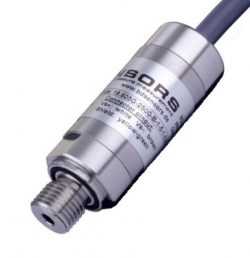
18.605 G Submersible Flood Water Level Transmitter
- Part Number: 18.605 G-1000-M-1-8-1-006-300-1-000
- Input Range: 1.0 mH2O (approx. 3.28 ftH2O)
- Output Signal: 4-20mA (2-wire)
- Accuracy: 1% FSO
- Electrical Connection: PVC cable (vented)
- Cable Length: 6 meters
- Special Version: Standard