• Skip to primary navigation
  • Skip to main content
  • Skip to primary sidebar
SensorsONE

SensorsONE

  • Products
  • Contact

Ideal Gas Law Calculator

Calculate Ideal Gas Law Parameters
Select Answer Mode
Pressure (P) [?]
Volume (V) [?]
Amount Of Substance (n) [?]
Temperature (T) [?]

Click save settings to reload page with unique web page address for bookmarking and sharing the current tool settings

✕ clear settings

Change the answer mode for this tool by selecting gas pressure (P), gas volume (V), amount of substance of gas (n) or gas temperature (T) as the parameter to calculate instead


Featured absolute pressure measurement products
  • Barometric Pressure Transmitters
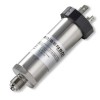
  • 20 bar absolute steam pressure transducer
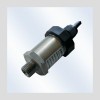
  • Depression vacuum 1 bar absolute range 0-5V output automotive test pressure sensor
  • 23 to 33 inHg barometric range pressure transducer with a 10 volt hi-resolution output Atmospheric air pressure transducer with 10 volt output

Related Tools

  • Boyle’s law calculator
  • Charles’ law calculator
  • Avogadro’s law calculator
  • Gay-Lussac’s law calculator
  • Combined gas law calculator
  • Pressure units conversion
  • Volume units conversion
  • Temperature units conversion

Contents

Toggle
  • User Guide
    • Formulas
      • Symbols
    • Pressure (P)
    • Volume (V)
    • Amount Of Substance (n)
    • Temperature (T)

User Guide

This tool will calculate any parameter from the equation for the ideal gas law PV=nRT, which includes  the pressure, volume, amount of substance and temperature of a quantity of gas.

Formulas

The Ideal gas law is explained with math in the following way.

Using SI units for each parameter, the multiplying together of pressure and volume will equal the multiplying together of the amount of substance, the temperature and the ideal gas constant.

P · V = n · R · T

The formulas used by this ideal gas law calculator to determine each individual parameter are:

P =  n · R · T / V

V = n · R · T / P

n = P · V / (R · T)

T = P · V / (n · R)

Symbols

  • P = Pressure of gas
  • V = Volume of gas
  • n = Amount of substance of gas
  • R = Ideal gas constant (8.31446261815324 J⋅K-1⋅mol-1)
  • T = Temperature of gas

Pressure (P)

This is the absolute pressure of the gas.

Volume (V)

This is the total volume occupied by the gas.

Amount Of Substance (n)

This is the number of gas atoms or molecules that are included in the quantity of gas.

Temperature (T)

This is the temperature of the gas.
Featured temperature measurement products

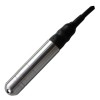
  • Submersible water level and temperature probe with SDI-12/USB interface for freshwater monitoring
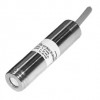
  • Water well 30mH2Og range 4-20mA out freshwater level sensor with RTD
  • Laboratory environment monitor for precise room pressure, temperature and humidity
  • Pressure and temperature recorder for monitoring up to 500 millibar

Primary Sidebar

Tools

  • Unit Converters
  • Pressure
  • Liquid Level
  • Temperature & Heat
  • Electrical & Electromagnetic
  • Flow
  • Force, Load & Torque
  • Mass & Weight
  • Dimensions
  • Density
  • Time & Frequency
  • Speed & Acceleration
  • Energy & Power
  • Sensors & Instrumentation
  • Shapes
  • Movement & Motion
  • Travel & Transportation
  • Pricing & Quantities
  • Chemical Quantities
  • Health & Fitness

Tool Feedback

Please provide feedback on using this Ideal Gas Law Calculator.

Wireless Pressure Measurement

Use this battery powered wireless pressure sensor to transmit readings to a receiver connected to USB, RS485, RS232, cellular network or analog output

Use this battery powered wireless pressure sensor to transmit readings to a receiver connected to USB, RS485, RS232, cellular network or analog output

Wireless Temperature Measurement

Use this battery powered wireless temperature probe to transmit readings to a receiver connected to USB, RS485, RS232, cellular network or analog output

Use this battery powered wireless temperature probe to transmit readings to a receiver connected to USB, RS485, RS232, cellular network or analog output
By clicking "OK" or continuing to use this website you are providing your consent to use cookies as described in our Privacy Policy

© 2026 SensorsONE Ltd, all rights reserved

  • Home
  • Products
  • Tools
  • Legal
  • Contact