
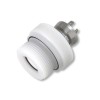
The following application story details the technical challenges and engineering solutions for monitoring suction pressures within highly corrosive industrial gas environments, specifically focusing on the integration of advanced fluoropolymer and ceramic materials to ensure long-term stability.
- Application Focus: Negative pressure measurement in aggressive gas mixtures containing halogens and nitrogen oxides.
- Media Complexity: Exposure to a cocktail of Chlorine (Cl2), Hydrogen Chloride (HCl), and Nitrogen Oxides (NOx), with intermittent wetting by Sodium Hydroxide (NaOH).
- Technical Solution: Utilization of a capacitive ceramic sensor with a high-purity Al2O3 diaphragm and FFKM (perfluoroelastomer) seals.
- Key Advantage: Flush-mounted design prevents crystalline accumulation and ensures mechanical integrity against acidic fumes and alkaline agents.
In specialized industrial environments such as hydrogen production plants or chemical gas scrubbing units, maintaining precise vacuum control is critical for process safety and efficiency. A common challenge involves measuring low-range negative pressures, specifically within the -10 kPa range, where standard sensor technologies often struggle with accuracy and material degradation. In this specific scenario, the instrumentation must reside within a flow of air mixed with highly reactive gases including Chlorine, Hydrogen Chloride, and various Nitrogen Oxides. Furthermore, the installation environment introduces the risk of the sensor being wetted by a 5% Sodium Hydroxide solution, a strong alkaline cleaning agent that can cause significant damage to metallic components and standard elastomeric seals.
The technical requirement for a gauge pressure reference ensures that the vacuum measurement remains accurate relative to local barometric fluctuations, which is vital for maintaining the delicate balance of gas mixtures. Traditional stainless steel pressure ports are susceptible to rapid pitting and stress-corrosion cracking when exposed to wet chlorine and acidic fumes like HCl. To counteract this, the selected solution utilizes a PVDF (Polyvinylidene Fluoride) pressure port. PVDF is a high-performance thermoplastic that offers exceptional chemical inertness across a broad pH range, making it equally resistant to the aggressive acidic gases and the alkaline Sodium Hydroxide wetting.
The heart of the measurement solution is the LMK 351 series, which features a capacitive ceramic sensor element. Unlike metallic strain-gauge sensors that rely on thin diaphragms and internal fill fluids, the capacitive ceramic design is a “dry” technology. This provides several niche advantages: the ceramic is inherently more rigid and resistant to the abrasive or corrosive nature of the gases, and it offers superior long-term stability in low-pressure ranges where metallic fatigue might otherwise cause zero-point drift. By upgrading the diaphragm to 99.9% high-purity Al2O3, the sensor gains an additional layer of protection against chemical attack, ensuring that the primary sensing surface remains pristine despite constant exposure to halogens.
Sealing integrity is perhaps the most critical failure point in such applications. While common elastomers like EPDM are suitable for alkaline solutions, they can rapidly swell or degrade when exposed to Chlorine or Nitrogen Oxides. Conversely, standard FKM seals may fail in the presence of strong bases. The solution employs FFKM (Perfluoroelastomer) seals, which provide a near-universal chemical resistance profile. FFKM combines the chemical inertness of PTFE with the elastic properties of an elastomer, ensuring that the internal vacuum remains sealed against the corrosive atmosphere. This is paired with a flush-mounted diaphragm design, which eliminates any “dead space” or orifices where crystalline deposits from the Sodium Hydroxide could settle and harden, thereby preventing measurement lag or mechanical blockage.
For the electrical interface, the 4-20 mA loop-powered configuration provides a robust signal capable of long-distance transmission without interference, which is typical for large-scale industrial plant layouts. In areas where corrosive fumes are particularly concentrated, the use of an FEP-coated cable or a robust ISO 4400 plug ensures that the external wiring remains protected from atmospheric corrosion. This holistic approach to material selection—combining capacitive ceramic, PVDF, and FFKM—creates a highly specialized measurement point capable of withstanding the most demanding chemical processing conditions.
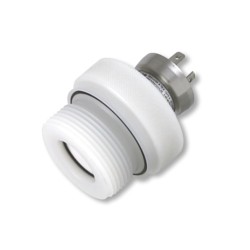
LMK351 High Purity Ceramic Diaphragm Vacuum Transmitter with PVDF Housing and FFKM Seals
- Part Number: 470-M100-1-3-100-M00-7-B-C-000
- Pressure Range: -100 to 0 mbar (Suction / Vacuum)
- Output Signal: 4-20mA (2 wire)
- Accuracy: 0.35% FS
- Electrical Connection: DIN43650A male and female plug (IP65)
- Process Connection: G1 1/2 male DIN3852 with flush diaphragm
- Media Exposed Seals: FFKM (Perfluoroelastomer)
- Process Connector Material: PVDF
- Diaphragm Material: Ceramic Alumina Al2O3 99.9%
- Special Version: Standard