
Air pressure data loggers are essential tools for monitoring and recording air pressure in various industrial and research settings. These compact devices provide accurate and reliable pressure measurements over extended periods, enabling engineers and researchers to analyze trends, identify anomalies, and ensure the safety and efficiency of their systems.
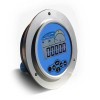 ADT681 Digital Pressure Gauge - The ADT681 digital pressure gauge family covers a wide range of pressures from as low as 1 inH20 differential to as high as 36,000 psi gauge.
- 100 mbar g low range air pressure gauge and logger with G1/4 male fitting
- Logger for factory air and steam pressures at different locations
- 10 psi vacuum air and 50 psi water pressure gauge and data logger
- 100 pascals range brick kiln and dryer air pressure logger and sensor
Send us your enquiry to discuss your Air Pressure Data-Loggers application with a product specialist, and they will help you select the best option to suit your specific requirements.
Air pressure data loggers are self-contained devices that combine a pressure sensor, a microprocessor, and internal memory for storing pressure readings. These loggers automatically record air pressure at pre-programmed intervals, allowing for continuous monitoring without constant human intervention. They are typically battery-powered and designed for long-term deployment in a variety of environments. Some loggers also include features such as LCD displays, alarms, and communication interfaces for real-time data access and remote monitoring.
Product Advantages
Air pressure data loggers offer key advantages, including continuous autonomous recording, high measurement accuracy, automated data collection to eliminate manual recording errors, long battery life for extended field deployment, and seamless digital export capabilities for comprehensive analysis and quality auditing.
Continuous Autonomous Monitoring
These self-contained instruments automatically log pressure readings at pre-configured time intervals. By operating continuously without requiring constant human oversight, they provide reliable long-term data tracking across industrial and research environments.
High Precision and Reliability
Equipped with advanced internal pressure sensors, air pressure data loggers deliver high-accuracy measurements over broad operating pressure ranges. They ensure consistent signal stability and precise measurements critical for process verification and leak detection.
Elimination of Manual Recording Errors
By directly digitizing and storing time-stamped data points into internal memory, these loggers remove the risk of human error associated with manual logging. This creates an uninterrupted, verifiable audit trail essential for quality control procedures.
Long Battery Life for Remote Deployment
Designed for low power consumption, air pressure loggers feature long-lasting internal batteries capable of supporting autonomous operation for months or years. This makes them ideal for remote or field installations where external power sources are unavailable.
Seamless Data Export and Analysis
Integrated communication interfaces (such as USB or RS485) allow captured datasets to be easily transferred to software programs. Users can generate graphical pressure profiles, export data to spreadsheets, and perform dynamic trend analysis with ease.
Product Applications
Air pressure data loggers play a critical role across a wide spectrum of operational environments, providing the continuous oversight needed to ensure process integrity, system safety, and regulatory compliance. From optimizing energy usage in large-scale industrial facilities to safeguarding delicate environmental parameters in scientific research, these instruments deliver actionable insights across diverse use cases.
Industrial Process Monitoring
Air pressure data loggers are widely deployed across manufacturing plants and processing facilities to continuously record pressure levels within compressed air systems, pneumatic machinery, and fluid lines. By continuously gathering high-resolution pressure data, operations teams can identify pressure drops, prevent costly downtime caused by supply failures, optimize air compressor cycles for maximum energy efficiency, and establish predictive maintenance schedules before catastrophic equipment breakdowns occur.
HVAC System Optimization
In commercial complexes, healthcare facilities, and industrial environments, maintaining accurate differential air pressure is critical for proper HVAC operation and airflow control. Data loggers track pressure differentials across filter banks, ductwork, and air handling units to signal filter clogging, balance ventilation networks, ensure proper building pressurization, and lower overall operational energy costs while ensuring occupant comfort and healthy indoor air quality.
Environmental Monitoring
Precise measurement of atmospheric pressure is vital in meteorological stations, environmental research projects, and specialized controlled environments such as semiconductor cleanrooms or pharmaceutical containment facilities. Air pressure loggers provide verifiable, continuous barometric readings that aid in weather forecasting models, ensure cleanroom positive/negative pressure isolation to prevent cross-contamination, and support rigorous compliance auditing.
Research and Development
During product development, scientific experimentation, and prototype evaluation, researchers rely on high-precision data loggers to capture empirical pressure metrics under variable thermal and environmental conditions. Specific applications include testing pneumatic actuator response times, evaluating micro-flow rates in medical ventilation devices, profiling pressure drops across prototype HEPA filters, and analyzing aerodynamic forces on scaled wind-tunnel models. The detailed datasets recorded by these loggers enable engineers to validate fluid dynamics models, verify product structural integrity under pressure stress, and ensure rigorous quality assurance before new components transition into full manufacturing.
Leak Detection and Integrity Testing
Data loggers play a key role in decay testing and system integrity checks for sealed vessels, pressure tanks, and distribution piping networks. By logging high-frequency pressure points over defined hold periods, technicians can easily detect minute pressure drops indicative of leaks or material degradation, allowing for prompt repairs and helping organizations adhere to strict safety and environmental standards.
Calibration and Validation
High-accuracy reference pressure loggers serve as benchmark standards for testing, calibrating, and validating installed pressure transmitters, mechanical gauges, and control sensors. Their stable measuring electronics and reliable data retention allow quality technicians to perform traceable field recalibrations, streamline validation workflows, and ensure instrumentation conformity across critical operations.
Product Selection
Selecting the optimal air pressure data logger requires careful evaluation of key performance metrics to ensure compatibility with your specific application demands. Engineers and technical specialists must consider parameters such as operating pressure ranges, required measurement accuracy, data acquisition frequencies, total internal memory storage, and digital communication capabilities to achieve reliable, continuous pressure monitoring.
Pressure Range
Choosing the correct pressure range is fundamental to preventing sensor overpressure damage and ensuring maximum measurement resolution. Data loggers are configured for absolute, gauge, or differential pressure sensing depending on system design. For ultra-low differential applications like cleanroom isolation or HVAC filter tracking, ranges in millibars or pascals are required, whereas industrial compressed air lines decay testing demand high-pressure gauge sensors up to hundreds of bar. Operating continuously near the upper limit of a sensor should be avoided to accommodate system pressure surges.
Accuracy and Precision
Measurement accuracy dictates the reliability of recorded pressure trends, typically expressed as a percentage of full-scale (% FS) or reading. High-precision applications such as calibration laboratory benchmarks or leak rate determination demand loggers with minimal thermal hysteresis, excellent long-term zero stability, and tight full-scale accuracy (e.g., ±0.05% FS or better). In contrast, general industrial monitoring may only require standard commercial accuracy. Evaluating thermal compensation capabilities across expected ambient operating temperatures is essential for maintaining accurate readings in field conditions.
Sampling Rate and Logging Interval
The sampling rate dictates how frequently a logger reads and stores pressure data points, ranging from several times per second for transient pressure surge capturing to hourly intervals for long-term barometric monitoring. High-frequency sampling captures fast pressure drops during valve cycling, pneumatic actuation, or burst testing, but rapidly consumes battery power and memory capacity. Many advanced loggers offer configurable recording schedules or burst-logging triggers, allowing normal low-power logging until a specific pressure threshold is breached.
Memory Capacity and Storage
Internal storage capacity determines how long a device can record data continuously before offloading or overwriting existing logs. Total storage is typically specified in thousands or millions of readings. In remote or long-term field deployments where physical access is infrequent, large non-volatile Flash memory is crucial to safeguard datasets against power interruption. Memory management modes, such as continuous ring memory wrap-around or stop-when-full logic, should be selected based on quality auditing and data retention requirements.
Communication Interfaces and Software
Efficient data retrieval and integration depend on the logger’s connectivity options and supporting software features. Loggers offer direct wired connections like USB, RS232, or RS485 for fast field offloading, as well as wireless protocols (Bluetooth, cellular, or Wi-Fi) for real-time telemetry and automated cloud synchronization. Dedicated companion software enables device configuration, calibration adjustments, graphical visualization, and export into CSV or PDF formats for seamless audit reporting and statistical analysis.