
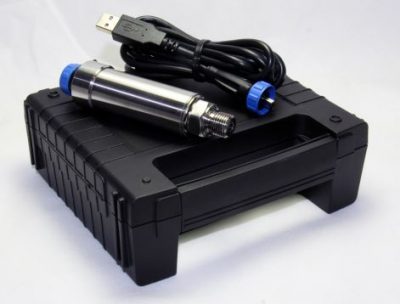
USB ready digital pressure sensor for recording pressures with a high speed sample rate of up to 1 kHz to a computer. The UPS-HSR is supplied with a 2m long USB cable, downloadable PC software and case. Choose a pressure range from -1 to 2.5 bar up to 5000 bar with a G1/4 or 1/4 NPT male up to 1500 bar, and AE F-250-C female for higher ranges.
Product Parameters
- Pressure Ranges: -1 to +2.5 bar…0 to 5000 bar sealed gauge
- Output Signal: USB
- Accuracy: 0.15% FS ≤ 3000 bar, 0.35% > 3000 bar
- Electrical Connections: USB mini B cable
- Process Connections: G1/4 or 1/4 NPT ≤ 1500 bar, and AE F-250-C female > 1500 bar
- Media Compatibility: Titanium alloy
- Special Features: Sampling rate up to 1000 Hz, resolution of 21 bits ≤ 5 Hz, or 16 bits > 5 Hz, compatible with C#, VB, Labview and Excel
Product Description
The UPS-HSR has been designed and developed for ease of use, reliable data collection and real time monitoring, to cover the majority of applications where a simple interface to a computer is required. Without the fuss of complicated interfaces, converters, external power supplies and USB driver issues, the UPS-HSR interface is simply a USB cable that powers the pressure sensor and has automatic recognition of the sensors that connect to the software.
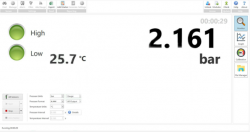
The accompanying Windows-based interface software simplifies data acquisition, configuration, and analysis. The software features an automatic sensor recognition routine that detects the unique serial number and calibrated pressure range of connected units instantly upon connection via the 2m USB cable. Users can monitor live pressure and temperature readings, display historical graphical plots, configure independent high/low pressure alarms, and implement a low-pass digital filter to suppress high-frequency process noise. For dynamic testing environments, the software provides an advanced interval configuration tool where engineers can adjust the recording frequency from slow, static tracking up to a fast 1 ms log interval (1000 Hz).
Data management options are robust, allowing researchers and test engineers to log up to 25 million readings per single continuous binary file. Acquired data can be seamlessly exported to Microsoft Excel worksheets, saving pressure and temperature records at each discrete acquisition interval. Additionally, the software includes an integrated report and certificate generator. This utility lets organizations design custom technical reports using templates, plot data markers at critical test events, upload corporate logos, and generate signable calibration or proof-pressure test certificates directly from the interface. For deeper laboratory integration, free API DLL libraries are available to facilitate direct data streaming into custom applications developed in C#, Visual Basic, LabVIEW, or Excel VBA.
Fuss-free USB connection
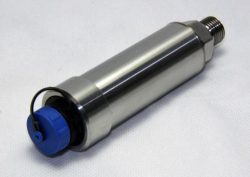
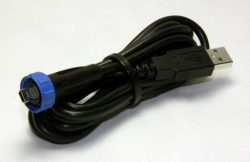
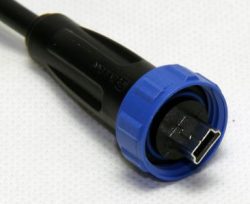
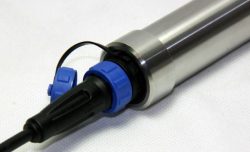
Each UPS-HSR is supplied with a USB mini B socket, when properly connected to the supplied mating cable assembly with USB connection it provides IP66 protection to the pressure sensor which is ideal if you are installing the pressure sensor in wet or arduous conditions. Power is provided to the sensor from the computer’s USB port so no additional connections are required. The USB cable is 2m in length as standard, or alternatively this can be extended if required.
Adjustable recording rate
Using the software, the sample rate can be adjusted to suit the requirements of the application, from a high sample rate capability of 1kHz for dynamic applications to slower rates for static applications.
Test certificate builder
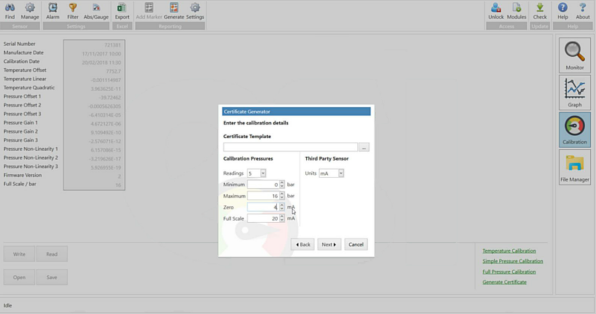
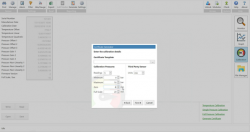
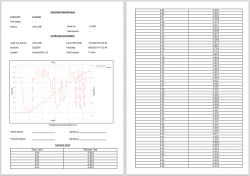
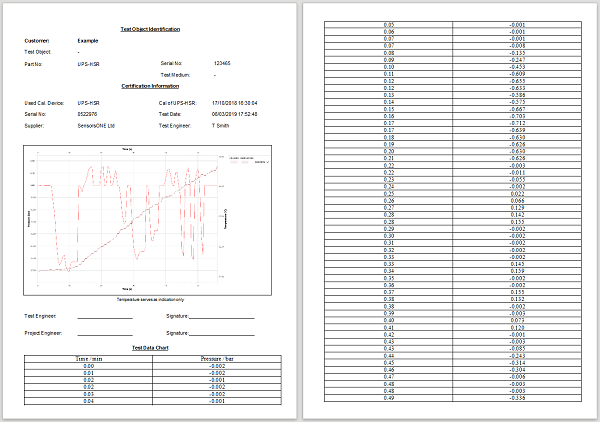
The software includes a ‘Certificate Generator’ which enables the user to upload their company logo, enter details about the test, site location, date and add a signature. Whilst running the test in certificate generator mode, markers can be placed along the graph for reporting on significant events or points of interest. Once the test is complete you can freely print the certificates or export the data to excel or other spreadsheet/database program.
Temperature measurement
In addition to the pressure measurement, the temperature can also be read and recorded in the software, and scaled in either °C or °F.
Accessories included
Every UPS-HSR is supplied in a robust ABS plastic carry case and comes complete with the interface USB cable and link to download software, so you are ready to plug & play.
High performance Silicon-On-Sapphire sensor technology
The sensing technology used in the UPS-HSR is Silicon-On-Sapphire (SoS), which produces outstanding performance, accuracy stability, repeatability and thermal stability. This level of accuracy enables the UPS-HSR to provide resolution with a precision of 1 in 100,000.
Low to very high range pressure capability
With a wide range of pressures from -1 bar (-14.5 psi) through to 5,000 bar (72,500 psi), this device should cover every pressure measurement requirement in a multitude of applications. Other engineering units can be selected by using the software such as bar, mbar, psi, MPa, Pa, mH2O, mmHg, atm or kg/cm2.
Titanium alloy wetted parts
Media compatibility is enhanced due to the wetted parts being constructed from Titanium Alloy, this gives the UPS-HSR excellent corrosion resistance, lightweight and the ability to withstand extreme temperatures. There is a choice of G1/4” male or ¼” NPT male pressure connections for pressures up to 1500 bar, and thereafter it is an Autoclave Engineers F-250-C female pressure connection. For alternative connections a wide range of adaptors to can be provided to suit.
Product Features
The UPS-HSR series is engineered to deliver high-performance, digital-ready pressure monitoring by combining robust material science with advanced software capabilities. This sensor series integrates Silicon-on-Sapphire technology for exceptional stability, user-friendly USB connectivity for simplified setup, and a comprehensive Windows software suite for real-time analysis, together providing a reliable, all-in-one solution for diverse testing environments.
Advanced Silicon-on-Sapphire (SoS) Technology
At the heart of the UPS-HSR series is advanced Silicon-on-Sapphire (SoS) technology. By utilizing a piezoresistive silicon strain gauge circuit epitaxially grown onto a sapphire diaphragm, the sensor achieves a robust single-crystalline structure that is molecularly bonded to a titanium alloy sub-diaphragm. This innovative design ensures superior measurement accuracy, exceptional long-term stability, and excellent repeatability. Furthermore, the construction allows the sensor to exhibit virtually no hysteresis, enabling it to endure substantial over-pressures without degradation even across demanding operational cycles.
High-Speed Dynamic Logging
The sensor supports software-adjustable logging rates of up to 1000 Hz, making it an ideal choice for capturing fast pressure transients and brief, high-frequency pressure pulses that slower sensors would miss. This capability, combined with the ability to adjust the recording frequency from slow, static tracking up to a fast 1 ms log interval, ensures that researchers and test engineers can precisely monitor dynamic environments. The flexibility in sampling rate allows the sensor to adapt to various test requirements, from long-term monitoring to rapid-fire event analysis.
High-Precision Measurement Resolution
The UPS-HSR delivers high-precision measurement resolution, providing up to 21 bits of data depth at sampling speeds of 5 Hz or slower. This extensive data depth is crucial for applications requiring high-resolution data acquisition, as it allows for the detection of subtle pressure variations that might otherwise be lost in noise. Even at higher sampling rates up to 1000 Hz, the system maintains a 16-bit resolution, ensuring that critical data integrity is preserved throughout high-speed testing sequences.
Corrosion-Resistant Titanium Construction
Constructed entirely from high-strength titanium alloy, the sensor’s wetted parts offer exceptional corrosion resistance, making it suitable for use with aggressive fluids and gases. Beyond its chemical compatibility, the titanium housing provides a lightweight, durable structural integrity that ensures reliable operation in harsh industrial or laboratory environments. This robust material selection enables the sensor to withstand wide media temperature ranges, providing a dependable solution for diverse and challenging process conditions.
Seamless USB Connectivity
The sensor features true plug-and-play USB 2.0 connectivity, which eliminates the need for external power supplies, specialized signal conditioners, or complex interface converters. By drawing power directly from the PC or laptop via its 2m USB cable, the device simplifies the setup process and reduces hardware clutter. This direct digital interface facilitates straightforward integration into existing test benches, allowing for immediate data transmission and device recognition without the overhead of traditional I/O boards.
Comprehensive Software Suite
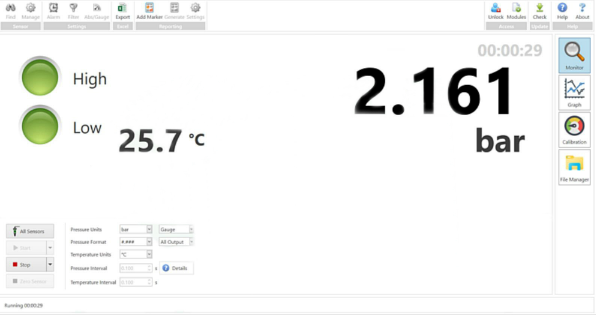
The accompanying Windows-based software suite transforms the sensor into a powerful, all-in-one data acquisition station. Users benefit from real-time graphical plotting, comprehensive data logging capabilities, and the ability to configure independent high and low-pressure alarms for safety or process control. The suite also includes a configurable low-pass digital filter, which effectively suppresses high-frequency process noise to deliver cleaner, more meaningful data for analysis and decision-making.
Integrated Reporting and Certificates
Beyond data collection, the software simplifies documentation through an integrated certificate and report generator. Organizations can customize technical reports with corporate logos, plot critical test event markers, and generate signable calibration or proof-pressure test certificates directly from the interface. This feature enables engineers to maintain professional, audit-ready records of their testing activities, ensuring that all data-driven results are both actionable and fully documented.
Product Specification
Sensor technology
The pressure is measured by a Silicon-on-Sapphire (SoS) diaphragm sensing element.
Output
USB 2.0 compatible
Supply voltage
5V dc from the USB port
Pressure reference
Sealed Gauge (default), Absolute (selectable in the software by adding barometric pressure)
Pressure ranges
This usb interface pressure sensor is available in the following pressure ranges
- -1 to 2.5 bar
- 0-16 bar
- 0-100 bar
- 0-400 bar
- 0-1,000 bar
- 0-1,500 bar
- 0-2,000 bar
- 0-3,000 bar
- 0-4,000 bar
- 0-5,000 bar
Engineering units
The following units can be selected within the dowloadable PC software:
- bar
- mbar
- psi
- MPa
- Pa
- mH2O
- mmHg
- atm
- kg/cm2
Safe over-pressure
The following pressures can be applied without damaging the usb pressure sensor:
- 1.5 x pressure range up to 1,000 bar
- 1.2 x pressure range up to 5,000 bar
Accuracy (NL&H)
The room temperature accuracy is 0.15 % of span BFSL max.
Reading sampling rate
User selectable up to 1,000 samples per second (1 kHz). ADC Resolution is 21 bits for less than 5 Hz and 16 bits for between 5 – 1,000 Hz sample rate.
Ambient temperature range
This usb pressure sensor can withstand the following surrounding environmental temperatures:
-20 °C to +85 °C (-4 °F to +185 °F)
Media temperature range
The usb pressure sensor is designed to be used on media within the following temperature range:
-50 °C to +125 °C (-58 °F to +257 °F)
Storage temperature range
It is recommended to store this USB pressure sensor kit in environments within the following temperature range:
+5 °C to +40 °C (+41 °F to +104°F)
Temperature effects
The errors expected at different media temperatures are as follows:
±1.5 %FS total error band for -10 °C to +80 °C. Typical thermal zero and span coefficients ±0.015 %FS/ °C
Media wetted parts
The material exposed to the media being measured is Titanium alloy
Permissable media
Fluids and gases compatible with Titanium alloy
Electrical connection
Mating to USB mini B socket for cable connection to PC. Supplied with 2m USB lead rated to IP66 as standard.
Pressure connection
The following process fittings are available for installing this usb pressure sensor
- 1500 bar pressure range and below: 1/4″ BSP male (G1/4) or 1/4″ NPT male
- 2000 bar pressure range and above: F250-C (Autoclave)
Electromagnetic compatibility
The usb pressure sensor conforms to the following electromagnetic compatibility standards for laboratory equipment:
- EN61326-1,
- EN61326-2-3
Operating system compatibility
The PC logging software available for download with this usb pressure sensor is compatible with the following version of Windows OS:
- Windows 7
- Windows 8
- Windows 8.1
- Windows 10
Application compatibility
This usb pressure sensor can be configured to send measurement data to the following application software, and DLL files are available for free download:
- Microsoft C# (C Sharp) programming language
- Microsoft VB (Visual Basic) programming language
- National Instruments (NI) Labview (Laboratory Virtual Instrument Engineering Workbench) programming language
- Microsoft Excel VBA (Visual Basic for Applications) (api dll library)
Product Applications
The UPS-HSR sensor series offers a versatile and high-precision solution for a wide range of industrial, research, and testing applications. Its robust design, rapid data acquisition capabilities, and ease of integration make it an ideal tool for monitoring pressure and temperature in diverse environments, from critical aerospace testing to routine manufacturing quality control.
Aerospace Component Testing
The sensor is ideal for aerospace test and research environments where engineers must assess the performance of pneumatic and hydraulic components under dynamic conditions. Its high-speed logging and high-resolution measurement allow for precise monitoring of pressure transients during flight-simulated stress tests, ensuring critical system reliability.
Automotive Fluid System Analysis
In automotive engineering, this sensor is used to monitor fluid system responses and transient pressure spikes. It provides the necessary bandwidth to capture rapid fluctuations in braking systems, fuel lines, or transmission hydraulics, enabling technicians to analyze system health and optimize performance during high-frequency operational cycles.
Academic and Industrial Research
This device serves as a foundational tool for laboratory, academic, and industrial research requiring high-resolution data acquisition. Its ability to provide precise, stable data over long periods makes it perfect for experimental setups where subtle pressure variations must be accurately recorded to validate scientific hypotheses or industrial process improvements.
Hydraulic and Pneumatic Network Monitoring
For network analysis in hydraulic and pneumatic systems, the sensor helps detect pressure surges and system operational imbalances. By continuously logging data, it allows engineers to identify root causes of instability, troubleshoot pressure spikes, and maintain the operational efficiency of complex piping infrastructures.
Autoclave and Sterilizer Validation
This sensor supports autoclave and sterilizer validation by enabling parallel temperature and pressure tracking within controlled environments. Its rugged, corrosion-resistant design ensures consistent, accurate performance, providing the reliable data necessary for verifying sterilization cycles and ensuring compliance with stringent safety and quality standards.
Leak Testing and Integrity Monitoring
The sensor is highly effective for leak testing and continuous pressure decay monitoring, essential for product quality control or pipeline integrity. Its sensitivity to minute pressure changes ensures that even slow leaks can be detected early, facilitating proactive maintenance and ensuring the safety and longevity of pressurized systems.
Pump and Compressor Performance Evaluation
Monitoring pumps and compressors is streamlined by using this sensor to evaluate continuous discharge profiles and fluid flow efficiency. By analyzing the pressure output over time, maintenance teams can identify performance degradation, detect abnormal vibration signatures, or optimize the operational settings of heavy-duty pumping equipment.
Hydrostatic Proof-Pressure Testing
The sensor is frequently employed for hydrostatic proof-pressure testing and high-pressure air test rig validation. It provides the high-precision readings required to verify that components meet safety specifications, ensuring they can withstand maximum rated pressures without failure during mandatory compliance testing.
Product Specifying Guide
Step 1: Select the required pressure range
Determine the maximum operational pressure of your application and select an appropriate full-scale range from the standard offerings. Available choices span from a compound vacuum range of -1…2.5 bar up to ultra-high pressures of 0…5000 bar sealed gauge. To ensure long-term sensor reliability, consider potential over-pressure events; the sensor supports a safe over-pressure limit of 1.5 times the rated range for models up to 1000 bar, and 1.2 times the rated range for models up to 5000 bar.
Step 2: Determine the mechanical process connection
Choose a thread style that matches your existing piping or test manifold configuration. For pressure ranges equal to or less than 1500 bar, you can specify either a G1/4 male or a 1/4 NPT male process connection. For ultra-high pressure applications operating at 1500 bar or above, the sensor must be specified with an Autoclave F-250-C female high-pressure connection to ensure a safe and secure fluid seal.
Step 3: Verify media compatibility and environmental ratings
Confirm that your process fluid or gas is chemically compatible with the high-grade titanium alloy wetted parts, which offer extensive resistance to corrosion and chemical attack. Additionally, ensure that your operational temperatures fall within the sensor’s design limits, which support a surrounding ambient environment of -20…85°C and a process media temperature range of -50…125°C.
Step 4: Finalize accessories and software requirements
Review the default package contents to ensure your testing laboratory is fully equipped. Each standard sensor kit is supplied complete with a 2m IP66-rated USB interface cable, a downloadable link for the full configuration and logging software, and a robust ABS plastic carry case for field transit. If longer distances are required between the sensor and the host PC, an optional 4.5m extended cable can be ordered separately.
Part Number Builder
Generate or decode UPS-HSR ordering code
Configuration Rules & Restrictions
High-Pressure Connections
- For ranges up to 1,000 bar: Pressure forces are low enough that standard threaded options like G1/4″ male (BSP) or 1/4″ NPT male are safe and readily available.
- At 1,500 bar: This is the crossover limit. All three connection styles (G, N, F) are technically viable and selectables depending on your existing manifold.
- For ranges above 1,500 bar (2,000 to 5,000 bar): Threaded NPT and G-threads cannot safely contain these extreme pressures. To prevent catastrophic leaks, the connection strictly defaults to an Autoclave F-250-C female cone connection (F) and the dropdown selection is locked.
Accuracy Limitations
- Up to 3,000 bar: The high-precision Silicon-on-Sapphire (SoS) sensor technology delivers an outstanding baseline accuracy of 0.15% of span BFSL.
- Above 3,000 bar (4,000 & 5,000 bar): Extreme mechanical stress on the titanium alloy diaphragm slightly affects linearity. At these ultimate limits, the baseline accuracy is rated to 0.35% of span BFSL. The builder handles this scaling behind the scenes.
Product Versions
Scroll down to the required pressure range and process connection and click on the button to request a quote.
-1 to + 2.5 bar, G1/4 male
- SKU ID: s1-upshsr-0001
- Part No: UPS-HSR-B02P5-G
- Pressure Range: -1 to +2.5 Bar
- Reference Type: Sealed Gauge
- Accuracy: 0.15 %FS
- Temperature Errors: 1.5% TEB -10 to +80°C (0.015% FS/°C)
- Output: USB
- Supply Voltage: 5Vdc via USB port
- Electrical Connection: USB Mini Connector
- Pressure Connection: G1/4 male
- Media Compatibility: Titanium alloy
- Accessories: PC logging software, USB Mini to Standard cable and case
-1 to + 2.5 bar, 1/4 NPT male
- SKU ID: s1-upshsr-0002
- Part No: UPS-HSR-B02P5-N
- Pressure Range: -1 to +2.5 Bar
- Reference Type: Sealed Gauge
- Accuracy: 0.15 %FS
- Temperature Errors: 1.5% TEB -10 to +80°C (0.015% FS/°C)
- Output: USB
- Supply Voltage: 5Vdc via USB port
- Electrical Connection: USB Mini Connector
- Pressure Connection: 1/4 NPT male
- Media Compatibility: Titanium alloy
- Accessories: PC logging software, USB Mini to Standard cable and case
16 bar, G1/4 male
- SKU ID: s1-upshsr-0003
- Part No: UPS-HSR-B0016-G
- Pressure Range: 0 to 16 bar
- Reference Type: Sealed Gauge
- Accuracy: 0.15 %FS
- Temperature Errors: 1.5% TEB -10 to +80°C (0.015% FS/°C)
- Output: USB
- Supply Voltage: 5Vdc via USB port
- Electrical Connection: USB Mini Connector
- Pressure Connection: G1/4 male
- Media Compatibility: Titanium alloy
- Accessories: PC logging software, USB Mini to Standard cable and case
16 bar, 1/4 NPT male
- SKU ID: s1-upshsr-0004
- Part No: UPS-HSR-B0016-N
- Pressure Range: 0 to 16 bar
- Reference Type: Sealed Gauge
- Accuracy: 0.15 %FS
- Temperature Errors: 1.5% TEB -10 to +80°C (0.015% FS/°C)
- Output: USB
- Supply Voltage: 5Vdc via USB port
- Electrical Connection: USB Mini Connector
- Pressure Connection: 1/4 NPT male
- Media Compatibility: Titanium alloy
- Accessories: PC logging software, USB Mini to Standard cable and case
100 bar, G1/4 male
- SKU ID: s1-upshsr-0005
- Part No: UPS-HSR-B0100-G
- Pressure Range: 0 to 100 bar
- Reference Type: Sealed Gauge
- Accuracy: 0.15 %FS
- Temperature Errors: 1.5% TEB -10 to +80°C (0.015% FS/°C)
- Output: USB
- Supply Voltage: 5Vdc via USB port
- Electrical Connection: USB Mini Connector
- Pressure Connection: G1/4 male
- Media Compatibility: Titanium alloy
- Accessories: PC logging software, USB Mini to Standard cable and case
100 bar, 1/4 NPT male
- SKU ID: s1-upshsr-0006
- Part No: UPS-HSR-B0100-N
- Pressure Range: 0 to 100 bar
- Reference Type: Sealed Gauge
- Accuracy: 0.15 %FS
- Temperature Errors: 1.5% TEB -10 to +80°C (0.015% FS/°C)
- Output: USB
- Supply Voltage: 5Vdc via USB port
- Electrical Connection: USB Mini Connector
- Pressure Connection: 1/4 NPT male
- Media Compatibility: Titanium alloy
- Accessories: PC logging software, USB Mini to Standard cable and case
400 bar, G1/4 male
- SKU ID: s1-upshsr-0007
- Part No: UPS-HSR-B0400-G
- Pressure Range: 0 to 400 bar
- Reference Type: Sealed Gauge
- Accuracy: 0.15 %FS
- Temperature Errors: 1.5% TEB -10 to +80°C (0.015% FS/°C)
- Output: USB
- Supply Voltage: 5Vdc via USB port
- Electrical Connection: USB Mini Connector
- Pressure Connection: G1/4 male
- Media Compatibility: Titanium alloy
- Accessories: PC logging software, USB Mini to Standard cable and case
400 bar, 1/4 NPT male
- SKU ID: s1-upshsr-0008
- Part No: UPS-HSR-B0400-N
- Pressure Range: 0 to 400 bar
- Reference Type: Sealed Gauge
- Accuracy: 0.15 %FS
- Temperature Errors: 1.5% TEB -10 to +80°C (0.015% FS/°C)
- Output: USB
- Supply Voltage: 5Vdc via USB port
- Electrical Connection: USB Mini Connector
- Pressure Connection: 1/4 NPT male
- Media Compatibility: Titanium alloy
- Accessories: PC logging software, USB Mini to Standard cable and case
1000 bar, G1/4 male
- SKU ID: s1-upshsr-0009
- Part No: UPS-HSR-B1000-G
- Pressure Range: 0 to 1,000 bar
- Reference Type: Sealed Gauge
- Accuracy: 0.15 %FS
- Temperature Errors: 1.5% TEB -10 to +80°C (0.015% FS/°C)
- Output: USB
- Supply Voltage: 5Vdc via USB port
- Electrical Connection: USB Mini Connector
- Pressure Connection: G1/4 male
- Media Compatibility: Titanium alloy
- Accessories: PC logging software, USB Mini to Standard cable and case
1000 bar, 1/4 NPT male
- SKU ID: s1-upshsr-0010
- Part No: UPS-HSR-B1000-N
- Pressure Range: 0 to 1,000 bar
- Reference Type: Sealed Gauge
- Accuracy: 0.15 %FS
- Temperature Errors: 1.5% TEB -10 to +80°C (0.015% FS/°C)
- Output: USB
- Supply Voltage: 5Vdc via USB port
- Electrical Connection: USB Mini Connector
- Pressure Connection: 1/4 NPT male
- Media Compatibility: Titanium alloy
- Accessories: PC logging software, USB Mini to Standard cable and case
1500 bar, G1/4 male
- SKU ID: s1-upshsr-0011
- Part No: UPS-HSR-B1500-G
- Pressure Range: 0 to 1,500 bar
- Reference Type: Sealed Gauge
- Accuracy: 0.15 %FS
- Temperature Errors: 1.5% TEB -10 to +80°C (0.015% FS/°C)
- Output: USB
- Supply Voltage: 5Vdc via USB port
- Electrical Connection: USB Mini Connector
- Pressure Connection: G1/4 male
- Media Compatibility: Titanium alloy
- Accessories: PC logging software, USB Mini to Standard cable and case
1500 bar, 1/4 NPT male
- SKU ID: s1-upshsr-0012
- Part No: UPS-HSR-B1500-N
- Pressure Range: 0 to 1,500 bar
- Reference Type: Sealed Gauge
- Accuracy: 0.15 %FS
- Temperature Errors: 1.5% TEB -10 to +80°C (0.015% FS/°C)
- Output: USB
- Supply Voltage: 5Vdc via USB port
- Electrical Connection: USB Mini Connector
- Pressure Connection: 1/4 NPT male
- Media Compatibility: Titanium alloy
- Accessories: PC logging software, USB Mini to Standard cable and case
1500 bar, Autoclave F-250-C female
- SKU ID: s1-upshsr-0017
- Part No: UPS-HSR-B1500-F
- Pressure Range: 0 to 1,500 bar
- Reference Type: Sealed Gauge
- Accuracy: 0.15 %FS
- Temperature Errors: 1.5% TEB -10 to +80°C (0.015% FS/°C)
- Output: USB
- Supply Voltage: 5Vdc via USB port
- Electrical Connection: USB Mini Connector
- Pressure Connection: Autoclave F-250-C female
- Media Compatibility: Titanium alloy
- Accessories: PC logging software, USB Mini to Standard cable and case
2000 bar, Autoclave F-250-C female
- SKU ID: s1-upshsr-0013
- Part No: UPS-HSR-B2000-F
- Pressure Range: 0 to 2,000 bar
- Reference Type: Sealed Gauge
- Accuracy: 0.15 %FS
- Temperature Errors: 1.5% TEB -10 to +80°C (0.015% FS/°C)
- Output: USB
- Supply Voltage: 5Vdc via USB port
- Electrical Connection: USB Mini Connector
- Pressure Connection: Autoclave F-250-C female
- Media Compatibility: Titanium alloy
- Accessories: PC logging software, USB Mini to Standard cable and case
3000 bar, Autoclave F-250-C female
- SKU ID: s1-upshsr-0016
- Part No: UPS-HSR-B3000-F
- Pressure Range: 0 to 3,000 bar
- Reference Type: Sealed Gauge
- Accuracy: 0.15 %FS
- Temperature Errors: 1.5% TEB -10 to +80°C (0.015% FS/°C)
- Output: USB
- Supply Voltage: 5Vdc via USB port
- Electrical Connection: USB Mini Connector
- Pressure Connection: Autoclave F-250-C female
- Media Compatibility: Titanium alloy
- Accessories: PC logging software, USB Mini to Standard cable and case
4000 bar, Autoclave F-250-C female
- SKU ID: s1-upshsr-0014
- Part No: UPS-HSR-B4000-F
- Pressure Range: 0 to 4,000 bar
- Reference Type: Sealed Gauge
- Accuracy: 0.35 %FS
- Temperature Errors: 1.5% TEB -10 to +80°C (0.015% FS/°C)
- Output: USB
- Supply Voltage: 5Vdc via USB port
- Electrical Connection: USB Mini Connector
- Pressure Connection: Autoclave F-250-C female
- Media Compatibility: Titanium alloy
- Accessories: PC logging software, USB Mini to Standard cable and case
5000 bar, Autoclave F-250-C female
- SKU ID: s1-upshsr-0015
- Part No: UPS-HSR-B5000-F
- Pressure Range: 0 to 5,000 bar
- Reference Type: Sealed Gauge
- Accuracy: 0.35 %FS
- Temperature Errors: 1.5% TEB -10 to +80°C (0.015% FS/°C)
- Output: USB
- Supply Voltage: 5Vdc via USB port
- Electrical Connection: USB Mini Connector
- Pressure Connection: Autoclave F-250-C female
- Media Compatibility: Titanium alloy
- Accessories: PC logging software, USB Mini to Standard cable and case
Installation & Operation Guide
Step 1: Physical installation and connection
Mount the pressure sensor mechanically onto the process connection using appropriate torque values and sealing practices suitable for the target pressure level. Once mechanically secured, attach the USB mini B connector of the provided 2m cable to the sensor cap, ensuring a tight fit to achieve the designated IP66 environmental protection rating. Plug the opposite standard USB Type-A end of the cable into an available USB 2.0 port on a computer running Windows 7, 8, 10, or 11.
Step 2: Launching the configuration software
Download and install the free interface software from the designated download repository. Launch the application from the Windows Start menu or the desktop shortcut. The software will automatically initiate a search across all active COM ports, scanning for connected hardware via the automatic recognition routine, and will display a list showing the sensor’s serial number, range, and manufacture date.
Step 3: Adjusting measurement parameters
Navigate to the navigation bar on the right side of the window and select the monitor window shortcut to set up your test parameters. In this interface, use the drop-down fields to select your preferred engineering units, such as bar, mbar, psi, or MPa, and set the reading reference type to gauge or absolute pressure. Enter the desired acquisition intervals in seconds for both pressure and temperature measurements, noting that the minimum interval is 0.001 seconds (1000 Hz) for dynamic tracking.
Step 4: Setting up data logging and alarms
If your procedure requires archiving test records, go to the file manager window, confirm the destination directory, and check the option to enable data logging. This will trigger the software to prompt you for a filename before starting the test, ensuring records are written continuously to a binary data file. You may also open the alarm menu from the top ribbon bar to enable independent high-pressure or low-pressure alarm thresholds that provide clear visual green-to-red LED indicators if crossed.
Step 5: Executing data acquisition and analysis
Click the start button in the command panel to begin real-time pressure monitoring and logging. Switch to the graph display window to review a live-scrolling plot of the pressure and temperature vectors over time. Once your test sequence is complete, click the stop button; the software maintains the final readings on the display, allowing you to click the export menu to push data tables straight into Microsoft Excel worksheets or generate professional test reports.
Product Help
In this section you will find help and guidance on using the UPS-HSR USB pressure sensor with high sample rate logging.
Integrating a USB sensor using a DLL API
How can I integrate a USB pressure sensor with custom or third-party software like LabVIEW or applications developed in C# without needing dedicated drivers or function blocks?
The UPS-HSR series pressure sensor integrates with custom software applications through a Windows Dynamic Link Library (DLL) file written in C++. A DLL is a library containing code and data that can be used by more than one program at the same time. This approach provides a universal application programming interface (API) that allows the sensor’s functions to be called from any programming language or environment that can utilize DLLs.
This includes common platforms used in test and research environments such as:
- C#
- C++
- VB.NET
- LabVIEW
- Excel (via VBA)
The key advantage of using a DLL is that it simplifies integration. Instead of requiring specific, dedicated drivers for each software environment, you can call the functions from the library directly within your own code. This gives a programmer or system integrator the flexibility to incorporate real-time pressure and temperature data into a wide range of custom-built applications, test rigs, or data acquisition systems, streamlining the development process. The sensor is powered directly by the USB port, further simplifying the hardware setup by eliminating the need for external power supplies or signal conditioning hardware.
8m extension cable
I would like to ask about cable extensions, since the 2 m cable that I have is not sufficient for me. My question is, whether I can connect the existing 2m cable to an extension cable of say 8m?
There is the option for a longer which is 4.5 metres long. Some users have had success using a cable extension USB cable extension around 10m with a built-in amplification chipset to maintain high-speed performance. These extension cables are readily available online cable accessory stores.
Logging time duration limit
What is the time duration for which the logging can be done @ 30Hz , what is the limiting factor, the data is directly stored in the HDD of the computer connected or in its RAM?
The time duration is only limited by the available storage memory within the computer running the logging software.
Python programming
Can I use Python programming language to create a program for communicating with this pressure sensor?
Yes, the device comes with driver files for the device so you can use it with Labview, C#, Python etc. and use the .api provided.
Titanium wetted parts
Is the diaphragm and pressure port all Titanium (no seals) and the body 316 stainless steel?
The diaphragm and pressure port are all titanium welded constriction, with no seals. The body is 316SS.
Absolute versions
Do you do absolute pressure range versions?
Absolute ranges are not possible with the SOS sensor technology utilised by the UPS-HSR. Alternatively we would suggest the 33X if you are looking for an absolute range pressure sensor with a USB interface capability.
Steam temperature
If the maximum temperature is 80 C , does this mean that it is not suitable for steam?
The body of the sensor is rated up to max 80°C, but the media that is measured within the pressure port is rated up to 125°C, therefore it will work with steam up to this temperature.
ATEX certification
Is the sensor ATEX certified?
No, this sensor has no ATEX approval, but as an alternative for a digital interface pressure sensor with ATEX, we would suggest the 33X digital pressure sensor.
Recording multiple sensors
Can we have multiple sensors connected to record behaviour of pressure chambers during a pressure test, some of our pressure tests require monitoring of two chambers at the same time?
Yes, you can connect up to 16 devices to one single software instance and have them all showing and recording on the same screen at the same time.
Internal memory
Does the sensor have any in-built memory for storing measurement readings?
No, the sensor does not have any internal data storage capacity, it is designed only to send data via the USB serial bus interface.
Upper ambient temperature limit
Can you confirm that the maximum temp is 40 C, since sometimes the temp is reaching 55 C here.
The upper ambient temperature limit is 85 C so it will work fine in a climate at 55 C.
Re-calibration
What is the calibration process for the sensor, and when should it be calibrated, at what schedule , and do we need to send it back to the factory?
There is not a defined time period specifically for this product, but under normal operating conditions it is recommended to calibrate at least every 12 months. If the device is continuously used and the accuracy is critical to the production process then you may want to check it more regularly and build up a record history of calibration changes to establish the appropriate re-calibration interval. If you do not have your own calibration equipment then you should be able to find a local company to do the calibration instead without having to sending it away too far or for too long. It is not possible to change the full calibration data since it involves collecting various pressure reading at a series of temperature points over the operating temperature range. However it is possible to adjust the zero reading which is the main component of measurement accuracy drift over time. Although unlikely to be necessary during the service life of the pressure sensor, it is possible to return the sensor to the factory to be fully re-calibrated.
Practical logging frequency
When logging via the downloadable software and connected via USB, what would be the practically achievable logging frequency? Is this the same for both USB 2.0 port and USB 3.0 port?
You can easily measure 1000 readings per second, and it will be the same timing on both USB port types.
Water system transients
I want to measure transients in a water system, can this sensor be damaged by the rate of rise of pressure, say a 20 bar rise over a few milliseconds?
The sensor is designed for fast transient monitoring so the sensing technology will not be damaged by dynamic pressure changes as described above.
Equivalent part numbers to Dynamic GD4200-USB
Is this the same product as the ESI Technology (formerly Ellison Sensors International) Dynamic GD4200-USB Digital Pressure Transducer, and what are the equivalent part numbers?
Yes, it is the same product, and the list below will guide you to the specification corresponding to the equivalent part number:
GD4200-USB02.5AB
GD4200-USB02.5AM
⇒ -1 to + 2.5 bar, 1/4 NPT male
GD4200-USB0016AB
GD4200-USB0016AM
GD4200-USB0100AB
GD4200-USB0100AM
GD4200-USB0400AB
GD4200-USB0400AM
GD4200-USB1000AB
GD4200-USB1000AM
GD4200-USB1500AB
GD4200-USB1500AM
GD4200-USB2000DE
⇒ 2000 bar
GD4200-USB3000DE
⇒ 3000 bar
GD4200-USB5000DE
⇒ 4000 bar
GD4200-USB5000DE
⇒ 5000 bar
Fast and highly sensitive pressure logging
I’m looking for a sensor that’s highly sensitive to pressure change and reads pressure change fast up to 5000 psig, at least 3 readings/second ideally and I also need a data logging function. The sensor must be able to record pressure change with time, over a period of at least 15 min, and be able to export the data to Excel.
The UPS-HSR will measure up to 1000 readings per second and has a 16 bit reading resolution at high sample rates. The sensor interfaces directly to a PC or Laptop via a USB connection, and using the downloadable software you can log pressures for any length of time. We would suggest the 400 bar range version for fast high resolution pressure logging up to 5000 psi gauge.
Time frame adjustment
Does this product log the pressure on any time frame? I would like it to log the pressure once every second.
The UPS-HSR can data log and display the current pressure reading as fast as 1000 readings per second and is fully adjustable in the software, so you can select a rate of once per second.
Laptop use for recording compressed air up to 10 bar
Will this record compressed air pressure data up to 10 bar using a laptop?
Yes you can connect the pressure sensor directly to your laptop via the provided USB cable. Windows PC laptop software is available for download to manage the data recording. We would suggest the 16 bar version for recording measurements of compressed air up to 10 bar.
1 ms log interval for 30 ms pulse up to 4500 psig
Our application is to measure the dynamic pressure swing (high to low each 30 ms) in a compressor piston. The readings will need to be each ms. Temperatures are in the 80-100 deg F range and pressures will be from 0 to 4500 psig. Will the dynamic nature of our pulse work with this sensor? We are going from 0 psig to ~3500 psig each 20-30 ms and we want to log the pulse to compare pressure drop to crank angle using another instrument.
The logging rate can be set in the software to less than 1 millisecond, the data you get will capture your pressure spikes, and the export to excel or .csv will include all readings at 1 msec intervals. We would suggest you use the 400 bar version which will provide a range of 0 to ~5800 psi, and you can select to record in psi in the software settings.
Fast recording rate of 4 rdgs/s up to 30,000 psi
I’m looking to record pressure readings of up to 30,000 psi faster than every second. Is this something that can record at rates of 4 every second?
The UPS-HSR is capable of recording at a rate of 1000 readings per second, and you can slow it down to 4 readings per second if you wish. We would suggest the 2000 bar version for your application which can read in psi by changing the units in the software.
Software User Interface Video Walkthrough
Labview 2010 compatibility
What I need to do is to read the pressure with Labview. Do you think that this is possible with this device? Is it compatible with the Labview 2010 version?
With this product you are provided with the Labview DLL library to enable you to build the UPS-HSR into your system seamlessly. The structure of the dll from version 2010 to the current version has not changed with Labview, so it will be compatible.
Live reading and high low alarms screenshot
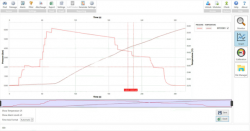
Live recording plot screenshot
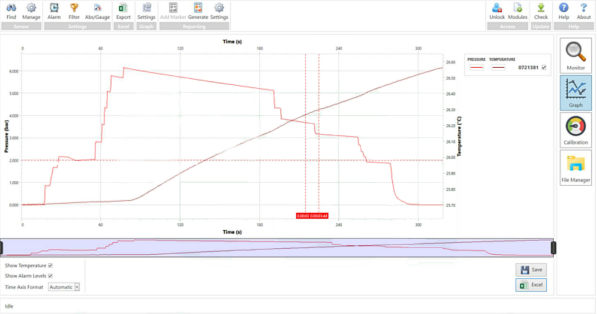
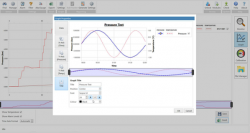
Plotting graphics setup screenshot
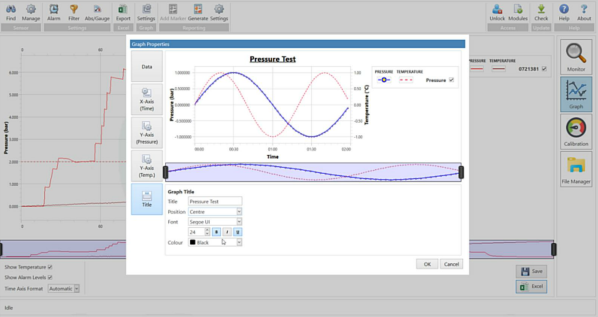
Test certificate generator setup screenshot
Example test certificate generated by software
Related Documents
Specification data sheet
Request Product Price
"*" indicates required fields