
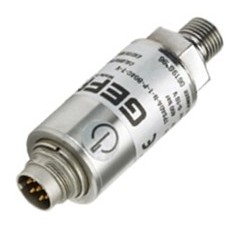
Contactless zero tare & span adjustment high pressure transmitter with 4-20mA current loop or amplified voltage output signal in pressure ranges from 4 bar up to 1000 bar gauge.
The TPSADA series is an advanced high-pressure transmitter specifically designed to address long-term signal drift through a contactless digital calibration system. Building upon the robust mechanical foundation of the high-pressure series, this model integrates a specialized “Digital Autozero & Span” electronics board, allowing operators to recalibrate the sensor in the field without opening the housing or utilizing complex handheld terminals. This transmitter is ideal for high-precision hydraulic applications where maintaining a perfect zero offset is critical over extended maintenance cycles.
Product Parameters
- Pressure Ranges: Available from 0…4 bar up to 0…1000 bar gauge.
- Accuracy: 0.1% FS typical for ranges 100 bar and above; 0.15% FS for lower ranges.
- Output Signals: 4-20mA current loop or multiple amplified voltage options (0-10V, 0.1-10.1V).
- Housing Length: Extended 75mm body to accommodate specialized digital calibration electronics.
- Calibration Signal: Internal 80% full-scale signal available for system verification.
- Reset Functions: Integrated partial and total reset options to return to factory calibration.
- Electrical Connections: Plug and cable options with IP65 to 67 protection rating
- Pressure Connections: BSP, NPT, UNF and metric threads, male or female
- Special Features: Auto zero & span calibration setting via magnetic pen
Product Description
The primary innovation of the TPSADA series is the elimination of mechanical potentiometers, which are traditional weak points in industrial sensors due to vibration-induced shifts and environmental ingress. Instead, the unit utilizes a magnetic-head pen to interact with internal hall-effect sensors located behind the stainless steel housing. This digital interface allows for “Coarse” and “Fine” zero adjustments, ensuring the 4-20mA or voltage floor remains precise even as the sensing element ages or undergoes thermal cycling.
Because the calibration is performed digitally, the sensor maintains superior stability compared to analog-trimmed units. The internal electronics also provide a “CAL” function, which simulates a pressure load of 80% of the full scale. This feature is invaluable for commissioning and troubleshooting, as it allows engineers to verify the entire signal chain, from the sensor through the cabling to the PLC, without applying actual hydraulic pressure. To accommodate these additional features, the TPSADA features a slightly longer 75mm body while maintaining the same rugged 17-4 PH stainless steel wetted parts found in the standard series.
Product Features
The TPSADA series incorporates a range of advanced electronic design choices to ensure long-term stability, user-friendly field maintenance, and superior performance in demanding industrial environments. By leveraging digital calibration and high-performance circuitry, these transmitters offer reliability that exceeds traditional analog sensing solutions.
Contactless Calibration
This system allows operators to adjust zero and span settings directly through the sealed stainless steel housing. By eliminating the need to open the sensor enclosure, the unit maintains its full environmental integrity, preventing the ingress of moisture, dust, or contaminants that could compromise the internal electronics during maintenance.
Magnetic Pen Activation
Adjustment is performed using a simple, user-friendly magnetic tool. This intuitive interface requires no specialized software, laptops, or complex programming terminals, making it ideal for field technicians who need to perform quick calibrations in remote or difficult-to-access locations.
Zero-Drift Correction
Over time, sensors can experience minor lifecycle-related drifts in their zero-point output. The TPSADA provides an easy, reliable path to correct these shifts in the field, ensuring the sensor remains accurate without the need to remove it from the process line, thus minimizing operational downtime.
No Internal Potentiometers
Traditional industrial sensors often rely on mechanical potentiometers, which are susceptible to vibration-induced shifts and wear. By removing these mechanical components, the TPSADA achieves enhanced reliability in high-vibration environments, such as heavy industrial presses and mobile hydraulic machinery.
80% FS Calibration Signal
The transmitter features an integrated shunt-style calibration signal that can be activated electronically. This allows engineers to simulate an 80% full-scale pressure load, enabling quick, safe verification of the entire measurement loop—from the sensor through the cabling to the PLC—without needing to apply actual hydraulic pressure.
Factory Reset Capability
For peace of mind during field configuration, the sensor includes a robust factory reset function. This allows the user to clear all manual adjustments and return the unit to its original, precise factory-calibrated settings, ensuring a clean slate if any configuration errors occur.
Infinite Resolution
The TPSADA utilizes high-performance, advanced electronics to process the sensor signal. Unlike stepped digital solutions, this architecture ensures a smooth, continuous, and infinite resolution signal output, providing the precision required for high-accuracy hydraulic control applications.
Product Applications
The TPSADA series is designed for versatility and reliability, offering high-precision pressure sensing across diverse industrial landscapes. Its advanced digital calibration capabilities and robust build quality make it an ideal choice for challenging environments where accuracy, accessibility, and durability are paramount.
Remote Process Monitoring
The TPSADA is exceptionally well-suited for installations where sensors are located in remote or difficult-to-access areas, such as high-altitude pipelines or deep-well pumping systems. Because the sensor features contactless calibration via a magnetic pen, maintenance personnel can perform zero-point adjustments without the need for complex, time-consuming bench recalibration, effectively eliminating the risk of system downtime caused by restricted accessibility.
High-Vibration Hydraulics
In heavy-duty industrial environments—such as stamping presses, injection molding machines, and mobile hydraulic platforms—vibration is a constant factor that degrades traditional sensors. The TPSADA eliminates the mechanical potentiometers found in legacy designs, ensuring that vibration cannot induce signal drift or mechanical wear. This makes it the standard choice for machinery where structural integrity and sensor signal consistency must be maintained despite continuous, high-amplitude mechanical shock.
Precision Test Benches
Research and development facilities often require frequent verification and calibration cycles between tests to ensure absolute data integrity. The TPSADA facilitates this workflow by providing a simple, repeatable method for zero-point validation. Technicians can use the magnetic pen to verify and reset the sensor zero state in seconds, ensuring that measurement cycles are always starting from a verified, accurate baseline without moving the equipment to a laboratory environment.
Sub-Station Monitoring
In automated sub-stations and grid-connected infrastructure, pressure sensors often run for years with minimal oversight. The TPSADA’s long-term stability—derived from its digital-first electronics architecture—minimizes the drift typical of aging sensors. This reliability ensures that automated systems continue to receive precise, drift-free pressure data over extended periods, reducing the frequency of required manual interventions and site visits.
Field Service Equipment
For portable hydraulic power units and field diagnostic kits, durability and ease of configuration after transport are critical. The TPSADA allows for rapid recalibration in the field, enabling technicians to correct any shifts in signal caused by physical handling or environmental temperature changes during transport. This ensures the equipment remains “ready-to-operate” regardless of where it is deployed, providing laboratory-grade accuracy in a portable, field-rugged package.
Product Specifying Guide
Determine the required range and output
Select the nominal pressure range (e.g., 400 bar) and the desired output signal (e.g., Code E for 4-20mA). Ensure the range is appropriate for the application’s operating pressure to maximize the resolution of the digital adjustment window.
Select the electrical connector
Choose a connector that supports the desired calibration functions. While all connectors support the magnetic pen “Autozero,” specific versions like the 6-pole bayonet (Code V) or 7-pole M16 (Code P) include dedicated pins for the CAL function, allowing for remote activation of the 80% signal.
Specify accuracy and response dynamics
Confirm the accuracy requirement (standard is ± 0.1% FS typical). If the application involves high-frequency pressure spikes, specify the “Fast” response time option (Code V) to ensure the electronics can track transients of less than 1 millisecond.
Confirm process connection
Match the transmitter to your existing manifold or pipework. Common options include G 1/4 male or 1/4-18 NPT. Given the TPSADA’s internal design, the unit remains insensitive to installation torque regardless of the thread type chosen.
Part Number Builder
Generate or decode TPSADA ordering code
Installation & Operation Guide
Mechanical installation
Mount the transmitter into the process port using a 22mm wrench. Ensure that the labels for “Autozero” and “Span” on the housing are visible and accessible to the operator for future calibration tasks.
Performing a digital autozero
With the system at zero pressure, place the magnetic pen against the “Z” target on the housing. Hold the pen in place for 1 to 10 seconds. The electronics will automatically adjust the output signal (e.g., to 4mA or 0V) and store the new offset in memory.
Activating the CAL signal
To verify the signal loop, apply the magnetic pen to the “S” target for 1 to 10 seconds (with no pressure) or close the contact between the CAL pins on the electrical connector. The output will immediately shift to 80% of the full-scale value for diagnostic verification.
Fine-autozero adjustment
If a more precise zero point is needed after a coarse adjustment, “tap” the magnetic pen against the “Z” target for less than one second. Each tap will shift the output signal by a small, discrete increment, allowing for highly granular control of the zero floor.
Total factory reset procedure
To clear all field-performed zero and span adjustments, place the magnetic pen on the “Autozero” target and hold it for more than 60 seconds. The output signal will fluctuate (typically rising to 7mA for current models) to indicate the reset is complete, restoring the original factory calibration values.
Product Help
Magnetic pen distance requirements
Does the magnetic pen need to touch the metal housing to trigger the calibration?
The pen should be held as close to the target label as possible, ideally touching the surface. The internal Hall-effect sensors detect the magnetic field through the stainless steel wall, so maintaining direct contact ensures the most reliable trigger.
Calibration limits
Is there a limit to how much the zero point can be adjusted?
Yes, the digital autozero function operates within a defined window (typically ±10% of the full scale). If the sensor has drifted beyond this limit due to extreme overpressure or damage, the autozero function will not activate, indicating that the unit requires factory service.
Partial vs total reset
What is the difference between a partial reset and a total reset?
A partial reset (holding the pen for 30 to 60 seconds) restores only the factory zero setting while keeping any custom span adjustments. A total reset (holding for over 60 seconds) clears all field settings and restores both the zero and span to factory-shipped specifications.
Span adjustment pressure requirements
Can I set the span at a pressure lower than the full scale of the sensor?
The autospan function is calibrated to recognize a pressure value within ±5% of the nominal full scale. Attempting to set the span with significantly lower pressure will result in an error, and the calibration will not be saved.
Cal pin remote activation
How do I trigger the 80% signal remotely without using the magnetic pen? For units equipped with 6-pole (V) or 7-pole (P) connectors, you can trigger the CAL signal by short-circuiting the designated pins (E-F for bayonet; 5-6 for M16). This is commonly done using a relay or switch in the control cabinet to verify the system’s operational readiness.
Related Documents
Specification data sheet
Operating manual
Request Product Price
Please select the options you require for the TPSADA Digital Auto-Zero High Pressure Sensor in your application and request a quote.