
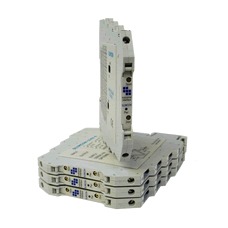
The Slimcon-6 Signal Converter is the ultimate low cost, high accuracy compact signal converter.
- Any 4-20mA or DC Voltage input
- Full 3-Port Isolation
- User Configurable
- High Accuracy, Low Cost
- Ultra Compact Slim design
Product Description
The Slimcon-6 signal converter is an ultra compact isolating signal conditioner which can convert and isolate virtually any 4-20mA or voltage input and provide an isolated mA or voltage output.
The unit is a DC powered signal converter which can accept any 4-20mA or voltage input and provide an isolated 4-20mA or voltage output.
The Slimcon-6 is housed in an ultra slim 6.4mm DIN rail enclosure saving panel space and money.
The input and output configuration can be user selected using DIP switches and the zero and span potentiometers allow easy non-interactive adjustment of the unit i the field.
The Slimcon-6 is the ultmate low cost, high accuracy compact signal conditioner.
Product Ordering Info
- SKU ID: s1-slimcon-0001
- Part No: II-SLIMCON-6-JJ-000
- Input Types: 4-20mA, 0-20mA, 0-10mA, 0-10V, 2-10V, 0-5V, 1-5V – switch selectable
- Output Types: 4-20mA, 0-20mA, 0-10V, 0-5V, 1-5V – source/sink, switch selectable
- Power Supply: 18-30Vdc, typical 24Vdc
- Isolation: Full 3-Port
- Installation Type: DIN Rail TS35
- Electrical Connections: Screw clamp with pressure plate
Product Help
Scaling a non-standard voltage signal
How can I convert a 0.5-5V signal from my sensor to a 0-10V signal required by my PLC, and how do I calibrate it?
You can achieve this using a signal converter like the SLIMCON series. This unit acts as a signal amplifier and offsetter. It takes the non-standard 0.5-5V range and scales it to the standard 0-10V range.
While units can be factory configured for this specific range, they can also be adjusted in the field. The SLIMCON features Zero and Span potentiometers for fine-tuning.
The calibration process would be:
- Set Zero: Provide a 0.5V input signal to the converter. Adjust the “Zero” potentiometer until the unit’s output measures exactly 0.0V.
- Set Span: Provide a 5.0V input signal. Adjust the “Span” potentiometer until the output measures exactly 10.0V.
- Verify: Re-check the zero point (0.5V in -> 0V out) as the span adjustment can sometimes slightly affect the zero. Repeat the process if necessary.
This allows the converter to “learn” that 0.5V from the sensor represents 0% of the process variable (mapping to 0V) and 5.0V represents 100% (mapping to 10V). The unit also accepts a wide range of other inputs, such as 0-5V, 1-5V, or 4-20mA, which can be selected via internal switches before calibration.
Benefits of 3-port isolation in signal conditioning
The product literature mentions “Full 3-Port Isolation.” What is this, and why is it important for my application?
Full 3-port isolation (also called 3-way isolation) means that the SLIMCON signal converter electrically separates three distinct parts of the system from each other:
- The Input: The connection from your sensor.
- The Output: The connection to your PLC, DAQ, or control system.
- The Power Supply: The 24Vdc used to power the converter itself.
This isolation is a critical feature for maintaining signal integrity and protecting equipment in industrial environments.
Key Benefits:
- Eliminates Ground Loops: This is the most common reason to use an isolator. Ground loops occur when a sensor in the field and a PLC in a control cabinet are grounded at different points. These points often have a small voltage difference, which creates a circulating current (a “loop”) that adds noise and error to your measurement. 3-port isolation breaks this electrical loop.
- Protects Equipment: It prevents a high-voltage transient, short-circuit, or fault on the sensor (input) side from travelling through the converter and damaging the expensive input card of your control system (output).
- Rejects Power Supply Noise: By isolating the power supply, it prevents electrical noise from the 24Vdc rail (which may be shared with noisy devices like motors or relays) from “leaking” into your sensitive measurement signal.
For example, if your sensor is mounted on a large machine frame and your PLC is in a control room 50 metres away, it’s highly likely they have different ground potentials. A 3-port isolator ensures the 0-10V signal received by the PLC is clean, accurate, and free from ground-loop interference.
Field configuration using zero and span potentiometers
Can I re-configure a SLIMCON converter in the field if my application requirements change, or do I need to order a new unit?
The SLIMCON series is designed for flexibility, allowing for both factory configuration and field-level adjustment. If your requirements change, for example, you need to switch from a 1-5V input to a 0-5V input, or adjust the output to 4-20mA, you can often re-configure the existing unit.
The unit contains internal switches that allow you to select the coarse input and output ranges (e.g., change from a voltage input to a current input).
After setting the switches for the new range, you use the accessible Zero and Span potentiometers to fine-tune the output precisely.
Practical Example: Imagine you want to change a unit from a 0-10V output to a 4-20mA output.
- You would first set the internal switches to select the “Current Output” (mA) range.
- Connect your 0V input signal and adjust the Zero pot until the output measures exactly 4.0mA.
- Connect your 10V (or maximum) input signal and adjust the Span pot until the output measures exactly 20.0mA.
This capability is extremely useful for technicians during commissioning and maintenance, as it allows a single model to be adapted for various tasks, reducing the need to stock multiple spare part numbers.