

Modernizing the instrumentation on a heritage vessel often presents a unique challenge: balancing the need for accurate data with the necessity of preserving the original structure. For a vessel built over 100 years ago, any modification such as drilling or welding to a fuel tank is strictly avoided to maintain historical integrity and structural safety. This application story details a non-invasive retrofit using a diesel-compatible hydrostatic sensor installed through a legacy valve, providing a precise 4-20mA signal for continuous level monitoring.
- Preservation of heritage tank integrity by avoiding new penetrations or drilling.
- Utilization of existing lower manifold valves for hydrostatic measurement of the fluid head.
- Selection of aromatic-hydrocarbon-resistant materials including FKM seals for diesel longevity.
- Integration of vented cable technology for automatic barometric compensation in varied marine environments.
The restoration and maintenance of a heritage vessel dating back more than 100 years requires instrumentation solutions that prioritize structural preservation. In this specific marine application, the operator of a historic boat required a reliable method for monitoring diesel fuel levels without the risk associated with drilling or welding new entry points into the original tank. The technical challenge involved finding a sensing technology that could be adapted to a legacy configuration—specifically, an unused generator pickup valve located at the lower side of the tank. By utilizing this existing tapping point, the installation remains entirely non-invasive, respecting the craftsmanship of the early 20th-century hardware while enabling modern digital monitoring.
The solution centers on the hydrostatic principle, where a sensor measures the pressure exerted by the liquid column directly above its installation point. For a tank depth with a height difference of just over one meter, a piezoresistive sensing element provides the necessary sensitivity to detect minute changes in head pressure. Because the sensor is positioned at the base of the tank through the former generator valve, it effectively measures the static head of the diesel fuel. To ensure long-term reliability in a marine environment, the sensor construction must feature media compatibility specifically tailored for diesel. This necessitates a stainless steel housing and a 316L stainless steel sensing diaphragm, paired with FKM (Viton) seals to prevent degradation or swelling from the fuel’s chemical composition.
To maintain accuracy despite fluctuating weather conditions and cabin pressure, the system employs a vented reference. This is achieved through a specialized cable containing an internal capillary tube that vents the back of the sensing diaphragm to the atmosphere. This atmospheric compensation ensures that the sensor only measures the pressure of the fuel itself, rather than a combination of fuel and barometric pressure. The 18.605 G series is particularly suited for this role; while typically used in a submersible format, its design allows for the removal of the protective nose cone to reveal a G1/4 male thread according to DIN 3852. This allows the device to be threaded directly into the existing valve manifold or an appropriate adapter, converting it into a robust screw-in transmitter.
Electrically, the system integrates seamlessly with standard marine monitoring equipment. The 4-20mA two-wire current loop output is a robust choice for the high-EMI environment of an engine room, providing a signal that is resistant to voltage drops over long cable runs. Powered by the onboard 12V or 24V DC supply, the loop-powered configuration simplifies wiring by carrying both the power and the signal on the same pair of conductors. This modernization provides the operator with continuous, high-resolution data on fuel reserves, ensuring operational safety during extended voyages without compromising the historical value of the vessel’s original infrastructure.
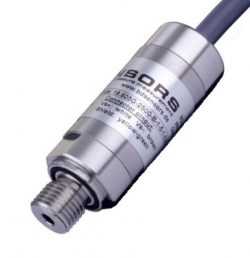
18.605 G Submersible Diesel Fuel Level Transmitter
- Part No: 18.605G-1000-M-1-5-1-006-300-1-000
- Measuring Range: 1 mH2O (3.28 ftH2O)
- Reference Type: Gauge / Vented (atm to +P)
- Output Signal: 4-20mA, 2 wire
- Accuracy: 0.5% FSO
- Electrical Connection: IP68 submersible cable
- Cable Type: PVC (70degC max)
- Cable Length: 6 metres (19.69 feet)
- Housing Material: Stainless Steel 304
- Diaphragm Material: Stainless Steel 316L
- Media Exposed Seals: FKM
- Mechanical Connection: G1/4 male