
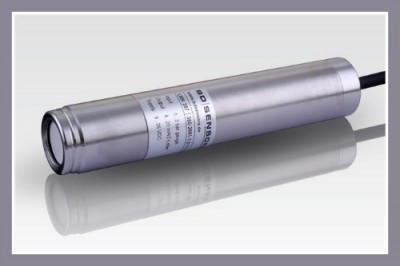
Rugged and easily cleanable pressure/level sensor for use with waste water sewage or sludge. The LMK387 has a small diameter of 22mm and the option for rear mounting into 1 inch diameter pipe for extra protection of cable from damage by floating debris.
Product Parameters
- Hydrostatic Pressure Range: from 0.4 up to 20 bar or 4 up to 200 mWG
- Accuracy: 0.35% or 0.25% FS IEC 60770
- Output Signal: 4-20mA, 2 wire current loop
- Electrical Connection: IP68 submersible gland with PUR, FEP or TPE-U shielded cable
- Pressure Connection: Flush ceramic diaphragm with protective nose cone, G3/4 flush male, G1/2 open port male
- Media Compatibility: Stainless steel 316L body, Ceramic Al2O3 (96%) diaphragm, FKM, FFKM or EPDM seal gasket plus selected cable jacket
- Dimensions: 22 mm diameter
- Weight: 180 g
- Special Options: ATEX certified to II 1 G EEx ia IIC T4 and II 1D Ex iaD 20 T 85°C, vented cable junction box with PT100 transmitter and/or overvoltage protection circuit, stilling pipe mounting, 125 degC max temperature for submersion with TPE-U cable, Drinking water certificate, HART communications
Product Description
This all purpose sensor comes with many installation option for measuring the level or pressure of wastewater.
The submersible wastewater level measurement version can be installed with or without a nose cone, which can be easily removed for cleaning any build up of sludge on the diaphragm surface that might diminish the performance of the sensor. A tapered R1/2 (1/2 BSPT) thread can be specified on the backend cable exit assembly for mounting into 1 inch diameter stilling pipe.
The external mount version comes with the choice of a G3/4 (3/4 BSPP) male thread mount with flush diaphragm or G1/2 (1/2 BSPP) male thread with open port. Both styles of process connection allow easy access to the sensing diaphragm for removing sewage and sludge deposits. The same IP68 sealed cable exit as the submersible version is used for the external mount version to protect the sensor from flooding or surrounding area cleaning processes.
The LMK 387 can be used in hazardous areas on waste water treatment works which require ATEX or IECEx intrinsically safe approval to eliminate ignition sources where flammable bio-gases are present.
Product Applications
- Bio-sludge level
- Sludge pump pressures
Product Help
Seawater compatibility for stainless steel level probes
Is a 316L stainless steel housing suitable for level measurement in tanks intermittently filled with seawater?
While 316L stainless steel (1.4404) is the standard housing material and offers excellent resistance to many industrial fluids, its suitability in seawater depends on the duration of exposure and maintenance practices. For applications where the tanks are “washed down daily” after seawater use, 316L provides a cost-effective and durable solution. However, for permanent immersion in seawater or environments where rinsing is not feasible, an optional titanium housing is recommended to prevent pitting and crevice corrosion. The sensor also utilizes various elastomer options, such as FKM or EPDM, to ensure the seals remain intact when exposed to different water qualities and chemical fire retardants.
Boat holding and sludge tank level senders
We have need of two senders that need to be a 4-20milliamp. One will be in a boats holding tank and about 1,2m deep, the other will be in a sludge tank and will be about 600mm deep. The holding tank is aluminium and the sludge tank is a plastic tek tank. I would be looking at suspending them upside down screwed into a tube that is fixed to the underside of a removeable lid. Can I have some guidance on what would be suitable?
We would suggest the LMK387 which is a submersible device that suspends into the tank by its cable, and you can clamp it in some form of cable gland in the lid of the tank. The sensor has the option for an R1/2 thread incorporated into the cable gland assembly on the back of the sensor, so that it can be screwed into the bottom of a stainless steel tube.

Holding tank
- SKU ID: s1-lmk387-6-63783
- Pressure Range: 0 – 1.6mWG
- Reference Type: Gauge / Vented (atm to +P)
- Output Signal: 4-20mA, 2 wire
- Accuracy: 0.35% FS
- Installation Type: Submersible Version
- Housing Material: Stainless Steel 316L
- Diaphragm Material: Ceramic Al2O3 96%
- Media Exposed Seals: FKM
- Cable Type: TPE-U
- Cable Length: 10
- Cable Length Units: Metres (m)
- Optional Extras Included: Prepared with R1/2 thread for mounting with stainless steel pipe
Sludge tank
- SKU ID: s1-lmk387-6-63783-2
- Pressure Range: 0 – 0.6mWG
- Reference Type: Gauge / Vented (atm to +P)
- Output Signal: 4-20mA, 2 wire
- Accuracy: 0.35% FS
- Installation Type: Submersible Version
- Housing Material: Stainless Steel 316L
- Diaphragm Material: Ceramic Al2O3 96%
- Media Exposed Seals: FKM
- Cable Type: TPE-U
- Cable Length: 10
- Cable Length Units: Metres (m)
- Optional Extras Included: Prepared with R1/2 thread for mounting with stainless steel pipe
Selecting crush-resistant cabling for mobile tank systems
What cable options are available to protect the internal atmospheric reference tube from mechanical pinching in dynamic retraction systems?
In mobile or “dynamic” applications where the sensor cable is subject to constant movement, the risk of crushing the internal ventilation tube (which provides the atmospheric pressure reference for gauge measurement) is high. To mitigate this, a heavy-duty TPE-U (Thermoplastic Elastomer Polyurethane) cable with a 9.0 mm outer diameter is used. This cable is significantly more robust than standard 7.4 mm PUR options. For these installations, it is essential to adhere to the specified bending radius: a 10-fold cable diameter for static mounting and a 20-fold diameter for “dynamic applications” to prevent internal tube occlusion or conductor fatigue.
Tank measurements required to specify sensor range
Do you need to know tank dimensions and volumes when ordering these sensors or is this normally a setup process when commissioning them?
Only the vertical height of the tank is necessary to specify the range of the sensor when ordering. These are hydrostatic level sensors so they measure the pressure created from the head of liquid above them, it is not volume dependant. If your tank is 3m in height then you would get a 4mA output at empty, 12mA at 1.5m and 20mA signal at 3m full (and every measurement in between). You will need to know the tank shape formula for calculating the volume from the vertical fill height in order to determine the tank contents from the liquid level. It is a non linear relationship between level and volume for a tank that has a varying cross sectional area in the horizontal plane.
Membrane bioreactor head pressure
We are looking for a low pressure transmitter for measuring the 3 metre head pressure on an MBR for sewage?
We would suggest a standard 400 mbar gauge range version of the LMK 387 to measure the 3 metre head pressure of the sewage.
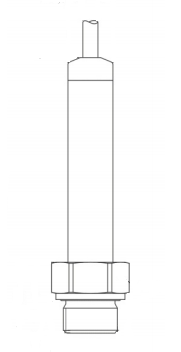
In addition we would also suggest the 3/4 BSP male thread fitting and flush diaphragm to prevent any clogging caused by solids suspended in the sewage on the pre-treatment side of the membrane bioreactor.
The sensor also has includes a submersible cable connection so it is protected from spillages or even continuous immersion if required, and ATEX IS approval for use in designated hazardous zones.
- SKU ID: s1-lmk387-25-15170
- Part No: 360-4000-1-B-2-E-1-2-3-010-000
- Pressure Range: 0 to 0.4 bar gauge
- Reference Type: Gauge / Vented (atm to +P)
- Output Signal: 4-20mA, 2 wire, Intrinsic Safety
- Accuracy: 0.35% FS
- Installation Type: Screw-in version
- Housing Material: Stainless Steel 316L
- Diaphragm Material: Ceramic Al2O3 96%
- Media Exposed Seals: FKM
- Process Connection: G3/4 male with flush diaphragm
- Cable Type: PUR (70degC max)
- Cable Length: 10
- Cable Length Units: Metres (m)
Field maintenance and calibration protocols for submersible level sensors
What are the recommended service procedures for ensuring the long-term accuracy of a ceramic-diaphragm level probe?
Long-term stability for this sensor series is rated at 0.1% FSO per year. To maintain this performance, a 12-month calibration cycle is recommended to verify the device remains within its specified accuracy of 0.35% (or 0.25% optional) FSO. In terms of physical maintenance, the device features a “removable protection cap”. This allows technicians to manually inspect the flush ceramic diaphragm for any biological growth or debris accumulation that could affect response time. Cleaning should be performed gently to avoid scratching the Al2O3 surface. Furthermore, the IP 68 ingress protection ensures the internal electronics remain dry even during deep immersion, provided the cable’s atmospheric reference tube is correctly terminated in a dry area or terminal box with an overvoltage protection unit.