
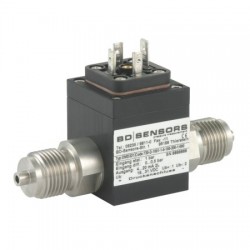
Wet wet differential pressure sensor with a high overpressure rating on both positive and negative side port for protection against accidental diaphragm damage.
The DMD 331 is an industrial differential pressure transmitter based on a piezoresistive stainless steel sensor designed for measuring differential pressure in liquids and gases compatible with 1.4404 (316L) and 1.4435 (316L) stainless steel. It measures differential pressure ranges from 0…20 mbar up to 0…16 bar with line static pressures up to 60 bar, delivering high mechanical robustness and dynamic response times under 5 ms. Offering standard analog output signals including 2-wire 4…20 mA and 3-wire 0…10 V, alongside optional intrinsically safe Ex ia versions (ATEX/IECEx certified) for hazardous environments, the device provides accurate measurements according to IEC 61298-2 with standard accuracy down to ≤ ±0.5% FSO. Its compact design with aluminum housing and IP 65 protection makes it an optimal solution for plant engineering, hydraulic monitoring, flow measurement, and filter differential pressure evaluation.
Product Parameters
- Pressure Ranges: from 200 mbar up to 16 bar differential
- Static Line Pressures: from 0.2 up to 16 bar including on one port only
- Accuracy: ±0.5% of full scale (IEC 60770)
- Output Signal: 4-20mA or 0-10V
- Electrical Connections: DIN43650A plug and Brad Harrison mini change
- Pressure Connection: G1/2, 7/16 UNF male and G1/4 female
- Media Compatibility: Stainless steel 316L, FKM seals
- Dimensions: 48 x 40 x 40 mm excluding connectors
- Weight: ~250g
- Special Features: High overpressure
- Special Options: ATEX approved intrinsic safety
Product Description
The DMD331 is an unconventional design for measuring differential pressure, in that two separate pressure sensors are utilised inside to measure the pressure at two ports. The difference between the two measurements are subtracted to create the differential pressure output signal.
The main advantage of this type of sensor is that full line pressure can be applied to one side without damaging the sensor. This also makes it unnecessary to incorporate a complex mechanical protection device, keeping size to a minimum dimensions and reduces the cost compared to more conventional differential pressure sensor technology.
The DMD 331 has 6 nominal pressure range from 0-0.2 bar up to 0-16 bar differential and each range has a choice of sub-ranges which can be selected depending on the required level of overpressure rating.
The lowest possible scaled pressure range is 0 to 20 mbar differential and this can withstand a 500 mbar overpressure and 200 mbar continuous line pressure on either the positive or the negative port.
The differential pressure signals can be transmitted as linear 4-20mA or 0-10Vdc analog output.
The all stainless steel 316L DMD 331 wet wet differential pressure sensor is suitable for use with compatible liquids down to relatively low differential pressures.
The compact size of the DMD-331 dp sensor makes it ideal for use in dense instrumentation packages where there is very little space between components for fitting a conventional dp transmitter.
Product Applications
Industrial Filtration Systems
The DMD 331 is ideal for monitoring differential pressure across various industrial liquid and gas filtration systems. By measuring the pressure drop across filters, the transmitter helps operators identify clogging or saturation, enabling timely maintenance and preventing process downtime caused by restricted flow.
Fluid Flow Measurement
This transmitter enables accurate flow rate measurement by evaluating pressure drops within fluid distribution pipelines. Its precise sensing capabilities allow for reliable calculation of flow velocity and volumetric throughput, which is essential for optimizing system efficiency and ensuring consistent performance in fluid transfer networks.
Hydraulic and Pneumatic System Monitoring
In heavy machinery and complex manufacturing equipment, the DMD 331 is used for essential hydraulic and pneumatic system monitoring. Its robust design and high-pressure tolerance allow it to provide critical feedback on system health, detecting potential leaks or pressure imbalances before they lead to mechanical failures.
Self cleaning water filter
Monitor the differential pressure drop across a water filter to determine when it is necessary to perform the self cleaning process.
- SKU ID: s1-dmd331-0002
- Part No: 730-D-6000-1-8-100-J00-1-000
- Differential Pressure Range: 0 to 0.6
- Units: bar
- Maximum Line Pressure: 6
- Units: bar
- Output Signal: 4 – 20mA, 2-wire
- Accuracy: 1% full scale
- Electrical Connection: DIN plug and socket
- Process Connection: G1/4 female
- Media Compatibility: Stainless steel 316L, FKM seals
Plant and Machine Process Control
The device serves as a reliable instrument for general plant and machine engineering process control. Its versatile output options and accurate measurement performance make it suitable for integration into automated control loops, ensuring precise regulation of process variables throughout the facility.
Energy Sector and Cooling Loops
Designed for the demanding energy sector, the DMD 331 excels at tracking differential pressure in water supply systems and cooling loops. By maintaining constant monitoring, it helps optimize thermal management and water distribution efficiency, which are critical for the longevity and performance of energy infrastructure.
Heat Exchanger Thermal Management
This transmitter facilitates effective pressure drop assessment in industrial heat exchanger networks. By monitoring the differential pressure across heat exchangers, it ensures optimal thermal transfer efficiency, helping to prevent fouling and maintaining the overall performance of industrial heating and cooling systems.
Oil filter health monitoring
Measure the differential pressure either side of an oil filter to monitor when it needs to be changed or cleaned.
- SKU ID: s1-dmd331-0005
- Part No: 730-D-3001-1-5-100-200-1-000
- Differential Pressure Range: 0 to 3
- Units: bar
- Maximum Line Pressure: 6
- Units: bar
- Output Signal: 4 – 20mA, 2-wire
- Accuracy: 0.5% full scale
- Electrical Connection: DIN plug and socket
- Process Connection: G1/2 male EN837
- Media Compatibility: Stainless steel 316L, FKM seals
Part Numbers
730-E-2501-1-5-100-200-1-000
- SKU ID: s1-dmd331-0004
- Part No: 730-E-2501-1-8-100-200-1-000
- Differential Pressure Range: 2.5
- Units: bar
- Maximum Line Pressure: 16
- Units: bar
- Output Signal: 4 – 20mA, 2-wire
- Accuracy: 1% full scale
- Electrical Connection: DIN plug and socket
- Process Connection: G1/2 male EN837
- Media Compatibility: Stainless steel 316L, FKM seals
Product Specifying Guide
Step 1: Select the differential pressure and line pressure ranges
Determine the nominal differential pressure range required for your application, spanning from 0…0.02 bar up to 0…16 bar. Ensure that the system maximum line static pressure and single-sided overload potential do not exceed the transmitter’s rated static limit, which ranges from 0.5 bar up to 60 bar depending on the baseline range.
Step 2: Choose the output signal and power supply configuration
Select standard 2-wire 4…20 mA (12…36 VDC supply) for conventional industrial loops, 3-wire 0…10 V (14…36 VDC supply) for voltage-input controllers, or intrinsically safe 2-wire 4…20 mA (14…28 VDC supply) for hazardous locations requiring Ex ia certification.
Step 3: Verify measurement accuracy requirements
Evaluate system accuracy needs, specifying either standard accuracy of ≤ ±0.5% FSO according to IEC 61298-2 or ≤ ±1% FSO based on the required differential pressure range and turn-down ratio.
Step 4: Specify process connections
Select mechanical pressure port connections matching system piping, including G1/2″ EN 837, internal G1/4″, or G7/16″ UNF threads.
Step 5: Confirm media and environmental compatibility
Confirm that process fluids are compatible with 1.4404 (316L) stainless steel pressure ports, 1.4435 (316L) sensor diaphragms, and FKM seals. Verify operating temperatures fall within -25…125 °C for media and -25…85 °C for ambient electronics.
Part Number Builder
Generate or decode DMD 331 ordering code
Installation & Operation Guide
Step 1: Safety check and mechanical mounting
Ensure the installation site is completely depressurized and de-energized prior to mounting. Secure the transmitter to a suitable mounting angle or bracket using the four M4 threaded mounting holes (10 mm depth) provided on the body housing. Ensure stress-free pipe assembly and never twist the pressure ports against the aluminum housing during installation.
Step 2: Connect process pressure lines
Connect system pressure lines so that the higher reference pressure attaches to input p+ and the lower reference pressure attaches to input p-. Tighten mechanical fittings to specified maximum torque limits: max 50 Nm for G1/2″ EN 837, max 20 Nm for G1/4″ internal thread, or max 30 Nm for G7/16″ UNF, holding the spanner flat SW 22 with a wrench during tightening.
Step 3: Execute electrical wiring
Wire the transmitter using a shielded, twisted multicore cable following the pinout on the manufacturing label. For ISO 4400 connector plugs, route cable through the gland (clamping diameter 4…6 mm), ensure the seal gasket is properly positioned between plug and socket, and tighten the retaining screw to maintain IP 65 sealing.
Step 4: Commissioning and pressure startup
Before energizing, verify all mechanical connections are leak-tight and electrical wiring is correct. During commissioning, apply process pressure simultaneously to both p+ and p- ports to avoid single-sided overpressure exceeding static thresholds. Once pressurized, apply DC power supply within specified limits (12…36 VDC standard or 14…28 VDC IS).
Step 5: Routine maintenance and cleaning
Periodically inspect the device for external contamination, corrosion, or signal drift. Clean outer housing using a damp cloth. If the pressure ports require cleaning, use compatible solvent liquids or non-aggressive gases; never use pointed mechanical tools or compressed air directly against the sensitive metal diaphragm.
Product Help
Differential pressure range capabilities
What differential pressure ranges and static line pressures does the DMD 331 transmitter support?
The DMD 331 covers differential pressure spans from 0…20 mbar up to 0…16 bar across nominal pressure ranges of 0.2 bar, 0.4 bar, 1 bar, 2.5 bar, 6 bar, and 16 bar. One-sided static line pressure capability extends up to 30 times the differential pressure range, with maximum static pressures reaching up to 60 bar.
Media compatibility and construction materials
Which process fluids and gases can be measured with the DMD 331?
The DMD 331 is designed for liquids and gases compatible with stainless steel 1.4404 (316L) pressure ports, stainless steel 1.4435 (316L) diaphragms, and FKM elastomeric seals. Common applications include industrial water, hydraulic oil, compressed gases, and non-aggressive chemical fluids.
Hazardous area certification and intrinsically safe operation
Is the DMD 331 certified for operation in explosion-hazard environments?
Yes, intrinsically safe Ex ia versions (DX13A-DMD 331) are certified under ATEX IBExU08ATEX1125 X for Zone 1 (II 2 G Ex ia IIC T4 Gb) and Zone 21 (II 2 D Ex ia IIIC T85 °C Db)
Pressure line connection rules
How should process pressure lines be connected to avoid damaging the sensor?
System pressure lines must always connect the higher pressure side to port p+ and the lower pressure side to port p-. During system startup, pressure must be applied simultaneously to both ports to prevent excessive single-sided overpressure from shifting sensor calibration or damaging internal diaphragms.
Max line pressures and dp ranges
What are the maximum line pressures and differential pressure ranges that are suitable for this device?
The DMD331 is not a conventional DP type sensor, it uses two pressure sensors internally and subtracts the difference, therefore this limits the max line pressure for each DP range, due to the nominal range of each of the pressure sensors.
The permissible static pressure in the table below represents the maximum over-pressure on one side which is intended for protection from brief abnormal operating conditions, and the nominal pressure represents the maximum static line pressure and the 100% base pressure range.

4-20mA range adjustment
Can the 4-20 mA range be varied e.g we would like it to measure over 0 to 3 bar?
The range is fixed and set in the factory and can’t be changed by the user. Alternatively you could consider the DPT200 rangeable dp transmitter which allows the user to vary the 4-20mA output via HART communications or the built-in manual push buttons.
Nominal range for 0-2 bar dp with 10 bar line pressure
I have a 10 bar line pressure and want to measure a pressure drop which ranges from 0-2 bar, which nominal range should I select for the DMD 331?
To measure a 0 to 2 bar pressure drop, you can specify either 2.5, 6, or 16 bar nominal range for the sensor. However the 2.5 bar range only has a line pressure rating of 2.5 bar max, and therefore this would not be suitable since it is below the required 10 bar line pressure. Likewise a 6 bar nominal range would be limited to 6 bar line pressure. Therefore a 16 bar nominal range would provide ample line pressure capability up to 16 bar. The sensor output is then down-scaled in the factory to 2.5 bar for the 4-20mA differential output signal.
The table shows the standard pressure range options:
Nominal and Differential pressure range meaning
On the last page of the data sheet there are options for nominal pressure range and differential pressure , what does this mean and what nominal pressure do I need if I need a differential of 6 bar?
This sensor is different to a typical dp sensor in that it utilises two pressure sensing modules, one for each connection port, and subtracts the two pressure readings to determine the differential pressure reading. The main advantage to this style of dp sensor is it is possible to provide high one-sided over-pressure protection without relying on extra mechanical mechanisms, which increases cost, size and complexity.
The nominal pressure range refers to the max pressure range of each pressure sensor. For each nominal pressure range it is possible to provide a choice of differential pressure ranges down 1/10 of the nominal pressure range. The main reason for this is to provide the optimal dp range for the line pressure of the pressure system. For example if your system pressure is 16 bar, the minimum nominal pressure range you could choose would be 1.6 bar.
- SKU ID: s1-dmd331-56-28045
- Part No: 730-E-1601-1-8-100-J00-1-000
- Differential Pressure Range: 0 to 1.6
- Units: bar
- Maximum Line Pressure: 16
- Units: bar
- Output Signal: 4 – 20mA, 2-wire
- Accuracy: 1% full scale
- Electrical Connection: DIN plug and socket
- Process Connection: G1/4 female
- Media Compatibility: Stainless steel 316L, FKM seals
Input supply voltage for IS 4-20mA signal
What is the input voltage for the DMD331 with 4-20mA output and intrinsic safety?
Any voltage between 14-28Vdc between the connections to the transmitter.
Jet-A kerosene fuel filter
We are looking for a intrinsically safe 4-20mA sensor to measure differential pressure across a Jet-A kerosene filter, the line pressure runs up to 75 psi and the maximum DP we need to measure is 40 psi?
The BD Sensors DMD 331 is available in an ATEX approved IS version, and the 4-20mA output can be scaled to exactly 0 to 40 psi differential pressure, which can be used on line pressure up 87 psi.
- SKU ID: s1-dmd331-0003
- Part No: 730-D-9999-E-5-100-J00-1-000
- Differential Pressure Range: 40
- Units: psi
- Maximum Line Pressure: 87
- Units: psi
- Output Signal: 4 – 20mA, ATEX / IECEx IS, 2-wire
- Accuracy: 0.5% full scale
- Electrical Connection: DIN plug and socket
- Process Connection: G1/4 female
- Media Compatibility: Stainless steel 316L, FKM seals
100 kPa range with 6 bar overpressure rating
What is the limit on the differential pressure that can be applied to a DMD331 transducer, we have a max upstream pressure of 6 bar, and the differential pressure range is 0 to 100 kPa, so can it withstand the 6 bar?
If you select a 6 bar (600 kPa) nominal pressure with differential pressure scaling of 0 to 1 bar (100 kPa) a 6 bar differential will not damage the sensor.
The max pressure that can be applied to both ports, or one side only, without damaging the sensor is 6 bar g.
e.g. High side port = 6 barg, Low side port = 5 barg, will read 1 bar diff, in range, no damage
e.g. High side port = 6 bar g, Low side port = 0 bar g, out of reading range, but no damage
Engine intake & exhaust flow differential air pressure
I have an engine which needs a differential pressure sensor to measure air flow between the intake and exhaust manifolds that is close to meeting the following requirements:
- IMP range (intake side): 100 – 300 kPa absolute
- EMP range (exhaust side): 100 – 420 kPa absolute
- Engine delta P range: -15 to 160kPa
- Accuracy: 2%
- Response time: 4.7 ms
We would suggest the following DMD331 options for measuring the air flow differential pressure between air intake and exhaust which would have a maximum intake or exhaust side pressure rating of 600 kPa absolute:
- SKU ID: s1-dmd331-0001
- Part No: 730-C-9999-1-5-100-J00-1-000
- Differential Pressure Range: -15 to 160
- Units: kPa
- Maximum Line Pressure: 6
- Units: bar
- Output Signal: 4 – 20mA, 2-wire
- Accuracy: 0.5% full scale
- Electrical Connection: DIN plug and socket
- Process Connection: G1/4 female
- Media Compatibility: Stainless steel 316L, FKM seals
- Optional Extras: Compound range output signal (-P1 to +P2)
Related Documents
Specification data sheet
Request Product Price
Please select the options you require for the DMD331 Compact Differential Liquid Pressure Sensor in your application and request a quote.
"*" indicates required fields