
Measurement of liquid levels in bulk chemical storage tanks presents significant challenges when the media is highly corrosive. This case study focuses on an industrial application requiring continuous level monitoring of 33% Hydrochloric Acid (HCL). The specific challenges addressed include:
- Aggressive Media: High concentration HCL (33%) which attacks standard stainless steel sensors.
- Temperature Variance: Process temperatures fluctuating between 26degC and 45degC, increasing the corrosive potential of the acid.
- Material Compatibility: The necessity for specialized wetted parts, including housing, seals, and cable sheaths, to ensure sensor longevity.
- Sensor Purity: The requirement for high-purity ceramic diaphragms to prevent long-term degradation.
A process engineer at an industrial facility, located in a region with significant mining and extraction activities, required a solution for monitoring the inventory of a chemical storage tank. The application involved a 3-meter high storage tank containing a 33% solution of Hydrochloric Acid (HCL). HCL is a highly aggressive medium often used in ore processing and water treatment, and its corrosive nature rules out the use of standard stainless steel submersible pressure transmitters. The engineer specified that the level transmitter needed to be fully submersible within the liquid, rather than externally mounted, to simplify installation and reduce leak paths associated with bottom-mounted fittings. A critical concern raised by the facility’s compliance team was the chemical compatibility of the sensor materials, particularly given the operating temperature range of 26degC and 45degC. As temperature increases, the reactivity and corrosive power of HCL accelerate, often causing rapid failure in materials that might survive at ambient temperatures.
To address the aggressive nature of the media and the thermal conditions, the LMK 809 plastic submersible probe was selected as the product solution. This series is specifically designed for continuous level measurement in waste water and most aggressive media, including acids and lyes. The standard configuration for this sensor series typically utilizes a Polypropylene (PP) housing; however, for 33% HCL, Polyvinylidene Fluoride (PVDF) was selected for the housing material. PVDF offers superior chemical resistance and mechanical stability at higher temperatures compared to PP, ensuring the probe body remains intact despite the 45degC peak temperature.
The internal composition of the sensor is equally critical for survival in this application. The LMK 809 utilizes a capacitive ceramic sensor as its basic element. While earlier generations of similar sensors utilized 96% Aluminium Oxide (Al2O3), field experience has shown that this purity level can eventually succumb to concentrated HCL over several years. Therefore, this solution was specified with a high purity 99.9% (Al2O3) ceramic diaphragm. This upgrade significantly enhances the sensor’s resistance to chemical attack, providing a robust long-term solution. The sensor is flush-mounted, which also facilitates easier cleaning should any solid parts or sludge from the medium deposit on the diaphragm.
Completing the chemically resistant barrier, the elastomeric seals and the electrical cable were customized for the application. Standard FKM or EPDM seals are often insufficient for high-concentration acids. Consequently, Perfluoroelastomer (FFKM) seals were chosen to ensure the integrity of the joint between the ceramic sensor and the PVDF housing. Finally, the submersible cable connecting the sensor to the control system was specified with an FEP sheath. FEP is a fluoropolymer with properties similar to PTFE, providing excellent resistance to the acidic fluid and vapors present in the tank. The probe was calibrated for a pressure range of 0… 1.824 mH2O (roughly 0… 0.18 bar) to correspond with the hydrostatic pressure exerted by the acid in the tank, maintaining a standard accuracy of 0.35% FSO. This combination of PVDF housing, high-purity ceramic sensor, FFKM seals, and FEP cable represents the only configuration reliably proven to survive this specific aggressive environment.
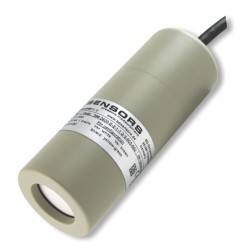
LMK809 Submersible Acid Resistant Level Sensor
- SKU ID: s1-lmk809-0001
- Part No: 396-9999-B-C-1-7-3-3-007-000
- Pressure Range: 0 – 1.824mWG
- Output Signal: 4-20mA, 2 wire
- Accuracy: 0.35% FS
- Installation Type: Submersible probe with flush diaphragm
- Housing Material: PVDF
- Diaphragm Material: Ceramic Al2O3 99.9%
- Media Exposed Seals: FFKM
- Cable Type: FEP (70degC max)
- Cable Length: 7
- Cable Length Units: Metres (m)